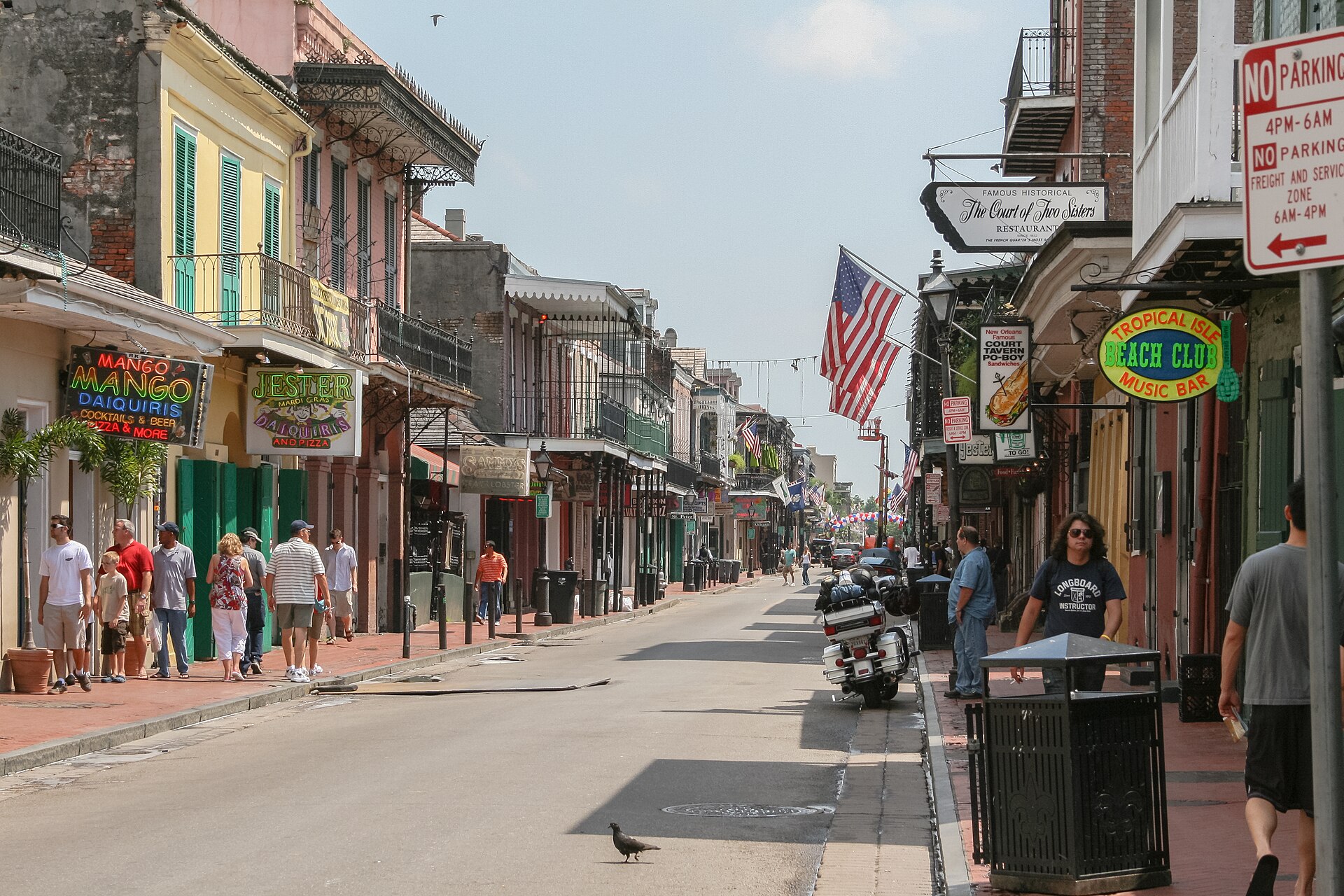
Bourbon Street is the most famous party street in America — a 13-block strip of neon signs, open doors, live music, and the kind of uninhibited public drinking that is illegal in almost every other American city but is not only legal here but expected. The open-container law that allows you to walk the streets of New Orleans with a drink in hand is most enthusiastically exercised on Bourbon, where the go-cups and giant frozen daiquiris are as much a part of the landscape as the cast-iron balconies above.
The street is named for the French royal House of Bourbon, not the whiskey — though the whiskey flows freely enough that the confusion is understandable. The architecture is genuine French Quarter: two and three-story buildings with wrought-iron galleries, many dating to the early 19th century, now housing bars, clubs, restaurants, and souvenir shops that sell everything from hot sauce to alligator heads. The music ranges from excellent (brass bands, jazz trios) to terrible (cover bands playing 'Sweet Home Alabama' for the tourist crowd), and the trick is knowing which doors to walk through.
Bourbon Street during Mardi Gras is an entirely different animal — the density of people, the volume of the music, the quantity of beads thrown from balconies, and the general atmosphere of cheerful chaos make it one of the most intense public celebrations on Earth. Outside of Mardi Gras, the street is busy but navigable, and the blocks above St. Ann Street transition into the quieter, more residential stretch of the Quarter where the real neighbourhood begins.
Verified Facts
Bourbon Street is named for the French Royal House of Bourbon, not the whiskey
New Orleans' open-container law allows public drinking on the street
The street runs for approximately 13 blocks through the French Quarter
Architecture on Bourbon Street dates primarily to the early 19th century
Get walking directions
Bourbon St, New Orleans, LA 70116