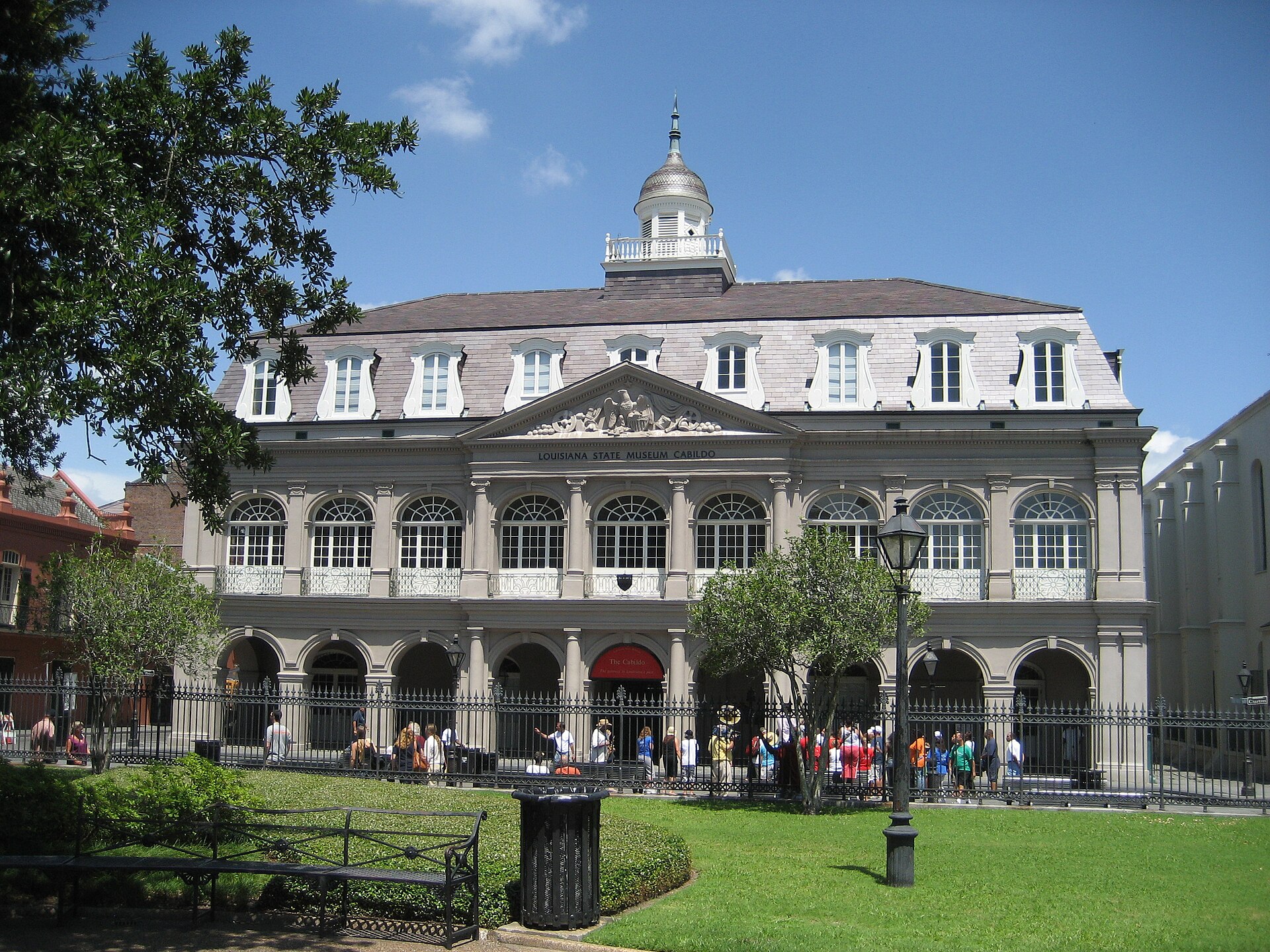
The Cabildo is the building where the Louisiana Purchase was signed on December 20, 1803 — the real estate deal that doubled the size of the United States, transferred 828,000 square miles from France to America for $15 million (roughly four cents an acre), and made New Orleans an American city almost by accident. The building flanks St. Louis Cathedral on Jackson Square and now houses a Louisiana State Museum that traces the state's history from Native American settlement through colonisation, slavery, the Civil War, and Reconstruction.
The building itself was constructed between 1795 and 1799 as the seat of the Spanish colonial government (cabildo is Spanish for 'town council'), which means it was built by the Spanish, used by the French to hand over the territory, and immediately occupied by Americans — a sequence that perfectly captures the serial colonialism that defines New Orleans history. The architecture is Spanish Colonial with later French modifications, and the wrought-iron balcony overlooking Jackson Square is one of the most photographed perspectives in the city.
The museum inside does an unusually honest job of presenting Louisiana's difficult history. The exhibits on slavery, the plantation system, and the complex racial hierarchy of colonial New Orleans — where free people of colour occupied a social position that existed nowhere else in the South — are frank about the brutality of the system while illuminating the cultural richness that emerged from it. The Napoleon death mask in the collection, one of only four in existence, is a reminder that this was a French city long before it was an American one.
Verified Facts
The Louisiana Purchase was signed in the Cabildo on December 20, 1803
The building was constructed between 1795 and 1799
The Louisiana Purchase transferred 828,000 square miles for approximately $15 million
The museum houses one of four Napoleon death masks in existence
Get walking directions
701 Chartres St, New Orleans, LA 70116