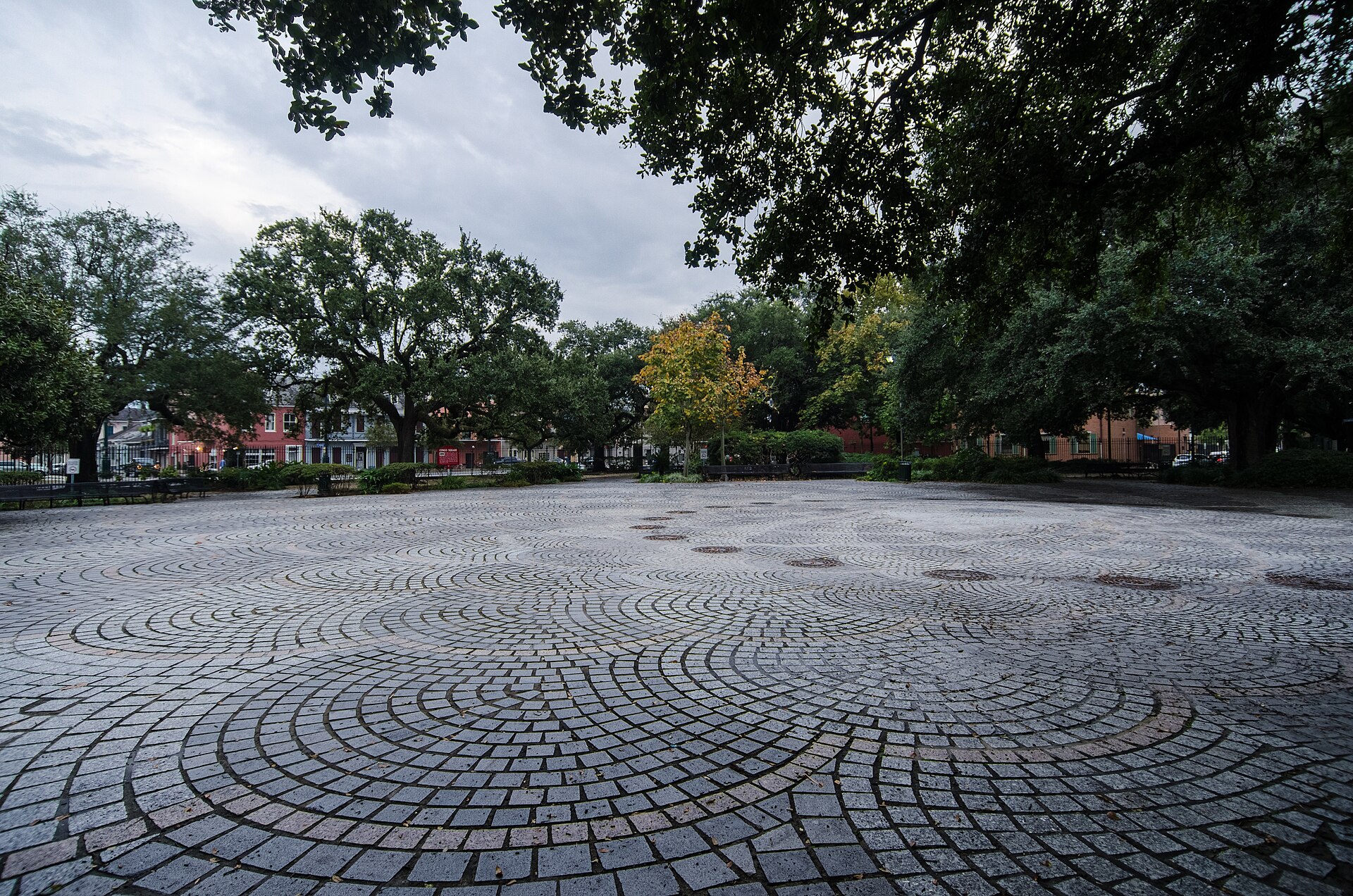
Congo Square is the most important piece of ground in the history of American music — the open space in what is now Louis Armstrong Park where enslaved Africans were permitted to gather on Sunday afternoons to drum, dance, sing, and trade, preserving the West African musical traditions that would eventually become jazz, blues, funk, and virtually every form of popular music that America has produced.
The gatherings at Congo Square were unique in the slave-holding South. French colonial law (the Code Noir) gave enslaved people Sundays off, and the authorities permitted the gatherings partly because they served as a social pressure valve and partly because the New Orleans economy depended on the skills and commerce that free and enslaved Black people conducted in the square. The music — polyrhythmic drumming, call-and-response singing, ring dances — was directly descended from Senegambian, Congolese, and Yoruba traditions, and the fact that it was performed continuously for over a century in this specific location created the musical DNA that New Orleans jazz inherited.
The square sits inside Louis Armstrong Park, a landscaped park at the edge of the French Quarter that also contains the Mahalia Jackson Theater and a statue of Armstrong himself. The park is free to enter but has a complicated relationship with the Tremé neighbourhood it borders — the construction of Armstrong Park in the 1970s demolished a section of Tremé, the oldest African-American neighbourhood in the country. The history layered into this small piece of land — African, French, Creole, American, musical, tragic — is dense enough to require a guided tour to fully appreciate.
Verified Facts
Enslaved Africans gathered at Congo Square on Sundays under the French Code Noir
The musical traditions preserved here are considered foundational to jazz
Congo Square is located within Louis Armstrong Park
Construction of Armstrong Park in the 1970s demolished part of the Tremé neighbourhood
Get walking directions
835 N Rampart St, New Orleans, LA 70116