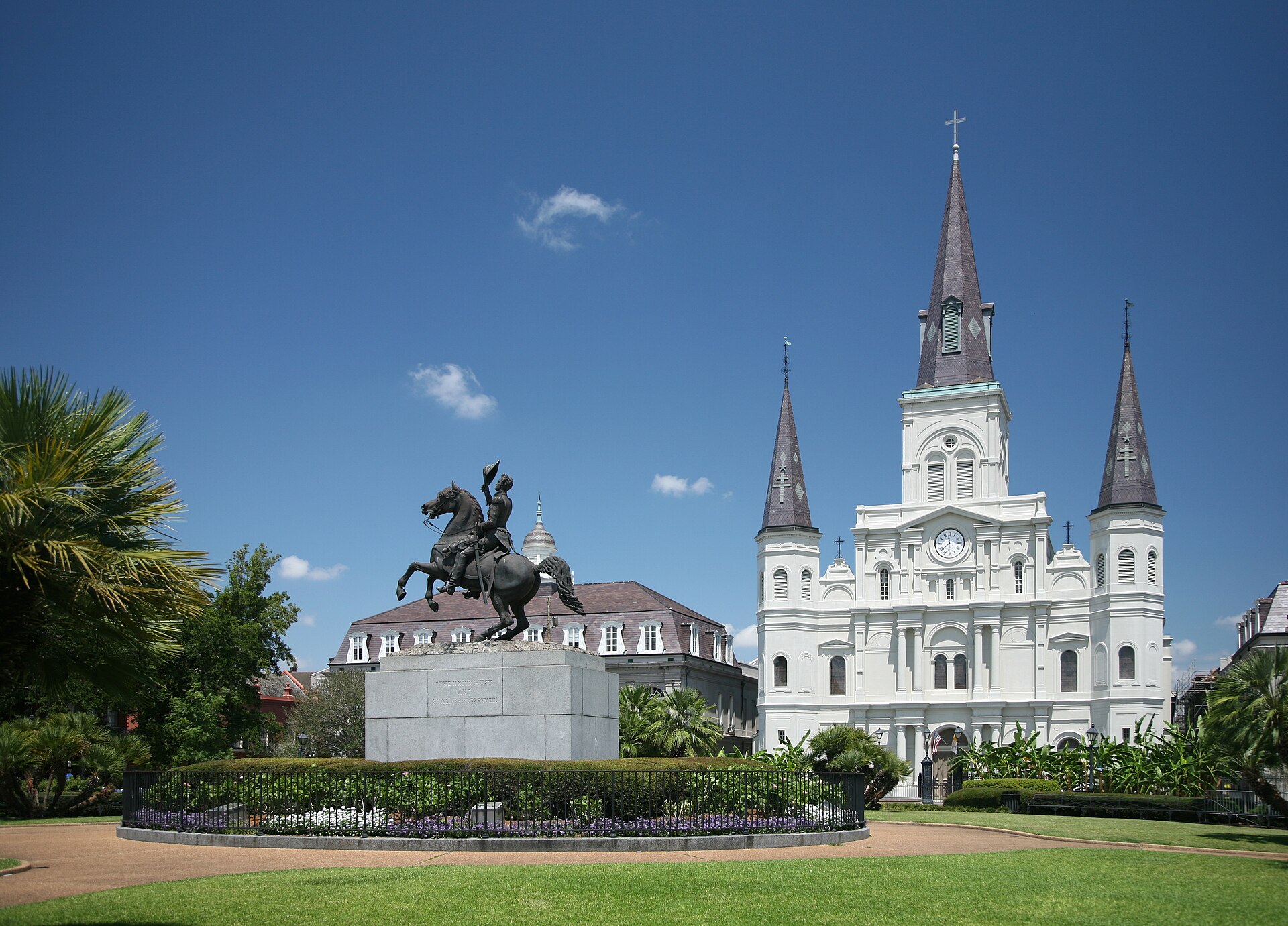
Jackson Square is the beating heart of the French Quarter — a formal garden square framed by the triple spires of St. Louis Cathedral, the Cabildo, and the Presbytère, with the Mississippi River flowing just beyond the levee at its back. The square has been the centre of New Orleans life since the city was founded by the French in 1718, serving variously as a military parade ground (the Place d'Armes), a public execution site, a gathering place for the enslaved and the free, and the daily stage for one of America's most colourful street scenes.
The iron fence surrounding the square is lined with artists displaying their work — portraits, landscapes, jazz scenes — while tarot readers, palm readers, and buskers compete for attention on the flagstones. The quality ranges from tourist kitsch to genuinely talented street artists who've been working the square for decades. On any given afternoon, you might hear a brass band, a solo saxophonist, and a spoken-word poet performing within earshot of each other, and the layered sound is pure New Orleans.
The equestrian statue of Andrew Jackson at the centre — the one that gives the square its current name — has been there since 1856, tipping its hat with the kind of permanent confidence that only bronze can manage. The Pontalba Buildings flanking the square's north and south sides, built in the 1840s by Baroness Micaela Almonester de Pontalba, are the oldest apartment buildings in America and set the architectural template — cast-iron galleries over ground-floor shops — that defines the French Quarter.
Verified Facts
The square was originally called Place d'Armes when New Orleans was founded in 1718
The Pontalba Buildings (1840s) are the oldest apartment buildings in America
The equestrian statue of Andrew Jackson was erected in 1856
The square is framed by St. Louis Cathedral, the Cabildo, and the Presbytère
Get walking directions
700 Decatur St, New Orleans, LA 70116