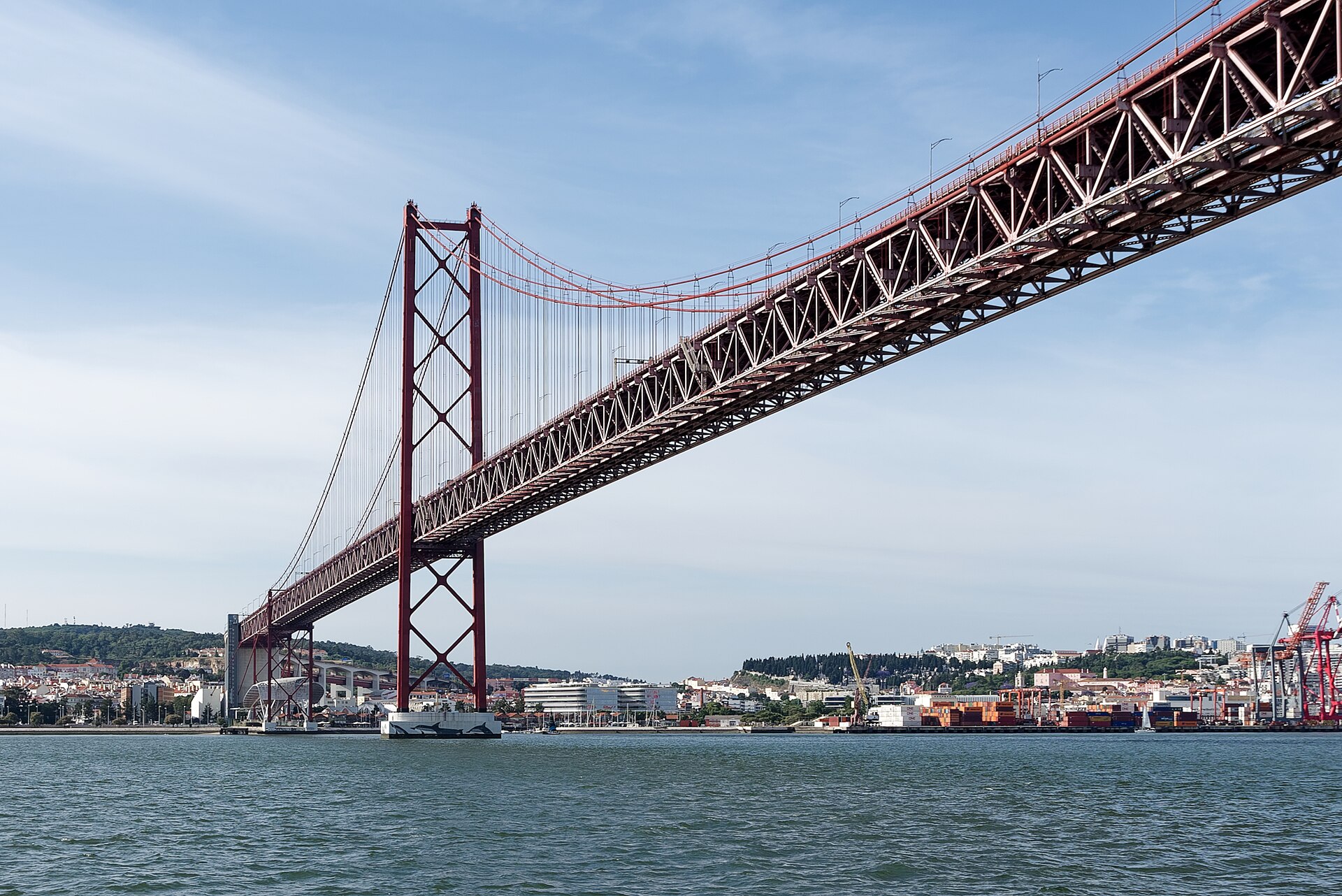
Yes, it looks exactly like the Golden Gate Bridge, and no, that's not a coincidence. The Ponte 25 de Abril was built by the American Bridge Company, the same firm that constructed the San Francisco–Oakland Bay Bridge, using steel from United States Steel. When it opened in 1966, it was called the Ponte Salazar, after the dictator who commissioned it. Eight years later, the Carnation Revolution toppled the regime, and the bridge was renamed for the date of the revolution — April 25, 1974. It's one of the most satisfying acts of political rebranding in history: a dictator's vanity project turned into a monument to his overthrow, and all they had to change was the sign.
The bridge spans 2,277 meters across the Tagus at its widest point, making it one of the longest suspension bridges in Europe. At the time of construction, it carried only road traffic, but a rail deck was added underneath in 1999 — an engineering feat that required reinforcing the entire structure while keeping it open to traffic. The bridge carries roughly 150,000 vehicles per day, making it one of the busiest in Europe, and the morning commute across it is a legendary exercise in patience and Portuguese profanity.
At the southern end, a massive Cristo Rei statue — inspired by Christ the Redeemer in Rio de Janeiro — faces the bridge with open arms. It was erected in 1959 as thanks for Portugal being spared the devastation of World War II, though Portugal's actual wartime position as a neutral country that sold tungsten to both sides makes "spared" a diplomatically flexible word. From the Lisbon side, the bridge is best appreciated at sunset, when the red steel glows against the river and you can briefly forget about the traffic and just see it for what it is: the most American thing in Portugal, renamed for the most Portuguese moment in modern history.
Verified Facts
Built by the American Bridge Company, the same firm that constructed the San Francisco–Oakland Bay Bridge, using steel from US Steel.
Originally named Ponte Salazar when it opened in 1966, it was renamed after the April 25, 1974 Carnation Revolution.
A rail deck was added underneath the road deck in 1999 while the bridge remained open to traffic.
The bridge carries approximately 150,000 vehicles per day, making it one of the busiest in Europe.
Get walking directions
2 Travessa de Alcântara, Alcântara, Lisboa, 1300-029, Portugal