Rising 640 metres on the eastern bank of the Salzach, Kapuzinerberg is the quieter, wilder counterpart to the fortress-crowned Festungsberg across the river. Humans have been settling on this hill since the Neolithic period, with major prehistoric settlements dating to around 1100 BC. Today it serves as Salzburg's green lung — a forested urban mountain where you can walk from the city centre to genuine wilderness in fifteen minutes. And you might share the path with wild chamois: a colony of these Alpine mountain goats has lived on the rocky outcrops of Kapuzinerberg for decades, one of the only urban chamois populations in the world.
The Capuchin monastery at the summit was built between 1599 and 1605 on the ruins of a medieval fortress called the Trompeterschlössl, established by Prince-Archbishop Wolf Dietrich von Raitenau as a spiritual bulwark against the Reformation. The climb to the top takes you past thirteen oratories depicting the Stations of the Cross, built between 1736 and 1744, each one a small Baroque chapel carved into the hillside.
Partway up the path, you'll pass the former home of Stefan Zweig, the Austrian writer who lived at the Paschinger Schlössl on the Kapuzinerberg from 1919 to 1934. This is where Zweig wrote some of his most celebrated works before fleeing the Nazis — first to London, then to Brazil, where he and his wife took their own lives in 1942. A memorial plaque marks the house, and the views from the terrace across to the old town are exactly the views Zweig would have seen each morning.
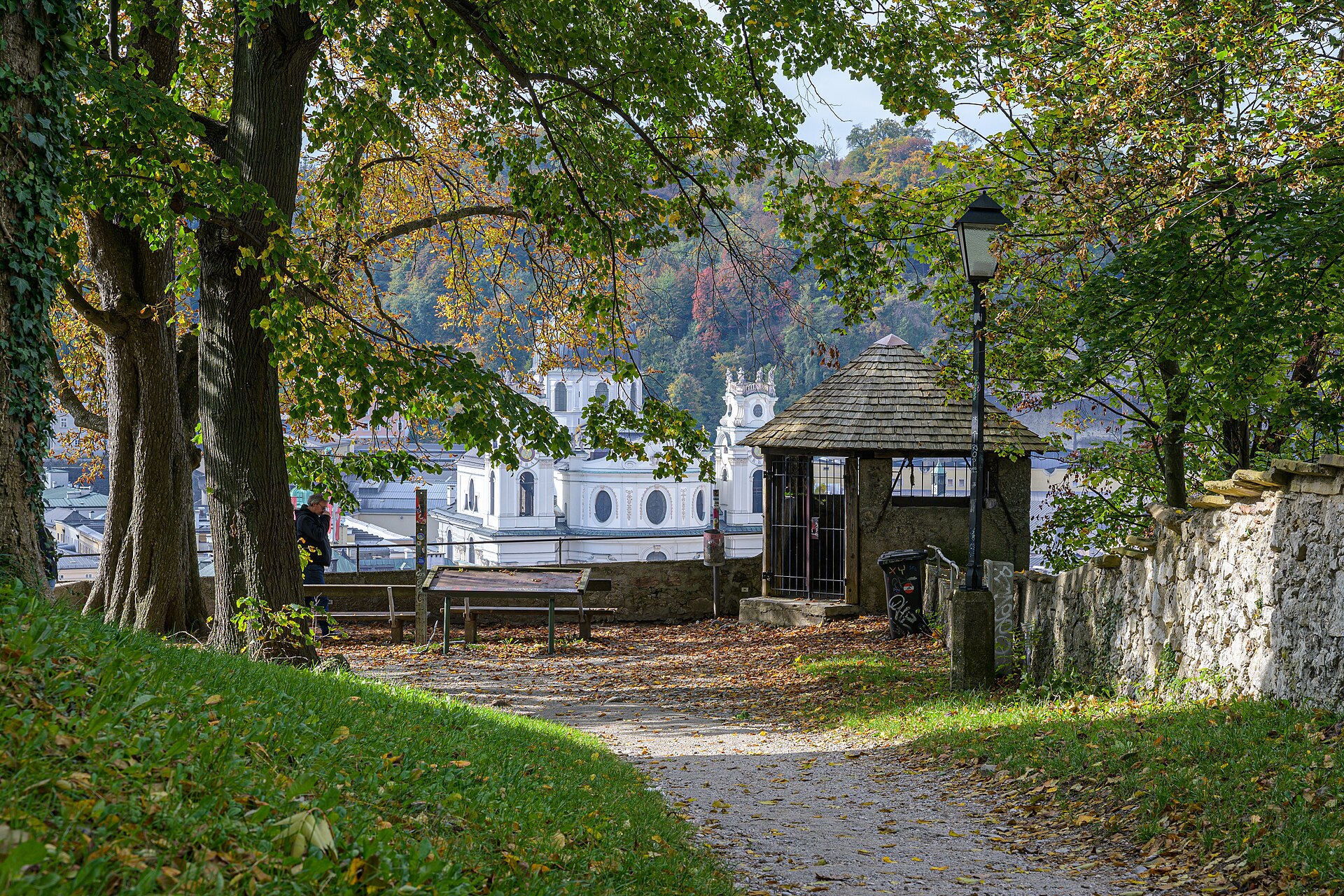
At the Hettwer Bastei viewpoint near the top, you get a panoramic sweep across the old town rooftops, the cathedral domes, and the fortress looming on the opposite cliff — arguably the finest free view in Salzburg. Most tourists never make the climb, which is exactly what makes it so rewarding.
Verified Facts
Prehistoric settlements on Kapuzinerberg date to around 1100 BC
A unique colony of wild chamois lives on the rocky outcrops of Kapuzinerberg
Stefan Zweig lived at the Paschinger Schlössl on Kapuzinerberg from 1919 to 1934
The Capuchin monastery was built 1599-1605 on the ruins of the medieval Trompeterschlössl fortress
Get walking directions
Altstadt, Salzburg, Austria