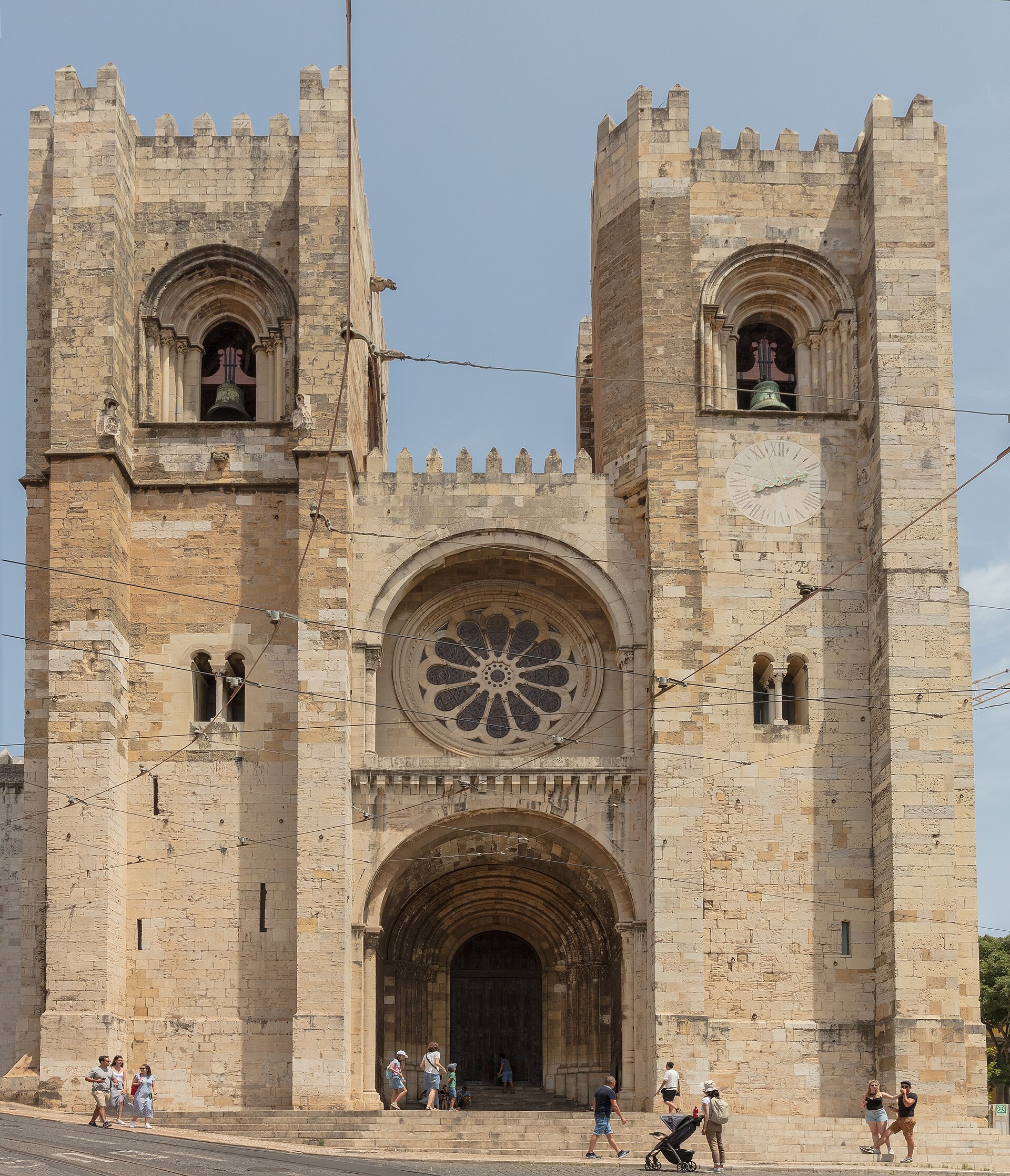
Lisbon's cathedral looks like it can't decide whether it's a church or a fortress, and that's because it was designed to be both. Built starting in 1147 — the same year Afonso Henriques took the city from the Moors — the Sé was constructed on the site of a mosque, which was itself built on the site of a Visigothic church. This layering of conquest is literally embedded in the walls: Romanesque bones, Gothic additions, Baroque chapels, and archaeological excavations that keep revealing older and older foundations. It's less a building than a geological core sample of religious power in Lisbon.
The twin bell towers give the western façade a military bearing that was entirely intentional. In the 12th century, this hilltop cathedral was part of the city's defensive perimeter, and the crenellated roofline could serve as a fighting platform. Inside, the Romanesque nave is austerely beautiful — thick columns, round arches, and a gloom that feels deliberately medieval. The Gothic cloister, added in the 13th century, was severely damaged in the 1755 earthquake but has been partially restored. Archaeological digs in the cloister have uncovered Roman, Visigothic, Moorish, and medieval Christian remains in layers, turning the area into an open-air excavation site that visitors can walk through.
The cathedral's most peculiar claim to fame involves Saint Anthony of Padua — yes, Padua, not Lisbon. António was actually born in Lisbon around 1195, possibly in a house on this very spot, and was baptized in the Sé's font. Portugal considers him a native son, and every June 13th the cathedral becomes the focal point of Santo António celebrations. The treasury houses a collection of silver, vestments, and relics, including what is claimed to be a piece of the True Cross. Tram 28 rattles past the front door every few minutes, and the juxtaposition of an 800-year-old cathedral with a 1930s streetcar is one of those Lisbon moments that makes the city feel like a time machine stuck between gears.
Verified Facts
Construction began in 1147 on the site of a former mosque, which itself replaced a Visigothic church.
Saint Anthony of Padua was born in Lisbon around 1195 and was baptized in the cathedral's font.
Archaeological excavations in the Gothic cloister have revealed Roman, Visigothic, Moorish, and medieval Christian layers.
The fortress-like twin bell towers were intentionally designed for defensive purposes as part of the city's 12th-century perimeter.
Get walking directions
Largo da Sé, 1100-585 Lisboa