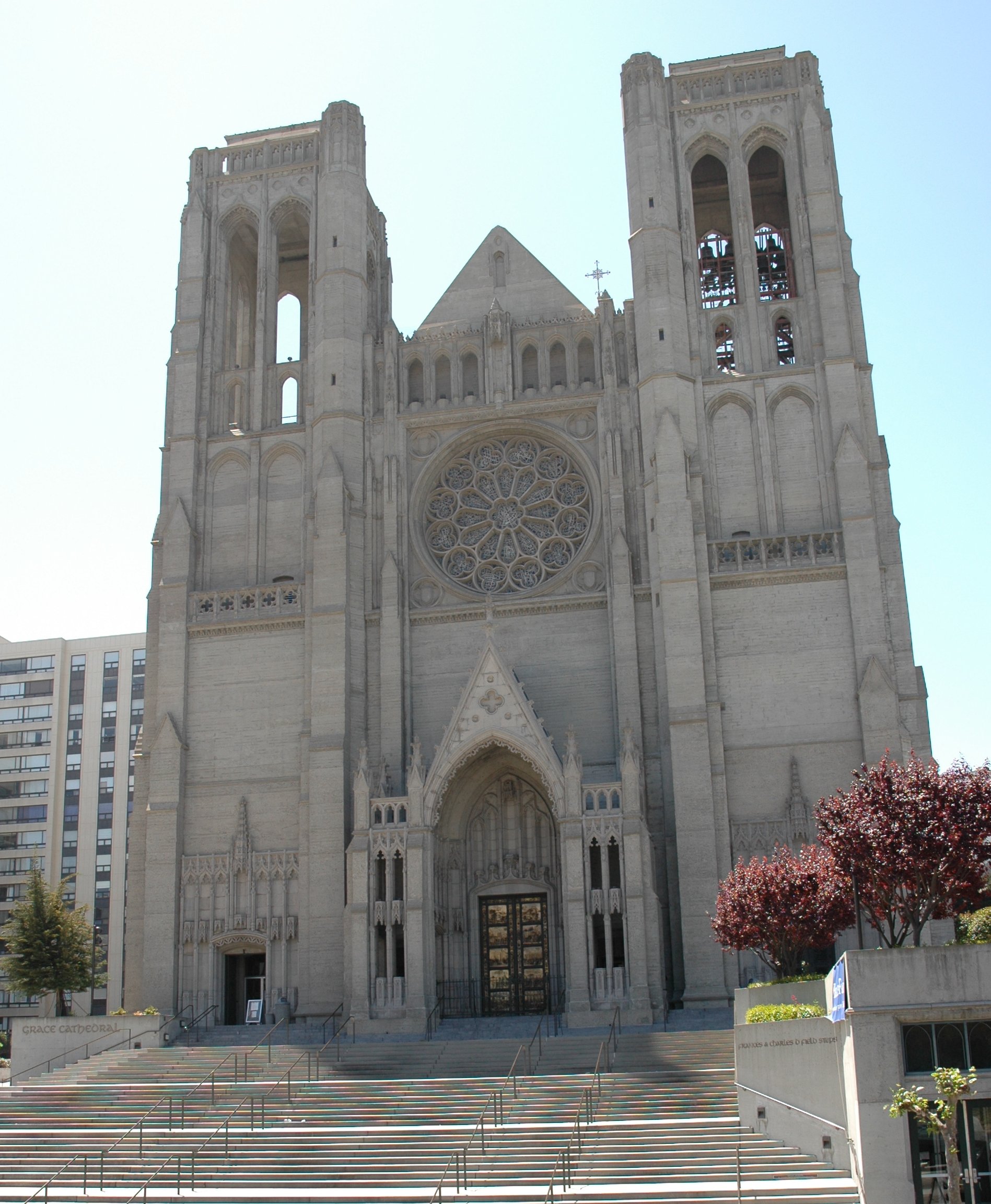
This cathedral sits on land that once belonged to Charles Crocker, one of the Big Four railroad barons who built the Transcontinental Railroad. Crocker's mansion stood right here on Nob Hill — a monument to Gilded Age excess. The nineteen-oh-six earthquake destroyed it completely. The Crocker family donated the land to the Episcopal Church, and Grace Cathedral eventually rose in its place. It took decades to build, finally being completed in nineteen sixty-four.
Step inside and look down. The cathedral has two labyrinths — one outdoors, one on the nave floor — modelled on the famous thirteenth-century labyrinth at Chartres Cathedral in France. They're not mazes. There's only one path. You walk in, following the curves, and you walk back out. The idea is meditation in motion, a walking prayer. People come here specifically to walk the labyrinth, some of them every week.
Now find the AIDS Memorial Chapel, and inside it, look for Keith Haring's altarpiece. This is where the story hits hardest. Keith Haring was one of the most celebrated artists of the nineteen eighties — his bold, graphic figures were everywhere, from subway stations to galleries. In nineteen eighty-nine, Haring was diagnosed with AIDS. He threw himself into creating art about the epidemic, and one of his final projects was this altarpiece for Grace Cathedral.
The triptych — a bronze and white gold panel covered in Haring's signature dancing figures — depicts the life of Christ through Haring's visual language. Angels, radiance, and that unmistakable Haring energy. He completed it just two weeks before his death in February nineteen ninety. The piece was unveiled on World AIDS Day, December first, nineteen ninety-five. It's one of the last works by one of the twentieth century's most vital artists, and it lives here, in a cathedral built on a railroad baron's ashes.
Verified Facts
Built on site of Crocker railroad baron mansion, destroyed in 1906
Two labyrinths modelled on Chartres Cathedral
Keith Haring's altarpiece was his final artwork, completed 2 weeks before his death
Unveiled World AIDS Day 1995
Get walking directions
1100 California Street, San Francisco