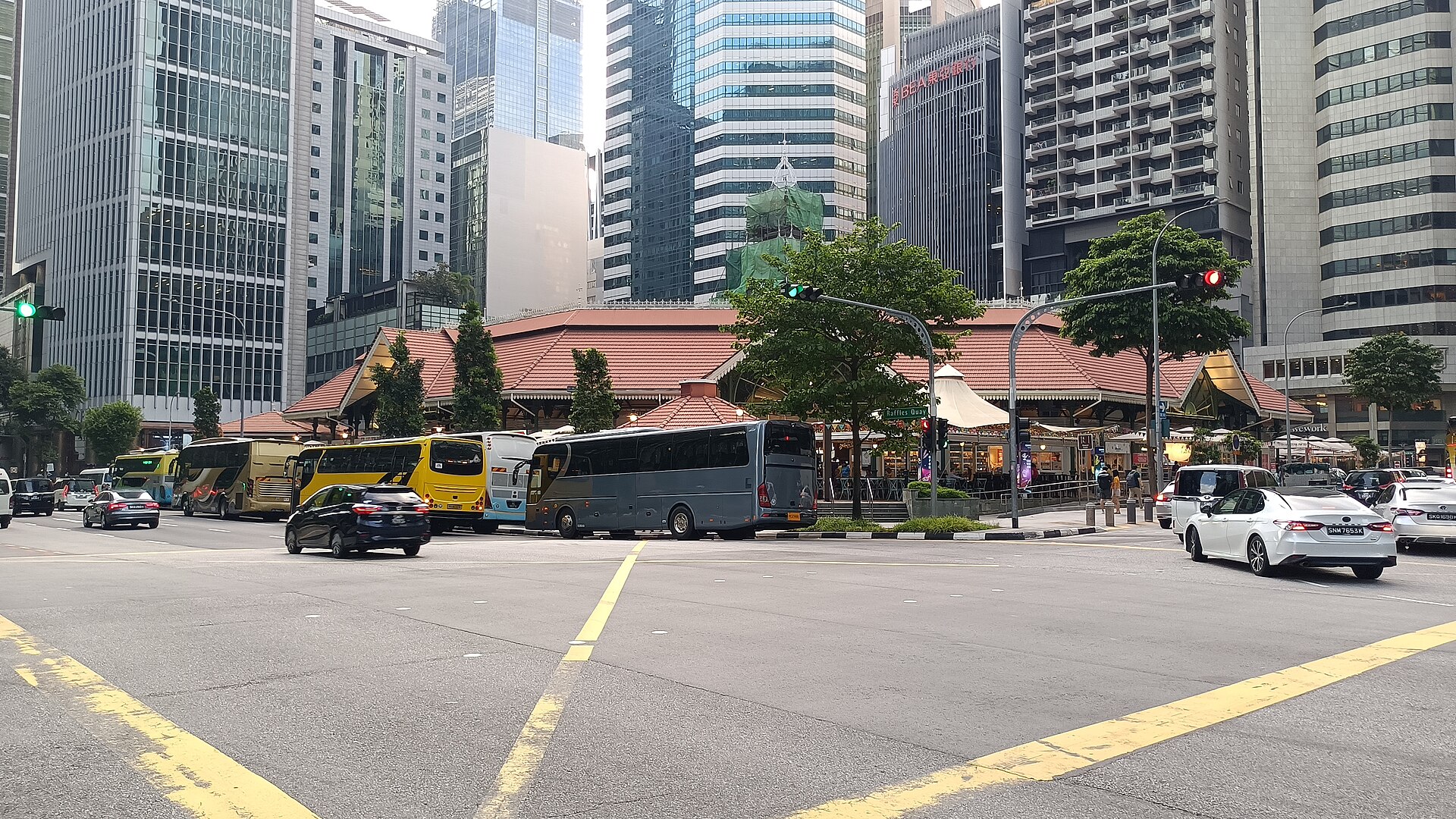
Lau Pa Sat is a Victorian cast-iron market hall in the Financial District that has been feeding Singapore since 1894 — an octagonal structure shipped in pieces from a foundry in Glasgow, assembled on the waterfront, and now sitting slightly incongruously among the glass towers of the CBD. The building was gazetted as a national monument in 1973, which is why a 19th-century Scottish cast-iron market survives in the middle of Singapore's most expensive real estate.
The hawker stalls inside serve the usual Singapore repertoire — chicken rice, laksa, nasi lemak, wonton mee — and the quality ranges from excellent to tourist-serviceable. But the real event is the satay street that sets up nightly on Boon Tat Street alongside the market. After 7pm, the street is closed to traffic and filled with charcoal grills, and the vendors — each specialising in chicken, beef, mutton, or prawn satay — create a wall of smoke and the smell of burning coconut shells that draws office workers from the surrounding towers like a dinner bell.
The market's name means 'old market' in Hokkien — it was renamed when a newer market was built nearby, and the 'old' stuck. The cast-iron structure, with its intricate columns, arched windows, and central cupola, is a beautiful example of colonial-era prefabricated architecture — the entire building was designed in London, manufactured in Scotland, shipped to Singapore, and assembled on-site, which was standard practice for British imperial infrastructure in the 19th century.
Verified Facts
The cast-iron structure was manufactured in Glasgow and shipped to Singapore
Lau Pa Sat was gazetted as a national monument in 1973
The building dates to 1894
Lau Pa Sat means 'old market' in Hokkien
Get walking directions
18 Raffles Quay, Singapore 048582