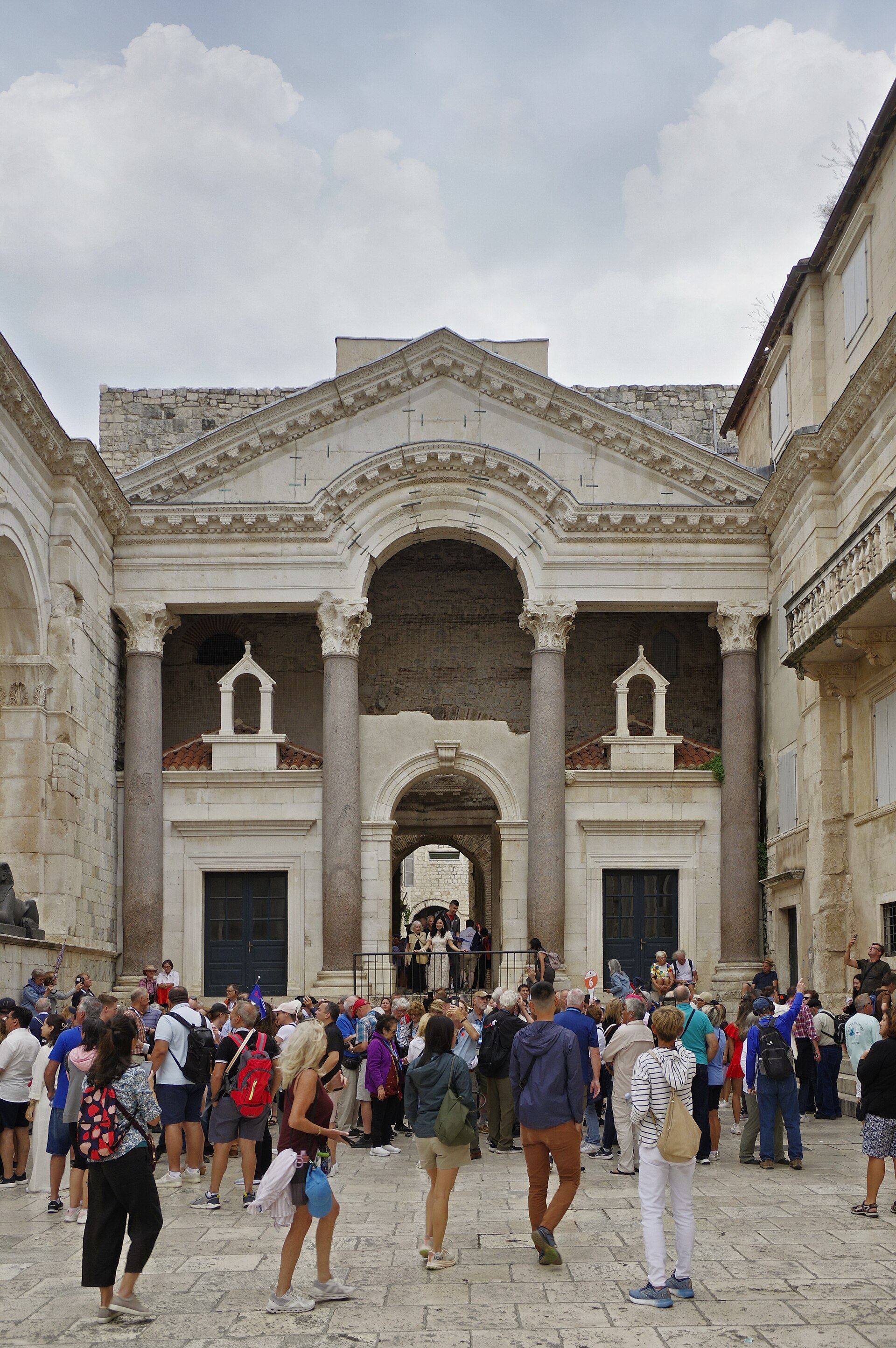
Diocletian's Palace is one of the most extraordinary ancient Roman structures in existence — a fortified retirement palace built between 295 and 305 AD by Emperor Diocletian that has been continuously inhabited for 1,700 years and now forms the living heart of Split's old town. Unlike Pompeii or the Roman Forum, Diocletian's Palace is not a ruin — it's a neighbourhood of 3,000 residents who live, work, and drink coffee inside the walls of an imperial Roman compound.
The palace covers 31,000 square metres (roughly half the area of the Vatican) and was built with white limestone from the nearby island of Brač (the same stone later used to build the White House). The original structure included Diocletian's private apartments, temples (to Jupiter and to Diocletian's patron deities), a mausoleum (now the Cathedral of St. Domnius, one of the oldest cathedral buildings in the world), and military quarters — all enclosed within walls that were 2 metres thick and up to 26 metres high.
The Peristyle — the palace's central courtyard, flanked by granite columns brought from Egypt — is the living room of Split, where visitors sit on the ancient steps, musicians perform, and the cathedral bell tower (added in the 13th century to Diocletian's octagonal mausoleum) rises above. The basement halls (substructures) beneath the palace, which mirror the layout of the imperial apartments above and were used for storage, provide the most complete surviving example of Roman palace architecture.
Verified Facts
The palace was built between 295 and 305 AD
Approximately 3,000 people live within the palace walls
The palace covers 31,000 square metres
The Cathedral of St. Domnius is one of the oldest cathedral buildings in the world
Get walking directions
Diocletian's Palace, Split