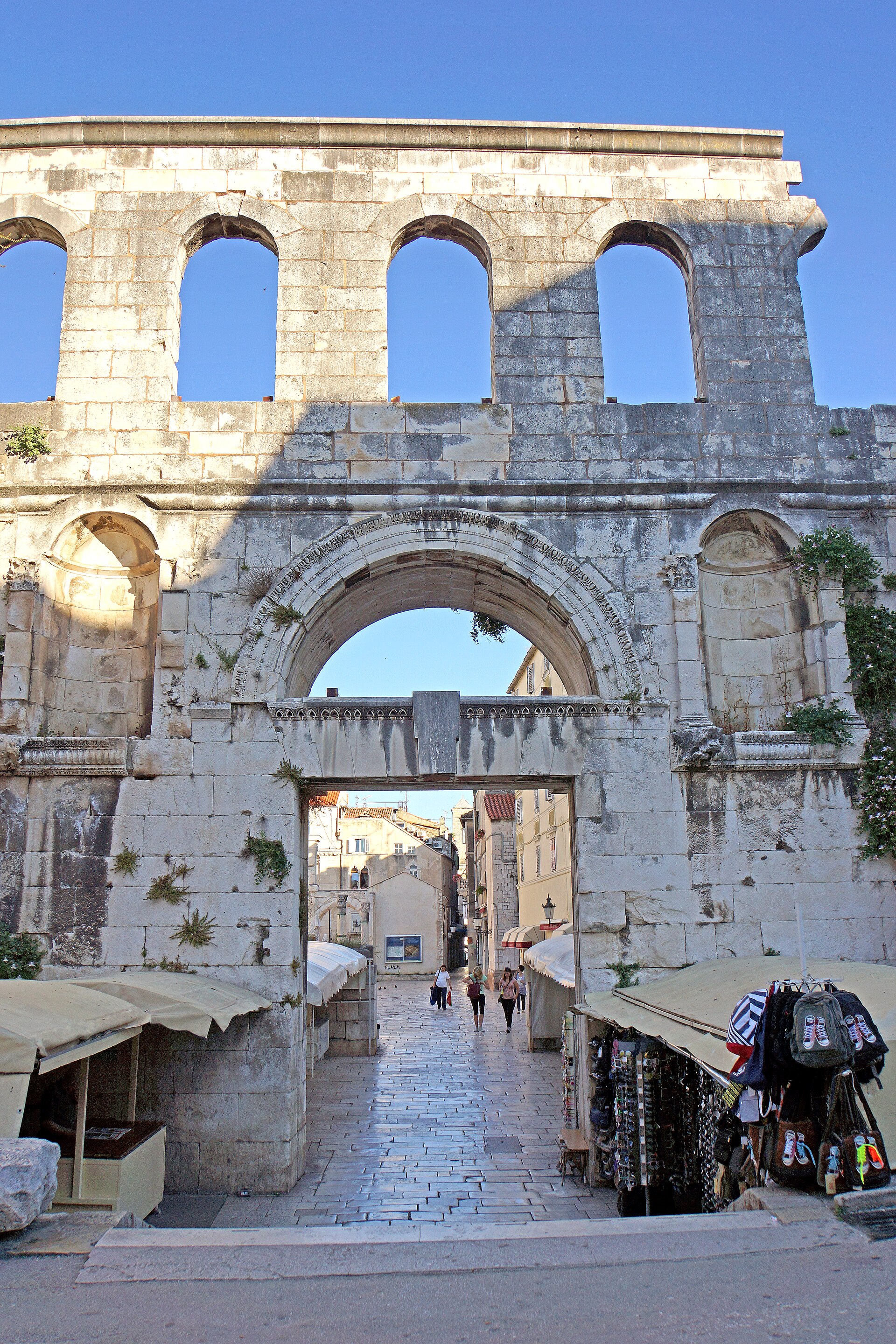
The Silver Gate is the eastern entrance of Diocletian's Palace — one of the four original gates, walled up during the Middle Ages and only reopened in 1952 when the rubble was cleared. The gate opens onto the Pazar (Green Market), creating one of the most evocative juxtapositions in Split where farmers' stalls of tomatoes, olives, and figs fill the shadow of a Roman gate that saw legions march through 1,700 years ago.
Passing through the gate, you enter the cardo maximus (the north-south Roman axis of the palace) and immediately encounter the Peristyle ahead. The walls on either side still show Roman stonework, medieval additions, and the scars of the 1952 clearance. The gate is named 'Silver' because each of the four palace gates was named for a metal (Silver east, Golden north, Iron west, Brass south), though the origin of the tradition is unclear.
Verified Facts
The Silver Gate was walled up during the Middle Ages and reopened in 1952
It opens onto the Green Market (Pazar)
The gate is on the eastern side of Diocletian's Palace
Each palace gate was named for a metal (silver, gold, iron, brass)
Get walking directions
Hrvojeva, Split