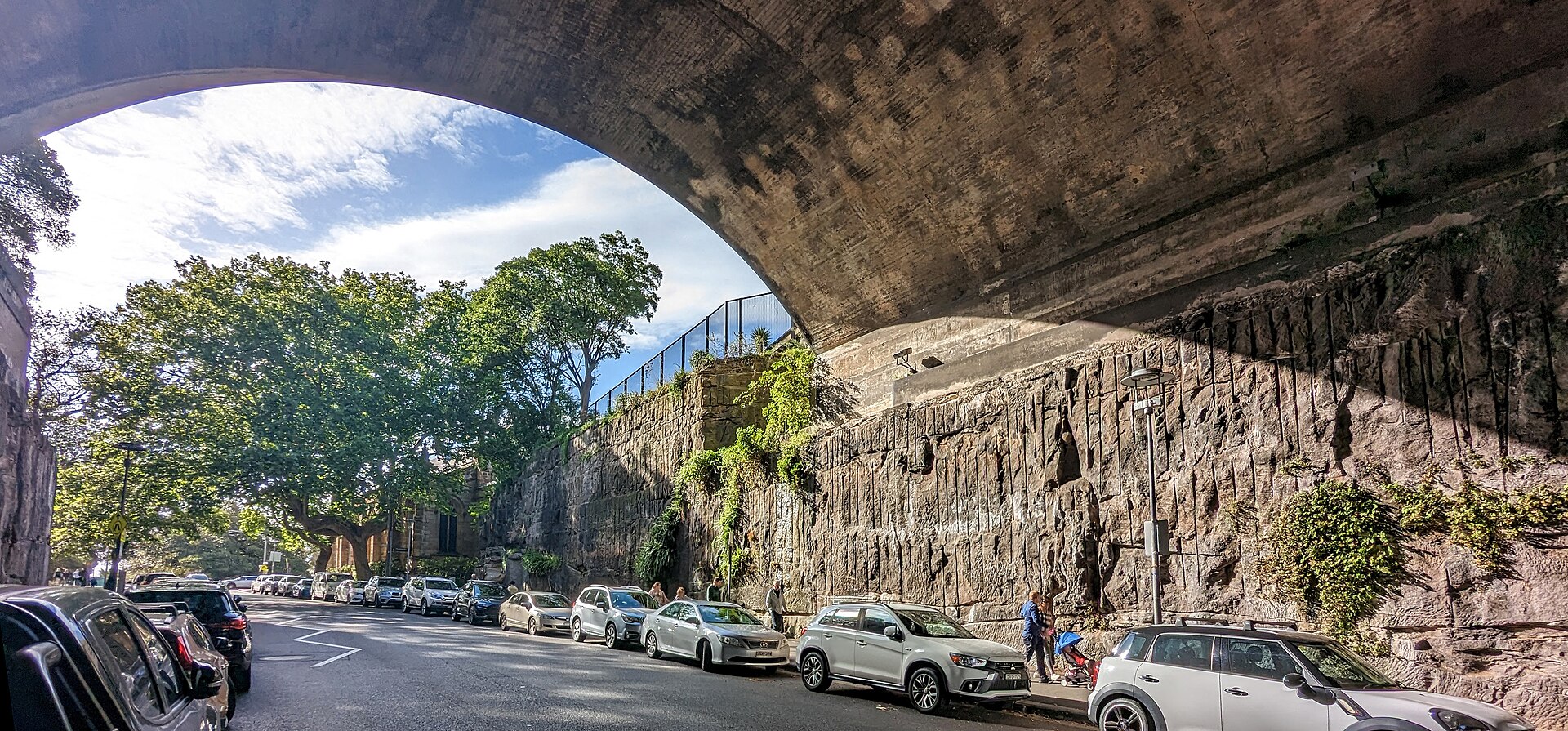
Walk through this passage and pay attention to the walls. You are inside a piece of living history that most people rush through without noticing. Look at the lower sections of the rock face -- rough, uneven, covered in visible chisel marks. Those marks were made by convict chain gangs starting in eighteen forty-three. Men in irons, swinging hand tools into solid sandstone, day after day, overseen by a man named Tim Lane who was known for ordering floggings.
Now look up at the upper sections. See how the rock is smoother and the cut is wider? That is where they gave up on the convicts and used explosives. The City Council finished the job with gunpowder and dynamite in eighteen fifty-nine -- sixteen years after the convicts started. The difference between human suffering and industrial blasting is written right into the stone.
The Argyle Cut was ranked alongside Busby's Bore and the construction of Circular Quay as one of the most impressive engineering feats in early Sydney. The purpose was straightforward: The Rocks was divided by a sandstone ridge, and the western side -- Millers Point, where the wharves and warehouses were -- was cut off from the eastern side. The colony needed a road through the ridge. So they sent in the convicts with chisels.
The cut is about twenty-five metres deep at its highest point. Run your hand along the lower wall if you can reach it. Those chisel grooves are almost two hundred years old, made by men who had no choice in the matter. The rock has been smoothed slightly by time and weather, but the individual marks are still distinct enough that you can almost count the strokes.
This is one of the most powerful historical sites in Sydney, and it is just a passageway that people use to get from one street to another.
Verified Facts
Convict chain gangs began cutting through the ridge with hand tools in 1843 under overseer Tim Lane
The City Council finished the job with explosives in 1859
The difference between hand-carved (rough, with chisel marks) and blasted (smoother, wider) sections is still visible
Ranked alongside Busby's Bore and Circular Quay as one of early Sydney's most impressive engineering feats
Get walking directions
Argyle St, Circular Quay, The Rocks, 2000, Australia