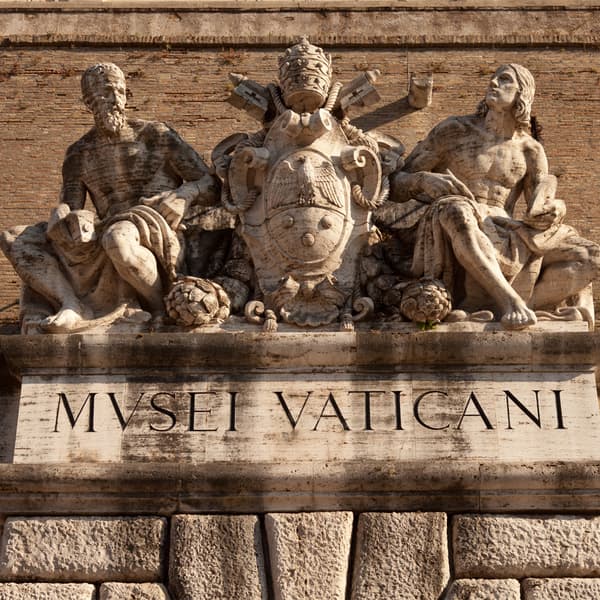
The Vatican Museums contain roughly seventy thousand works of art, of which about twenty thousand are on display at any given time. The collection spans five hundred years of papal acquisition, donation, confiscation, and — let's be honest — looting. Laid end to end, the galleries would stretch about seven kilometres. Six million people visit each year, making this the fourth most visited museum in the world. On a peak day, you will be body-to-body with twenty-five thousand other people, and the experience is less "contemplating masterpieces" and more "being squeezed through a marble tube."
The Gallery of Maps alone is worth the visit. Commissioned by Pope Gregory XIII in 1580, it features forty fresco panels showing every region of Italy in extraordinary cartographic detail, painted on the walls of a one-hundred-and-twenty-metre corridor. The maps are oriented with west to the left (facing Rome), meaning the Adriatic coast faces one wall and the Tyrrhenian coast faces the other. They are not just beautiful — they are geographically accurate enough that modern cartographers have verified their precision.
The Raphael Rooms were Raphael's greatest commission and his greatest curse. He was twenty-five when Julius II hired him to decorate the papal apartments — the same pope who was simultaneously torturing Michelangelo on the Sistine ceiling. The School of Athens, in the Stanza della Segnatura, is probably the most famous fresco outside the Sistine Chapel. Raphael painted himself into it, looking out at the viewer from the lower right corner. He also painted a brooding figure in the centre foreground who is almost certainly Michelangelo — added late, after Raphael snuck in to see the Sistine ceiling before its unveiling.
The Laocoon sculpture was discovered in a Roman vineyard in 1506, and Michelangelo was one of the first people called to examine it. It was immediately recognized as the sculpture described by Pliny the Elder in the first century AD, making it the only ancient sculpture whose discovery can be matched to a specific ancient literary description. Pope Julius II bought it on the spot and built the Octagonal Court to house it.
Verified Facts
The collection contains roughly 70,000 works spanning 7 km of galleries; about 20,000 are displayed at any time
The Gallery of Maps (1580) contains 40 fresco panels verified by modern cartographers for geographic accuracy
Raphael painted himself and a figure believed to be Michelangelo into The School of Athens
The Laocoon was found in 1506 and matched to Pliny the Elder's 1st-century description — the only such confirmed match
Get walking directions
Viale Vaticano, XVIII Municipio, Rome, 00165, Italy