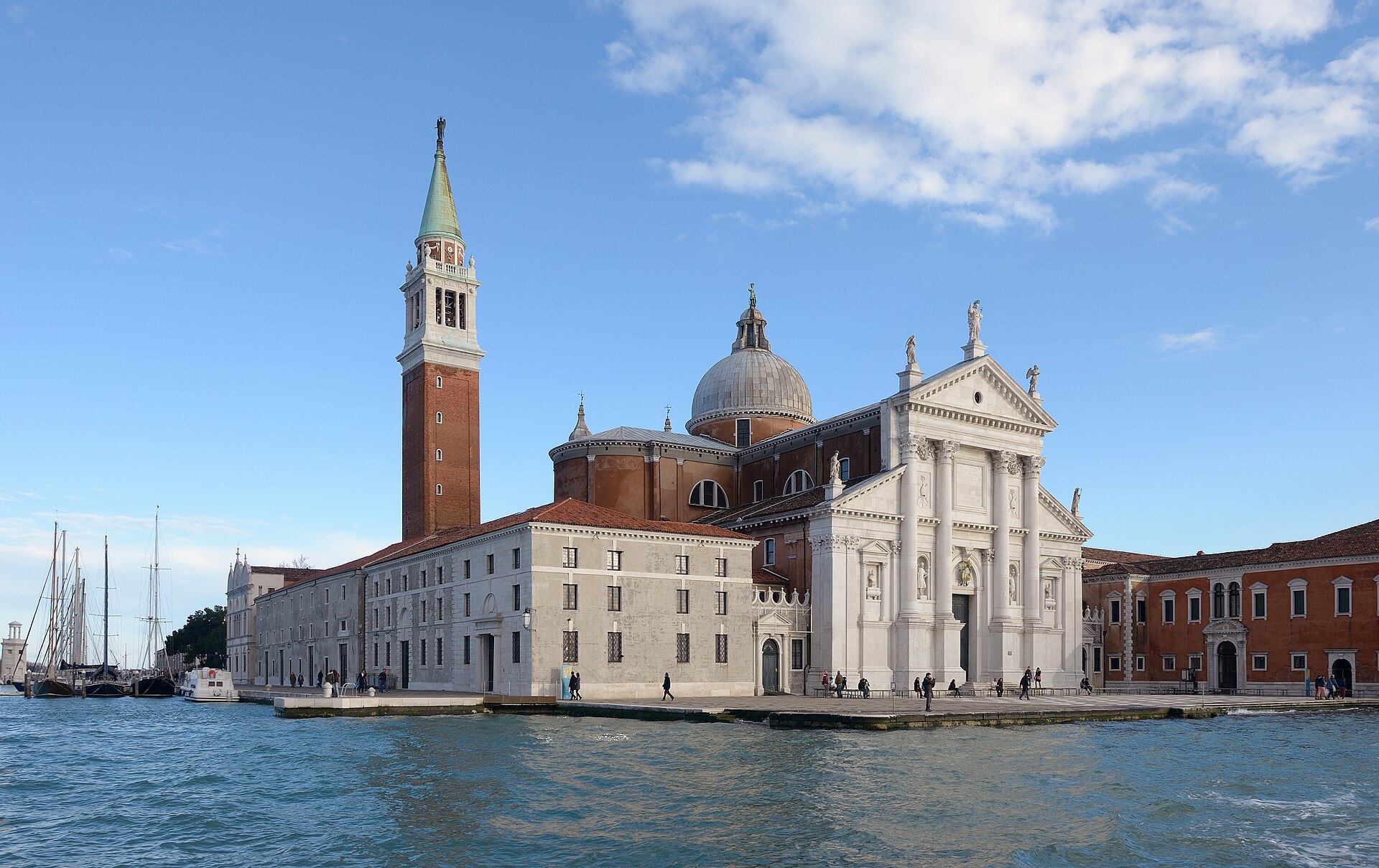
From Piazza San Marco, the church of San Giorgio Maggiore looks like a white marble mirage floating on the water across the basin. It's one of the most photographed views in Venice, but surprisingly few visitors actually take the two-minute vaporetto ride to reach it. Their loss — the bell tower here offers arguably the best panoramic view in the city, and you won't share it with a thousand other tourists.
Andrea Palladio, the architect who basically invented the neoclassical style, designed the church in 1566. He spent the rest of his life working on it and died in 1580 before it was finished — the facade wasn't completed until 1610. Palladio's genius was solving the problem of sticking a classical temple front onto a Christian church with its tall nave and low side aisles. His solution was to overlap two facades, one wide and one narrow, creating a design so influential that every white-columned church you've ever seen owes something to it.
Inside, two enormous Tintoretto paintings flank the main altar: "The Last Supper" and "The Fall of Manna." Tintoretto's "Last Supper" is the radical one — instead of the usual symmetrical arrangement, he painted the table at a dramatic diagonal, with servants bustling, cats prowling, and angels materialising out of smoke. It was completed in 1594, the last year of his life.
Benedictine monks have been on this island since 982, when the Doge gave it to their order. In 1951, the monastery was taken over by the Giorgio Cini Foundation, which now hosts conferences, concerts, and art exhibitions. The open-air theatre designed by Japanese architect Tadao Ando in the garden is one of Venice's best contemporary architectural additions.
Verified Facts
Designed by Andrea Palladio starting in 1566; the facade was completed in 1610, thirty years after his death
Benedictine monks have occupied the island since 982, when Doge Tribuno Memmo donated it to the order
Tintoretto's "The Last Supper" here was completed in 1594, the last year of his life
The Giorgio Cini Foundation took over the monastery complex in 1951
Get walking directions
Isola di San Giorgio Maggiore, Venice