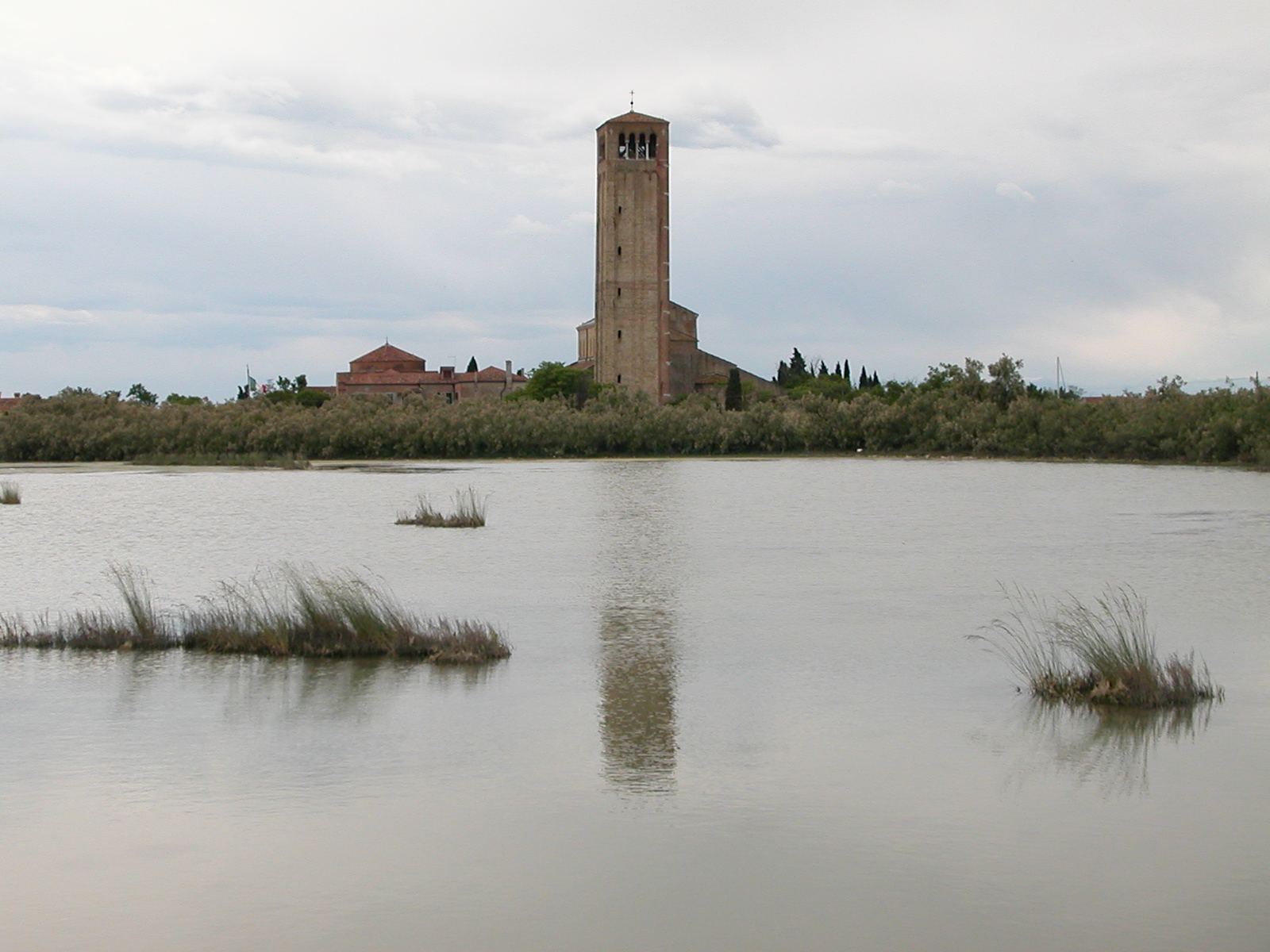
Venice began here, on this eerily quiet island at the northern edge of the lagoon. In the 5th and 6th centuries, refugees fleeing barbarian invasions on the mainland — first the Huns under Attila, then the Lombards — settled Torcello and built it into a thriving city of 20,000 people. For centuries, Torcello was the political and commercial centre of the lagoon. Then malaria came, the canals silted up, and the population drained away to the rising new settlement around the Rialto. Today, fewer than a dozen people live here.
The Cathedral of Santa Maria Assunta, founded in 639 AD, is the oldest building in the entire Venetian lagoon. Inside, the western wall is covered with a massive Byzantine mosaic of the Last Judgement — one of the largest and most complete in existence, dating to the 11th and 12th centuries. Demons stuff sinners into the mouths of hell while angels weigh souls on golden scales. Opposite, in the main apse, a lone figure of the Virgin Mary stands against an enormous field of gold, isolated and otherworldly. The contrast between the terrifying west wall and the serene east wall is one of the great artistic experiences in Italy.
Outside, a stone chair in the overgrown square is traditionally called "Attila's Throne," though it almost certainly has nothing to do with the Hun king — it was probably a medieval bishop's seat. Hemingway loved Torcello and retreated here during his Venice years, staying at the Locanda Cipriani, a small inn still run by the family behind Harry's Bar.
The walk from the vaporetto stop to the cathedral takes about ten minutes along a canal path lined with reeds. After the chaos of central Venice, the silence here is almost supernatural. This is what all of Venice used to be: lagoon, stone, light, and the sound of water.
Verified Facts
The Cathedral of Santa Maria Assunta was founded in 639 AD, the oldest building in the Venetian lagoon
Torcello had a population of approximately 20,000 in its heyday before malaria and silting caused its decline
The Last Judgement mosaic on the west wall dates to the 11th-12th centuries and is one of the largest Byzantine mosaics in existence
Fewer than a dozen permanent residents live on Torcello today
Get walking directions
Isola di Torcello, Venice