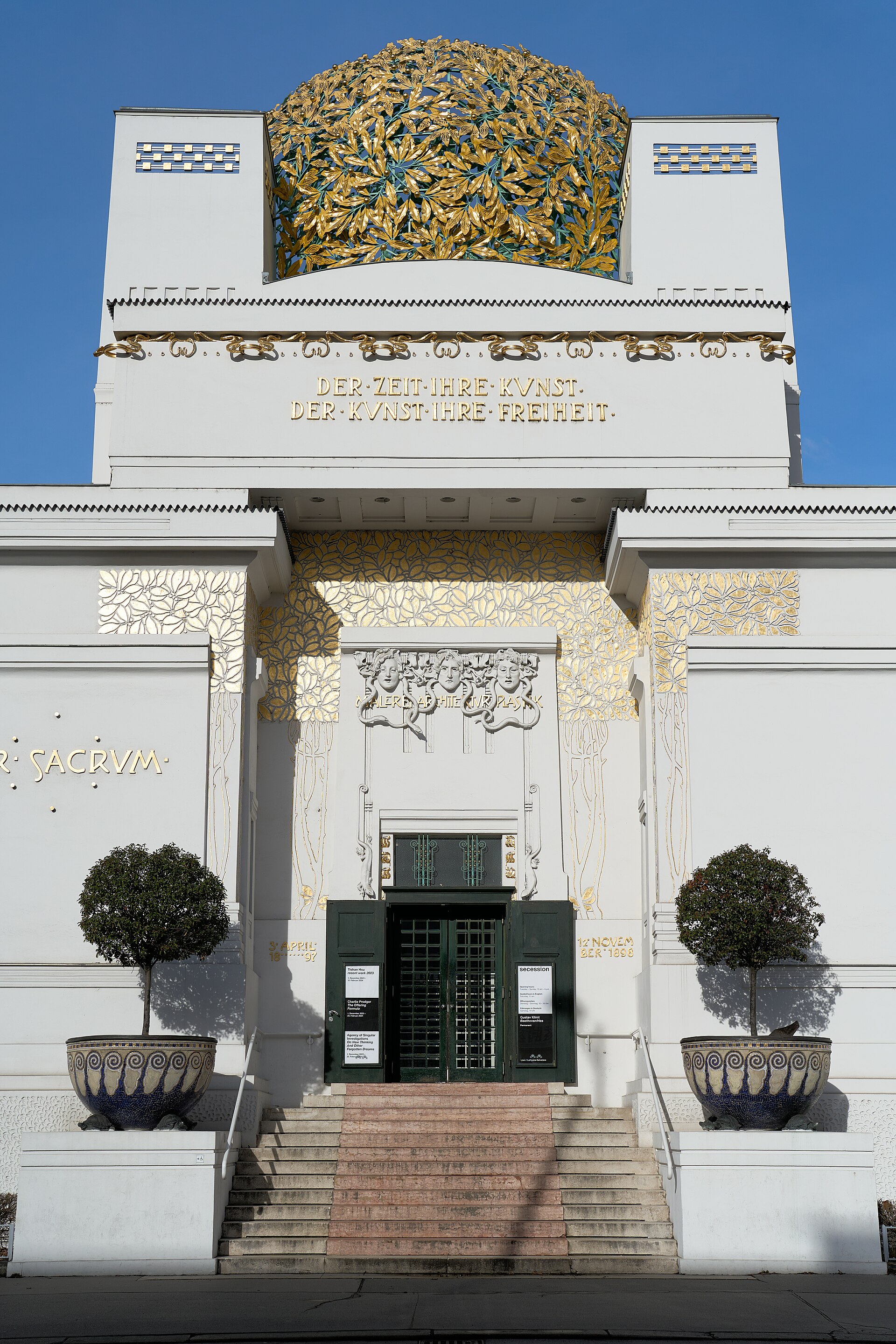
In 1897, Gustav Klimt and eighteen other artists walked out of Vienna's conservative art establishment and founded their own movement. They needed a building to match their manifesto, and Joseph Maria Olbrich delivered one that still looks like it landed from another planet. The Secession Building is a white cube topped with a golden dome made of 3,000 gilded laurel leaves, which the Viennese immediately nicknamed "the golden cabbage." Love it or hate it, you cannot ignore it.
Above the entrance, gold lettering spells out the movement's motto: "Der Zeit ihre Kunst. Der Kunst ihre Freiheit" — "To every age its art. To art its freedom." It was a direct challenge to the academic establishment that had controlled Viennese art for decades, and the building was designed to be as confrontational as the statement: no historical ornament, no classical columns, just clean geometric forms and a lot of attitude.
In the basement lives Klimt's Beethoven Frieze, a 34-metre-long painting originally created for a temporary 1902 exhibition and never intended to survive. Standing 2.15 metres high, it combines Ancient Greek, Byzantine, and Japanese influences in Klimt's trademark gold-leaf style, interpreting Beethoven's Ninth Symphony as a journey from suffering to joy. Art collector Carl Reininghaus bought it in 1903 to save it from destruction. The Nazis later seized it; it was recovered from a salt mine after the war and finally returned to the Secession in 1986.
The building continues to host contemporary art exhibitions, rotating shows roughly every two months. The upper gallery floods with natural light from the clever skylight system, and the proportions of the rooms shift depending on the installation — the walls are moveable. Olbrich designed a building that could reinvent itself, which is fitting for a movement that was all about breaking rules.
Verified Facts
The golden dome is made of approximately 3,000 gilded laurel leaves, nicknamed "the golden cabbage" by Viennese
Klimt's Beethoven Frieze is 34 metres long and 2.15 metres high, created for a 1902 exhibition
The building was designed by Joseph Maria Olbrich and completed in 1898 for the Vienna Secession movement
The Beethoven Frieze was seized by the Nazis, recovered from a salt mine, and returned to the Secession in 1986
Get walking directions
Friedrichstraße 12, 1010 Vienna