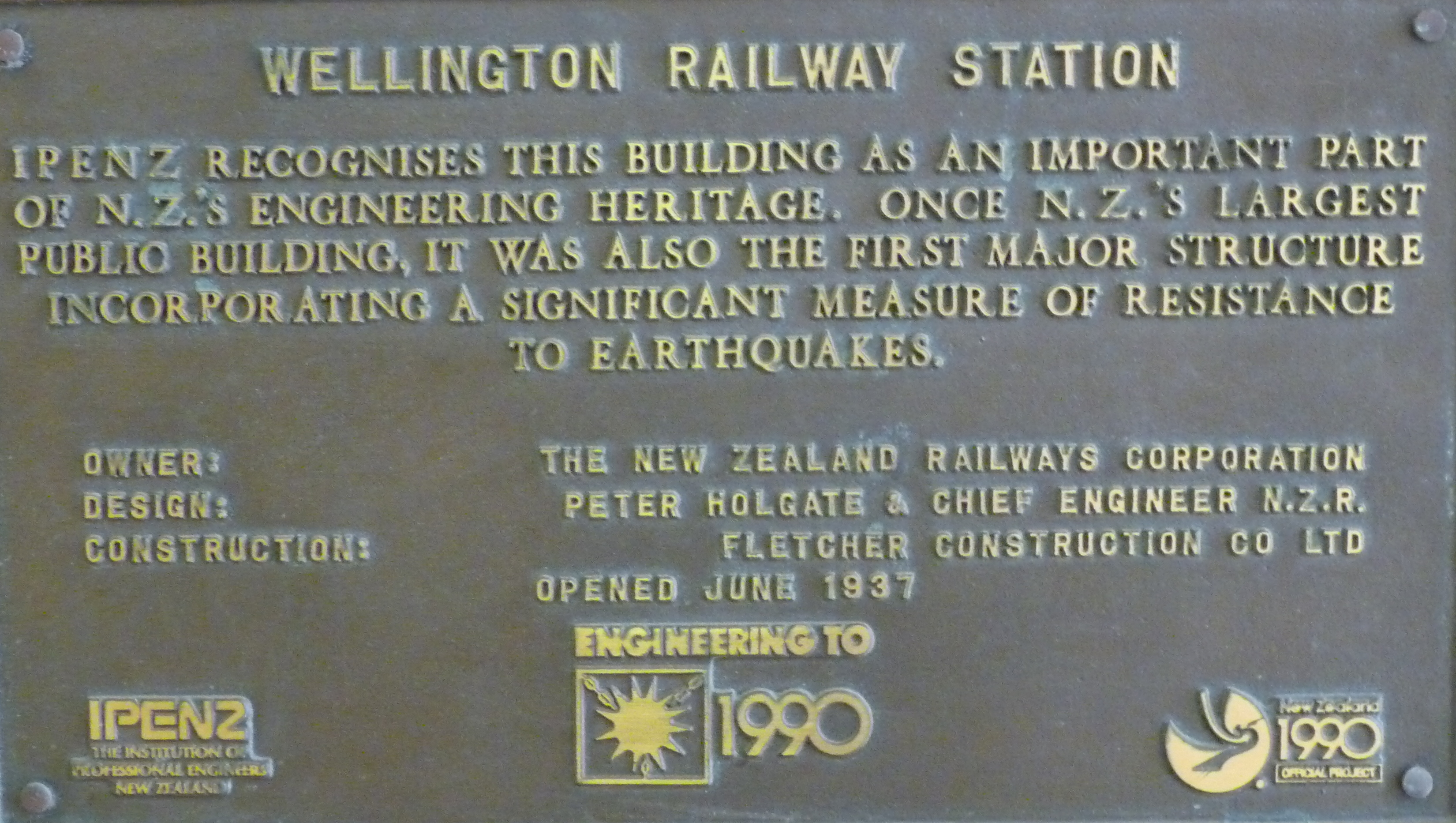
Wellington Railway Station opened in June nineteen thirty-seven, and when it did, it was the largest building in New Zealand. It covers over half a hectare, with a combined floor area of two hectares. But the really remarkable thing about this building is what's inside it — or rather, what it's designed to survive.
This was one of New Zealand's first seismically-proofed structures. The architect, W. Gray Young, designed it in a stripped Classical style with reinforced concrete specifically engineered to flex during an earthquake rather than crack. In a city that sits on multiple fault lines and had been devastated by the eighteen fifty-five quake, this was not an academic exercise. This building was designed to stay standing when the ground moved.
The station sits on sixty-eight acres of reclaimed land — the Thorndon reclamation that began in nineteen twenty-three. It replaced two earlier termini, Lambton and Thorndon, which had served the city since the eighteen-seventies. Look at the facade. The clean lines and symmetrical arches are classic inter-war architecture — grand enough to announce that you've arrived somewhere important, but restrained enough to feel distinctly New Zealand rather than borrowed from London or Washington.
The station has been a backdrop to some of Wellington's most significant moments. It was part of the funeral cortege route for Prime Minister Michael Joseph Savage. During World War Two, it served as a coordination point for home-front defence. And during the Wahine disaster of nineteen sixty-eight — when the inter-island ferry sank in the harbour during a catastrophic storm, killing fifty-three people — the station was used as a casualty treatment centre. Tens of thousands of commuters pass through here every day without thinking about any of this.
Verified Facts
Opened June 1937, largest building in NZ at the time
Designed by W. Gray Young, stripped Classical style
One of NZ's first seismically-proofed structures
Built on 68 acres of reclaimed land (Thorndon reclamation from 1923)
Part of PM Savage's funeral cortege route
Used as casualty centre during 1968 Wahine disaster
Get walking directions
Wellington, New Zealand