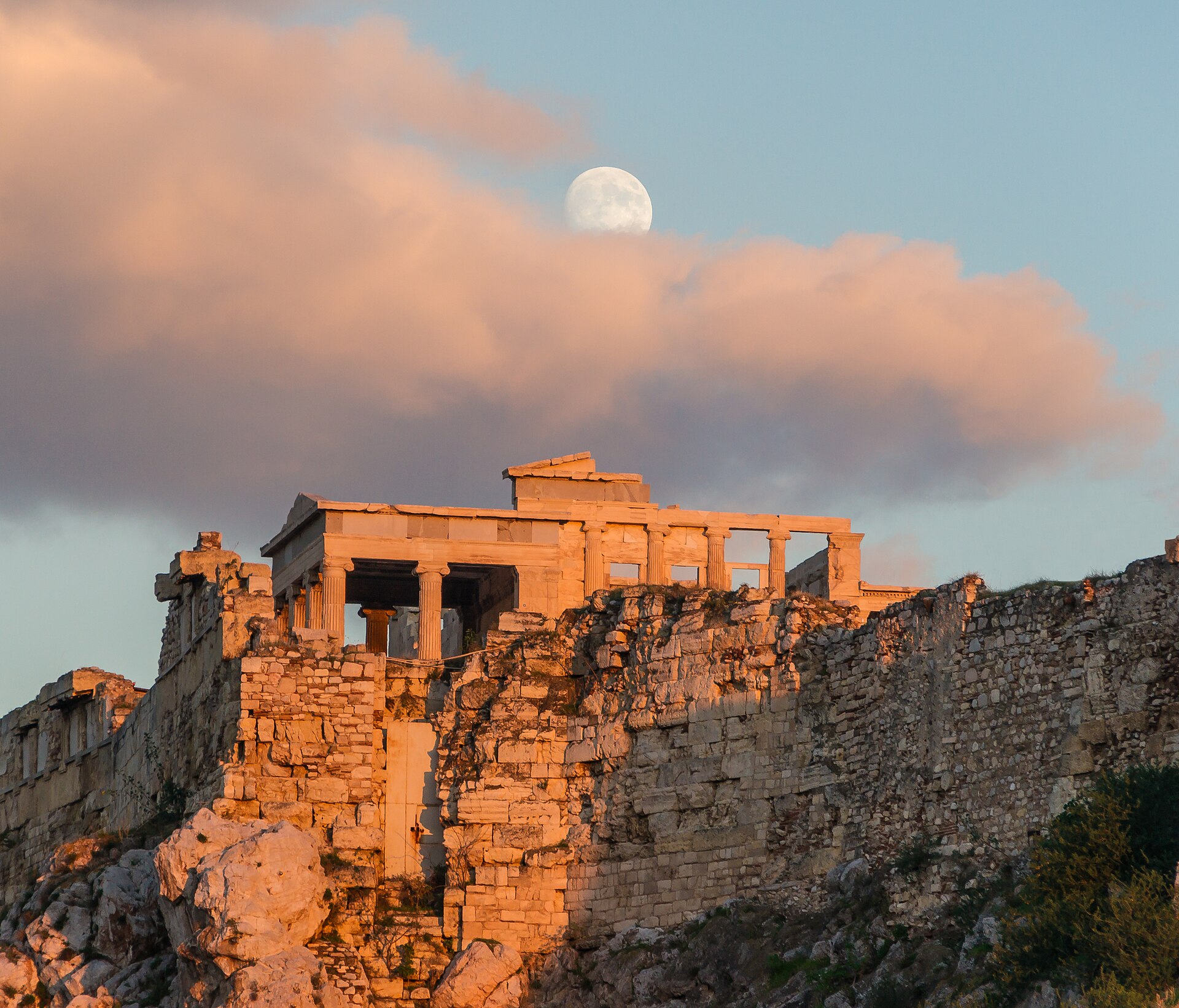
If the Parthenon is Athens' power statement, the Erechtheion is its mystery. This asymmetrical, multi-level temple is the most architecturally complex building on the Acropolis, and it had to be — it was built over the most sacred spots in Athenian mythology. This is where Athena and Poseidon supposedly held their contest for patronage of the city. Poseidon struck the rock with his trident, producing a salt spring; Athena planted an olive tree. The judges picked olives over seawater, and a sacred olive tree grew on this spot for centuries.
Built between 421 and 406 BC during a pause in the Peloponnesian War, the Erechtheion housed the ancient wooden cult statue of Athena Polias — the most sacred object in Athens, an olive-wood figure that legend said fell from heaven. The building's irregular plan accommodated multiple shrines at different levels: sanctuaries to Athena, Poseidon-Erechtheus, and the legendary king Kekrops, whose tomb was believed to lie beneath the southwest corner.
The real stars are the Caryatids — six female figures, each 2.3 meters tall, that serve as columns supporting the south porch roof. They're not identical: the three on the left stand on their right foot, the three on the right on their left foot. Their draped clothing creates vertical folds that cleverly mimic the fluting of Ionic columns, making the engineering look effortless. Lord Elgin took one in 1801; it's been in the British Museum ever since. The other five originals are in the Acropolis Museum, replaced on-site by casts.
Look closely at the north porch floor and you'll see marks supposedly left by Poseidon's trident. Whether you believe a sea god made them or an earthquake did, someone's been telling this story for 2,500 years.
Verified Facts
The Erechtheion was built between 421 and 406 BC and housed the ancient wooden cult statue of Athena Polias, believed to have fallen from heaven
The six Caryatids of the south porch stand 2.3 meters tall; the three on the left stand on their right foot and vice versa
Lord Elgin removed one Caryatid in 1801, now in the British Museum; the five remaining originals are in the Acropolis Museum
A sacred olive tree grew on the site, representing Athena's gift in her contest with Poseidon for patronage of Athens
Get walking directions
Acropolis, Athens 105 58