Hadrian's Arch
Two inscriptions. Two sides. Two completely different claims about who built Athens. On the side facing the Acropolis and old city: "This is Athens, the former city of Theseus." On the side facing the Temple of Olympian Zeus and the new Roman quarter: "This is the city of Hadrian and not of Theseus." It's either a diplomatic compliment or the most elegant piece of urban trash talk in history.
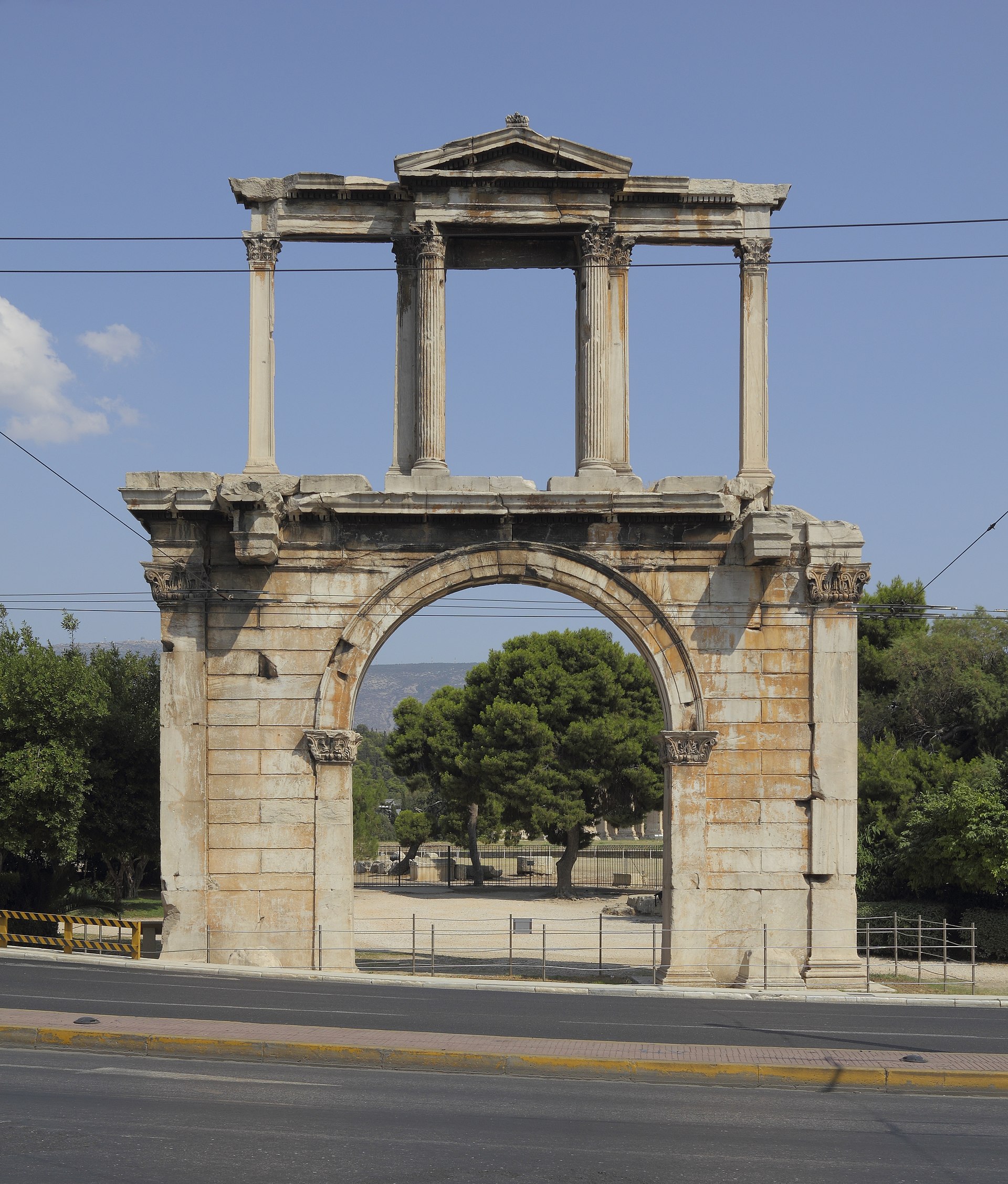
Emperor Hadrian built this 18-meter-tall gateway around 132 AD, probably to celebrate the dedication of the nearby Temple of Olympian Zeus that he'd finally completed after 638 years of false starts. The arch straddles what was then the boundary between the ancient Greek city and Hadrian's ambitious new Roman quarter — an entire urban extension with baths, temples, a library, and a gymnasium. It was a line in the marble between old Athens and new Rome, between myth and empire.
Architecturally, the arch is a fascinating hybrid. The lower section is a Roman arch — a single opening flanked by Corinthian columns on pilasters. But the upper section is pure Greek: a row of Corinthian columns supporting an entablature, essentially a Greek propylon sitting on top of a Roman gate. The whole thing is carved from Pentelic marble and stands 13.5 meters wide and 2.3 meters deep. It was never a defensive gate — there's no evidence of walls connecting to it — making it purely ceremonial, a threshold of meaning rather than function.
Today it stands marooned on a traffic island on one of Athens' busiest streets, ringed by cars and buses. Hadrian probably didn't envision his grand boundary marker sharing space with a pedestrian crossing and a souvlaki stand, but Athens has always been good at absorbing empires into its everyday life.
Verified Facts
The arch bears two inscriptions: "This is Athens, the former city of Theseus" on the Acropolis side, and "This is the city of Hadrian and not of Theseus" on the other
The arch is 18 meters high, 13.5 meters wide, and built entirely of Pentelic marble, erected around 132 AD
It marked the boundary between the ancient Greek city and Hadrian's new Roman quarter extension
Get walking directions
Leoforos Vasilissis Amalias, 2nd Municipal Community, Athens, 105 58, Greece