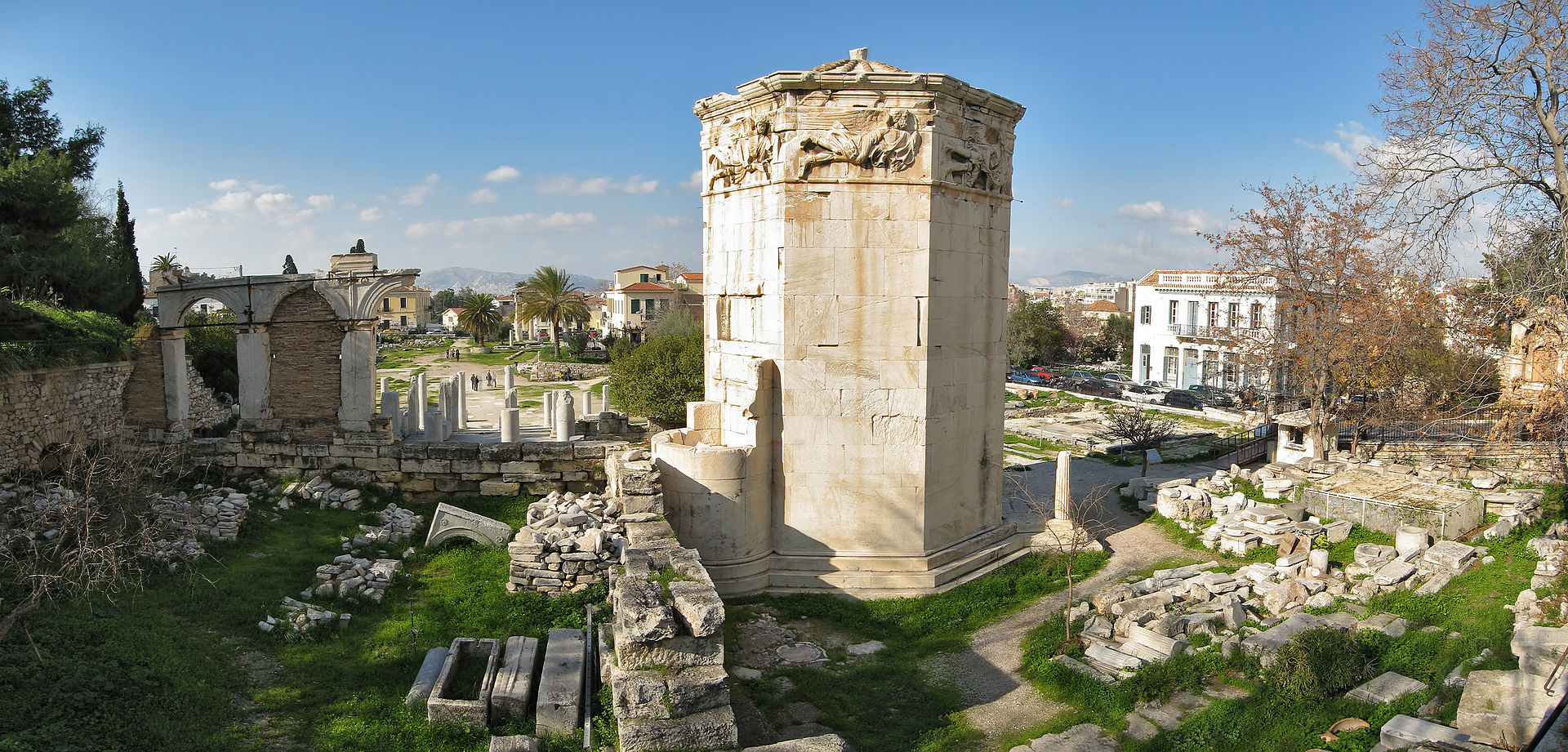
Before smartphones, before clocks, before even sundials were common, this octagonal marble tower told Athenians the time, the wind direction, and the weather forecast — all at once. The Tower of the Winds is the world's first known meteorological station and the only surviving clock tower from classical antiquity, and it's been standing in the Roman Agora virtually intact for over 2,000 years.
Built around 50 BC by the astronomer Andronicus of Cyrrhus, the tower is 12.8 meters tall and 7.9 meters in diameter, constructed entirely of Pentelic marble. Each of its eight sides faces a cardinal or intercardinal direction and features a relief sculpture of the corresponding wind god — Boreas (north), Kaikias (northeast), Apeliotes (east), and so on. The sculptures aren't just decorative: each wind god carries objects that indicate the weather his wind brings. Boreas wears a heavy cloak and blows a conch shell; Zephyros (west) carries flowers.
The tower originally featured nine sundials on its exterior walls, a large water clock (clepsydra) inside powered by water from a spring on the Acropolis, and a bronze wind vane in the shape of a Triton on its conical roof. The water clock was an engineering marvel — a complex system of pipes and floats that kept time even when the sun wasn't shining.
During the Ottoman period, the tower was used as a tekke (a lodge for Whirling Dervishes), and it was buried up to half its height in accumulated soil until excavation in the nineteenth century. Today, fully exposed and recently restored, it stands as proof that the ancient Greeks were doing things with architecture, astronomy, and engineering that wouldn't be attempted again for centuries.
Verified Facts
Built around 50 BC by astronomer Andronicus of Cyrrhus, the tower is the only surviving clock tower from classical antiquity
The octagonal tower is 12.8 meters tall, built of Pentelic marble, with eight relief sculptures of wind gods on its faces
It originally contained nine sundials, a water clock (clepsydra), and a bronze Triton wind vane on its roof
During the Ottoman period, the tower was used as a tekke (lodge) for Whirling Dervishes
Get walking directions
Plaka, Athens, 105 55, Greece