Checkpoint Charlie
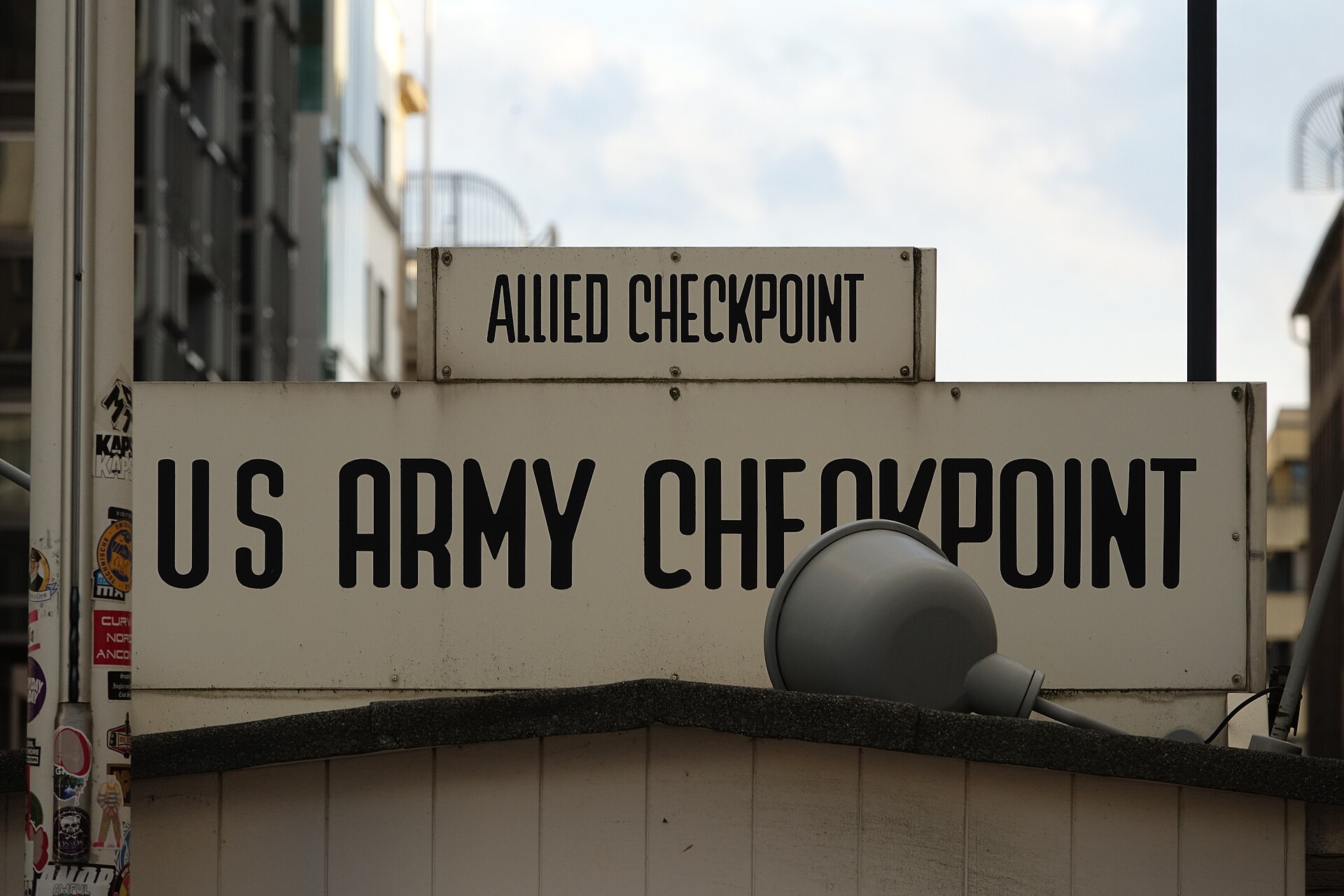
It's the most famous border crossing in history, and today it's one of Berlin's most surreal places — a strange collision of real history and pure tourism. The guardhouse you see is a replica. The sandbags are decorative. People dressed as soldiers will charge you for a photo. But the street beneath your feet is the same street where, in October 1961, American and Soviet tanks faced each other barrel-to-barrel, thirty metres apart, for sixteen hours. It was the closest the Cold War came to turning hot in Europe.
Checkpoint Charlie was the designated crossing for diplomats, military personnel, and foreigners — 'Charlie' is simply NATO phonetic alphabet for 'C', the third checkpoint after Alpha (Helmstedt) and Bravo (Dreilinden). East Germans weren't allowed anywhere near it.
The real stories are in the escapes. People hid in modified car engines, in surfboards, in suitcases. One man built a zip line from a rooftop. A family floated across in a homemade hot air balloon. Twenty-one-year-old Peter Fechter was shot trying to climb the wall near here in 1962 and bled to death in the death strip while crowds watched from the West, unable to help. His death became one of the defining images of the Cold War.
The museum next door — the Mauermuseum — was founded in 1963 in a two-room flat and documents the wall's history and the extraordinary ingenuity people used to cross it.
Verified Facts
In October 1961, American and Soviet tanks faced each other at Checkpoint Charlie for 16 hours in a direct standoff
'Charlie' comes from the NATO phonetic alphabet — Alpha (Helmstedt), Bravo (Dreilinden), Charlie (Friedrichstraße)
Peter Fechter was shot trying to cross near Checkpoint Charlie in August 1962 and bled to death in the death strip
The Mauermuseum was founded in 1963 in a two-room flat
Get walking directions
43-45 Friedrichstraße, Friedrichshain-Kreuzberg, Berlin, 10969, Germany