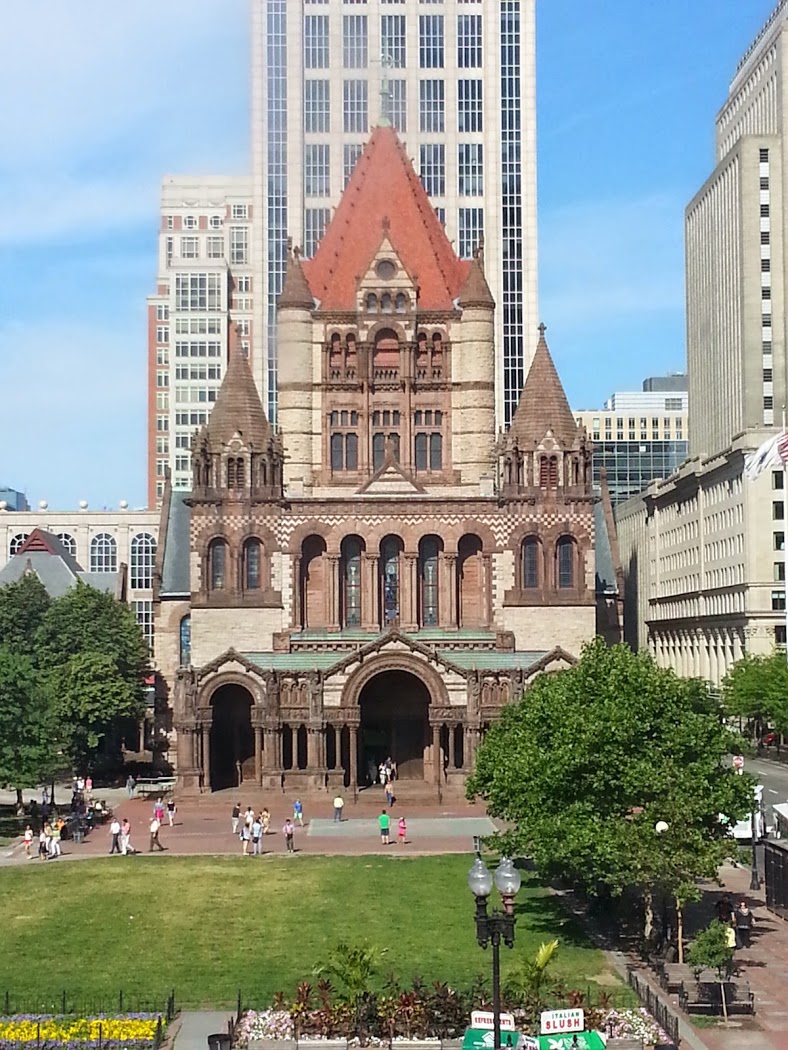
Trinity Church is Henry Hobson Richardson's masterpiece — the building that launched an entire architectural movement (Richardsonian Romanesque) and has been ranked among the ten most significant buildings in American history by the American Institute of Architects. Completed in 1877, it sits in Copley Square with its tower reflected in the glass facade of the Hancock Tower behind it, creating one of the most photographed architectural juxtapositions in the country.
Richardson's design draws from French and Spanish Romanesque churches but assembles them into something entirely original — massive rough-cut granite walls, a central tower modelled on the Old Cathedral of Salamanca, and an interior decorated by John La Farge with murals, stained glass, and painted surfaces that cover every available inch. La Farge's work at Trinity Church — including the enormous Christ in Majesty over the chancel — is considered his finest achievement, and the interplay of colour and light through the stained glass windows creates an atmosphere that's more Byzantine than New England.
The engineering challenge was extraordinary. Back Bay is built on filled land — essentially a swamp — and Richardson had to sink 4,500 wooden pilings through the fill to reach bedrock. The building weighs 9,500 tons, and the fact that it hasn't sunk into the mud in nearly 150 years is a testament to 19th-century engineering. Guided tours explain both the architecture and the ongoing maintenance required to keep a 9,500-ton stone church level on reclaimed land.
Verified Facts
Trinity Church was designed by H.H. Richardson and completed in 1877
The building launched the Richardsonian Romanesque architectural style
The interior murals and decorations were done by John La Farge
4,500 wooden pilings were driven through filled land to support the building
Get walking directions
206 Clarendon St, Back Bay, Boston, 02116, United States