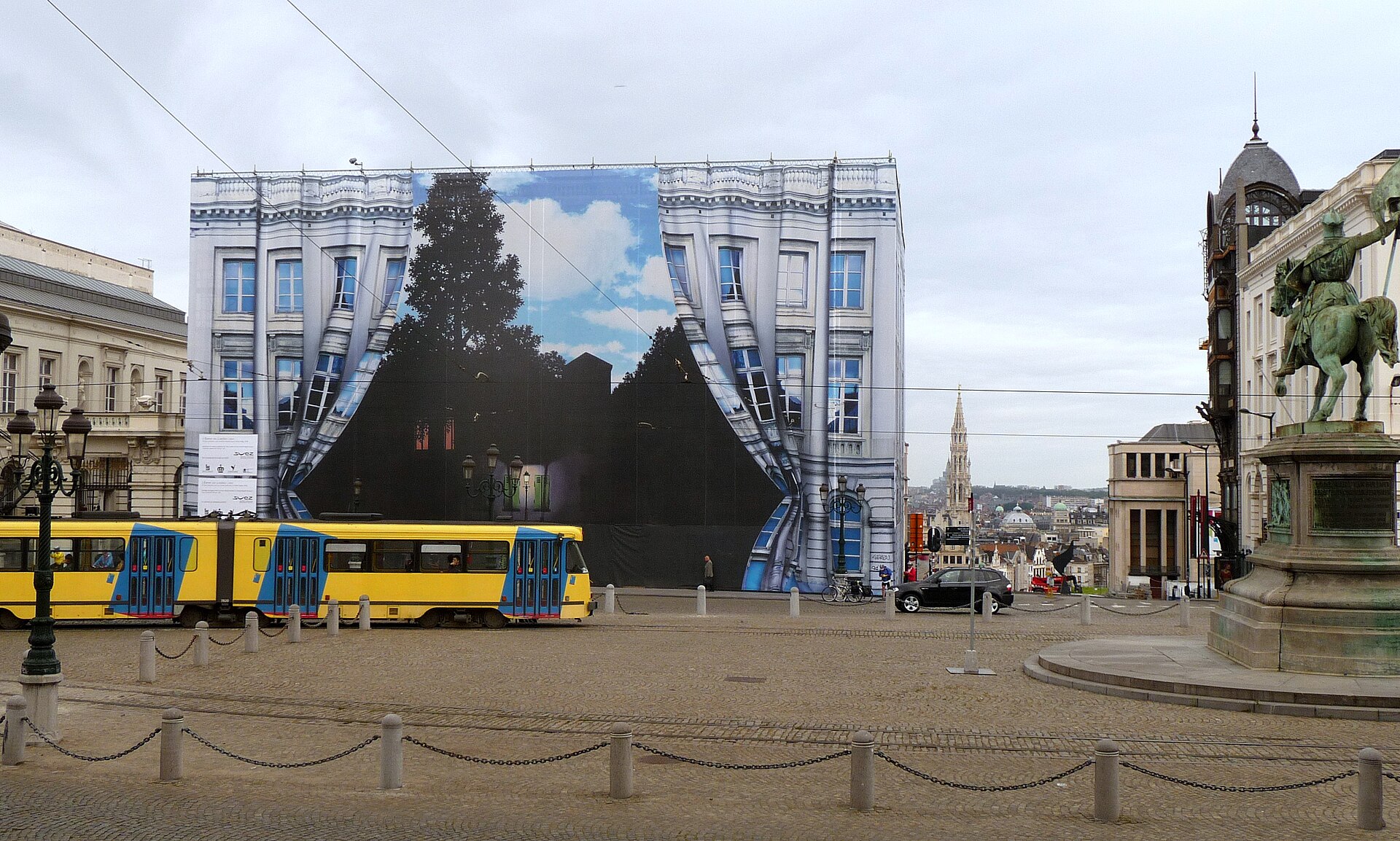
The Magritte Museum houses the world's largest collection of works by René Magritte — over 200 paintings, drawings, sculptures, and objects by Belgium's most famous artist, displayed chronologically across five floors of a neoclassical building on Place Royale. The museum is part of the Royal Museums of Fine Arts complex but has its own entrance and identity, and the experience of seeing Magritte's development from early experiments through mature surrealism to late-career stylistic adventures is more coherent here than in any other museum.
Magritte spent most of his life in Brussels — working from an ordinary suburban house in Jette, wearing a bowler hat, walking his dog, and producing paintings that upended the relationship between images and reality with the quiet precision of an accountant filing tax returns. The museum captures this tension between the mundane life and the extraordinary art: the biographical sections show a man of conventional habits, while the paintings on the surrounding walls — clouds floating through rooms, men raining from skies, pipes that are not pipes — demonstrate a mind that treated reality as a set of suggestions rather than rules.
'The Empire of Lights' series — paintings showing a daylit sky above a nighttime street, impossibly combining two times of day in a single image — is the museum's most affecting work. The paintings are larger in person than reproductions suggest, and the uncanny quality of the light — technically impossible but emotionally correct — is something that photographs can't convey. The museum shop sells Magritte-themed bowler hats, which is exactly the kind of commercial surrealism that Magritte would have both deplored and secretly enjoyed.
Verified Facts
The museum contains over 200 works by René Magritte
It is the world's largest collection of Magritte's work
Magritte lived and worked in Brussels for most of his career
The museum is part of the Royal Museums of Fine Arts complex
Get walking directions
Rue de la Régence 3, 1000 Brussels