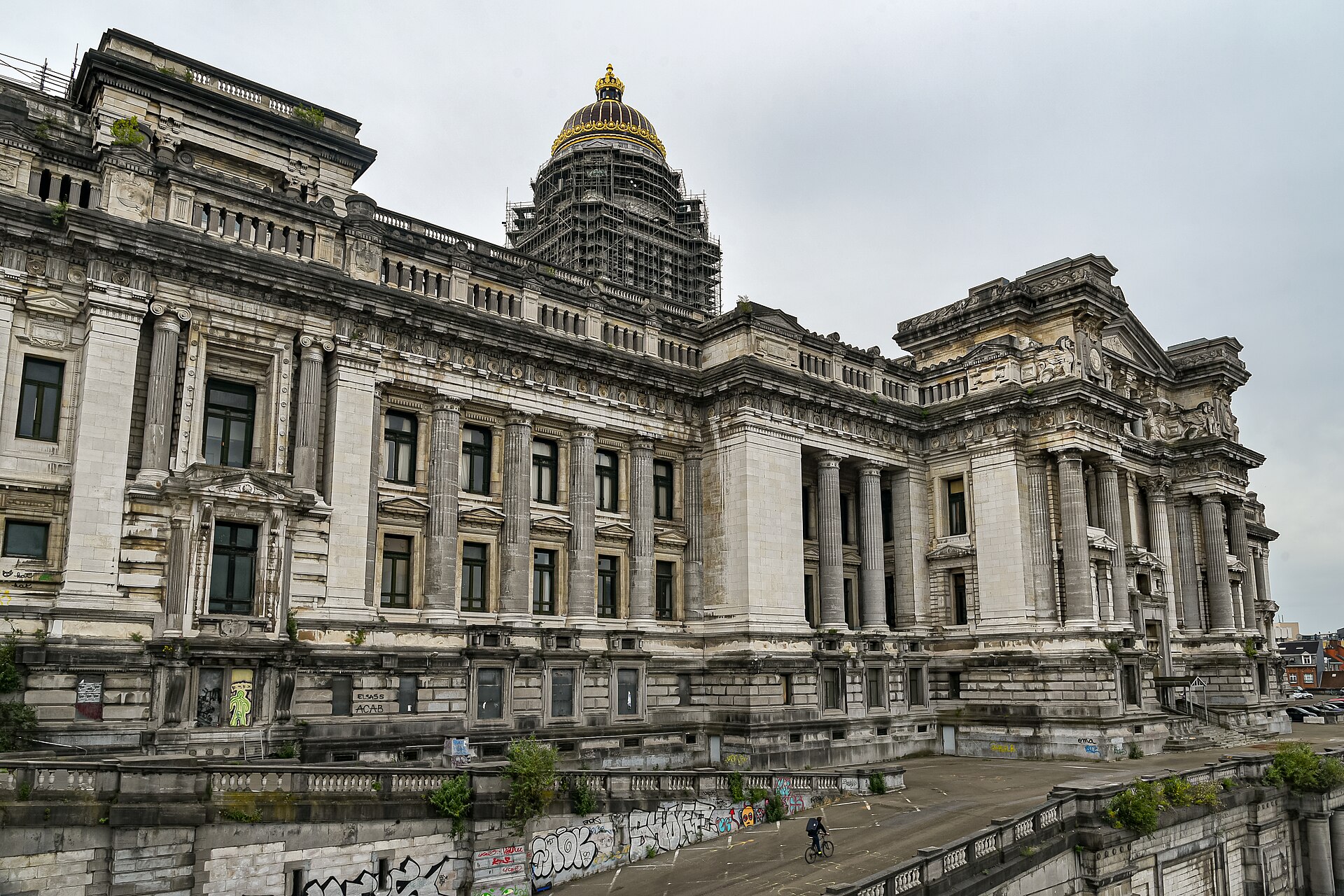
The Palais de Justice is the largest courthouse in the world — a colossal Greco-Roman-Egyptian-Assyrian pile that covers 26,000 square metres (larger than St. Peter's Basilica), rises 104 metres from its foundations, and sits on the Poelaert plateau overlooking the Marolles neighbourhood like a government building from a dystopian film. The architect, Joseph Poelaert, designed it to overwhelm, and in this he succeeded — the building has been intimidating Brusselaars and visitors since its completion in 1883.
The scale is genuinely disorienting. The main hall, where you enter through bronze doors several storeys tall, is a covered atrium of such vertical ambition that the floor-to-ceiling height exceeds that of most churches. The corridors stretch in every direction, and getting lost is virtually guaranteed. The building was controversial from conception — its construction required demolishing a section of the Marolles neighbourhood, and the displaced residents' anger toward the architect gave Brussels the insult 'schieven architek' (crooked architect).
The terrace in front of the Palais, Place Poelaert, provides one of the best panoramic views of Brussels — looking north across the Marolles rooftops to the Grand-Place spires and beyond. A glass elevator connects the terrace to the Marolles neighbourhood 30 metres below, providing a quick shortcut and a dramatic change in altitude. The courthouse is still a functioning judicial building, and the interior is open to the public during court hours — walking through its vast halls, passing lawyers in robes and litigants looking anxious, is one of Brussels' most surreal experiences.
Verified Facts
The Palais de Justice is the largest courthouse in the world at 26,000 square metres
The building was designed by Joseph Poelaert and completed in 1883
Construction required demolishing part of the Marolles neighbourhood
A glass elevator connects the terrace to the Marolles below
Get walking directions
Place Poelaert 1, 1000 Brussels