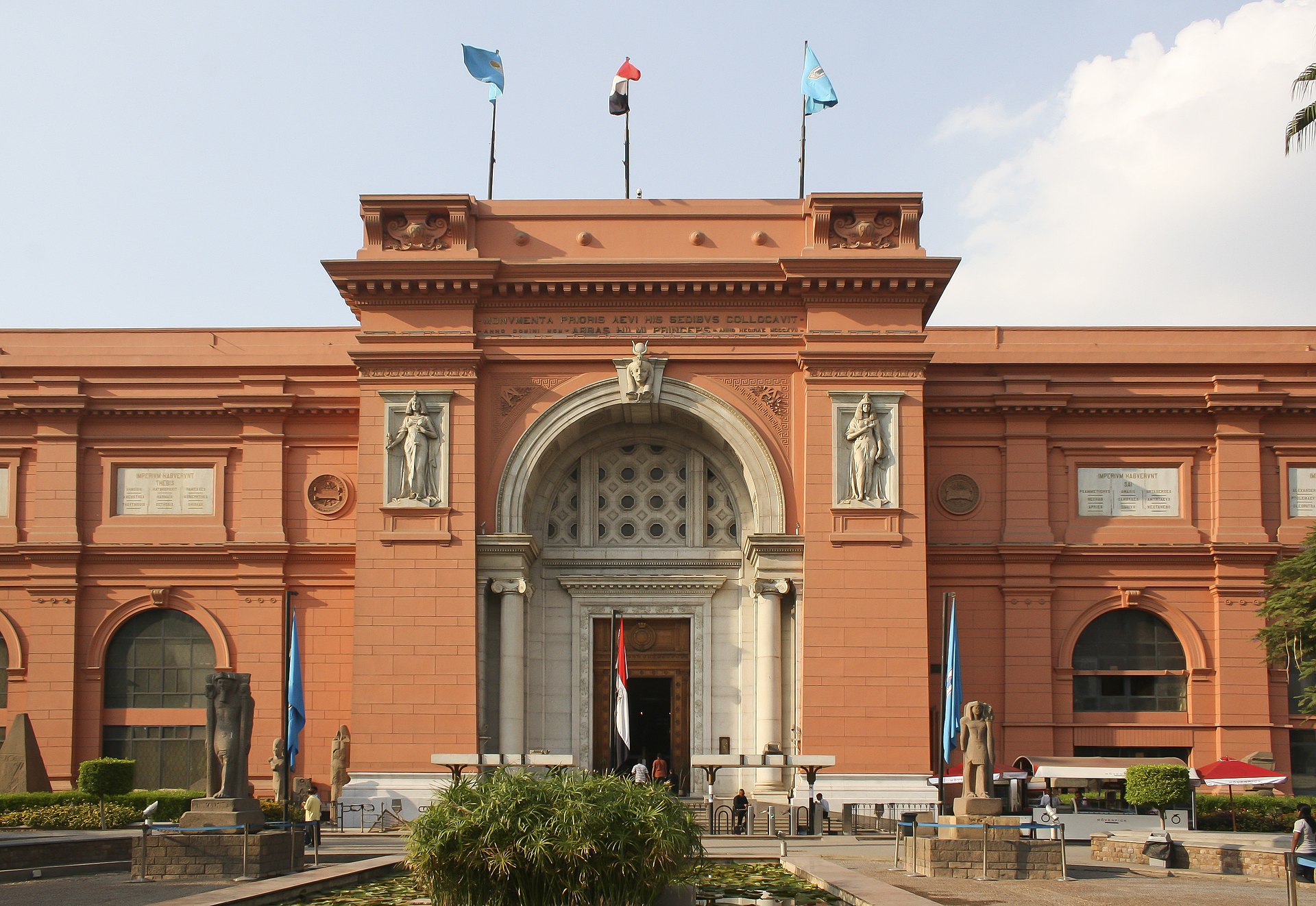
The Egyptian Museum on Tahrir Square is the most important collection of pharaonic antiquities in the world — over 120,000 artifacts spanning 5,000 years of Egyptian civilisation, housed in a pink neoclassical building from 1902 that is itself a monument to the 19th-century passion for Egyptology. The museum's most famous resident is Tutankhamun — the golden death mask, the golden throne, the canopic jars, and the thousands of objects recovered from his tomb in the Valley of the Kings in 1922 by Howard Carter.
The museum is overwhelming by design — the galleries are packed, the labelling is minimal, and the experience of walking through room after room of stone sarcophagi, painted coffins, jewellery, and statuary that spans from the predynastic period to the Greco-Roman era is less like visiting a curated exhibition than like wandering through a warehouse of civilisational achievement. The Royal Mummies Room (requiring a separate ticket) displays the preserved bodies of pharaohs including Ramesses II and Hatshepsut — meeting the face of a ruler who died 3,000 years ago is one of those museum experiences that makes time feel malleable.
The museum's collection is gradually being transferred to the Grand Egyptian Museum near Giza, and the Tahrir Square building's future is uncertain. Visiting now — while the museum retains its famously chaotic, treasure-house atmosphere — offers an experience that the new museum's sleek, modern galleries will deliberately not replicate. The building's location on Tahrir Square adds a layer of modern history — the square was the epicentre of the 2011 Egyptian revolution, and the museum was damaged during the protests.
Verified Facts
The museum houses over 120,000 artifacts
The building was completed in 1902
Tutankhamun's tomb was discovered by Howard Carter in 1922
The museum was damaged during the 2011 Egyptian revolution
Get walking directions
El Tahrir Square, Qasr Al Doubara, Cairo, 11519, Egypt