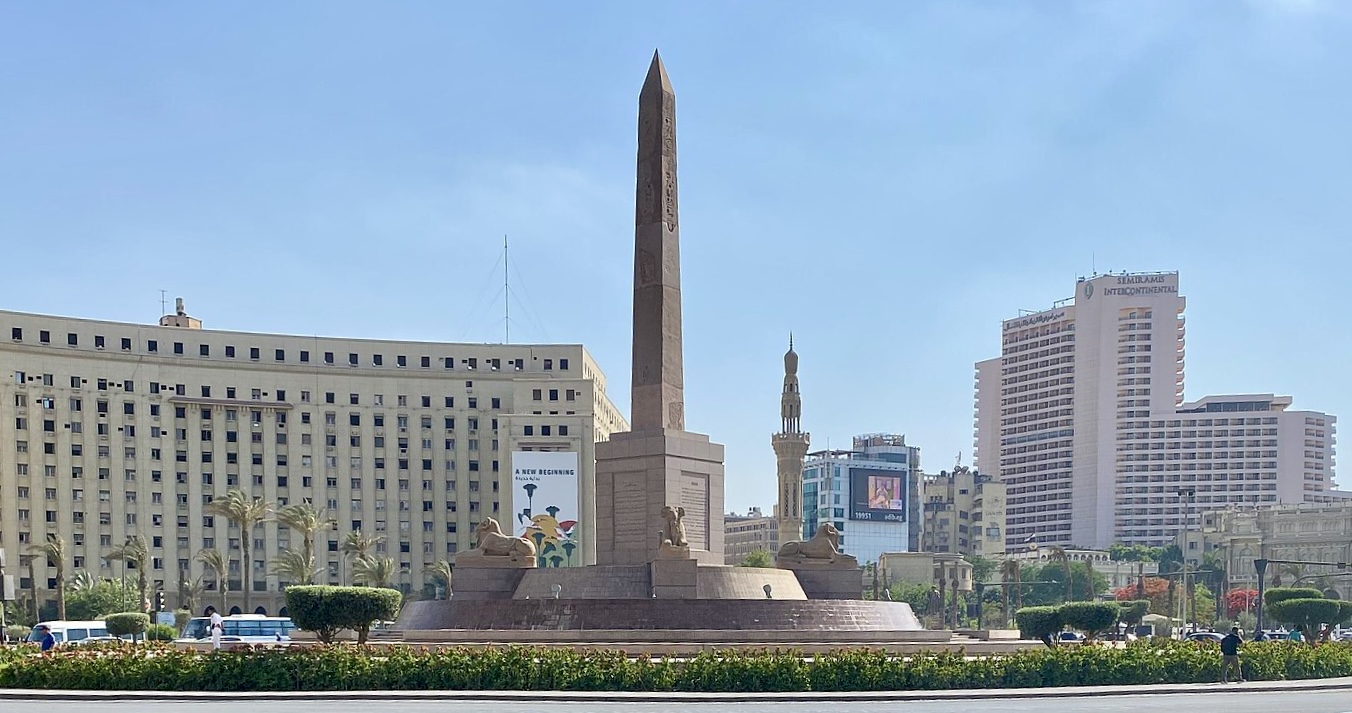
Tahrir Square is the most politically significant public space in the Middle East — a traffic-choked roundabout in downtown Cairo that became the epicentre of the 2011 Egyptian revolution, when millions of Egyptians gathered to demand the resignation of President Hosni Mubarak. The 18 days of protest (January 25 to February 11, 2011) that ended Mubarak's 30-year rule were broadcast from this square to the world, and the name 'Tahrir' (Liberation) — given to the square after the 1952 revolution that ended the monarchy — acquired a new and more powerful meaning.
The square was originally designed in the 19th century as the centrepiece of Khedive Ismail's Haussmann-inspired downtown, and the surrounding buildings — the Egyptian Museum, the Nile Hilton (now the Ritz-Carlton), the Arab League headquarters, and the former National Democratic Party headquarters (burned during the revolution and since demolished) — represent the institutional architecture of 20th-century Egypt. The square's transformation from traffic circle to revolutionary arena and back to traffic circle is itself a commentary on the relationship between public space and political power.
Today, Tahrir Square has returned to its pre-revolutionary function — a noisy, congested intersection that bears little physical trace of the events that made it globally famous. A flagpole and a small monument have been added, but the square's significance is historical and symbolic rather than visual. The Egyptian Museum on the square's northern edge remains the area's main attraction for visitors, and the downtown streets radiating from the square provide the most walkable urban experience in a city where walking is often an act of faith.
Verified Facts
The 2011 Egyptian revolution was centred on Tahrir Square
Protests lasted 18 days, from January 25 to February 11, 2011
Tahrir means 'Liberation' in Arabic
The square was designed as part of Khedive Ismail's 19th-century downtown
Get walking directions
Tahrir Square, Downtown Cairo