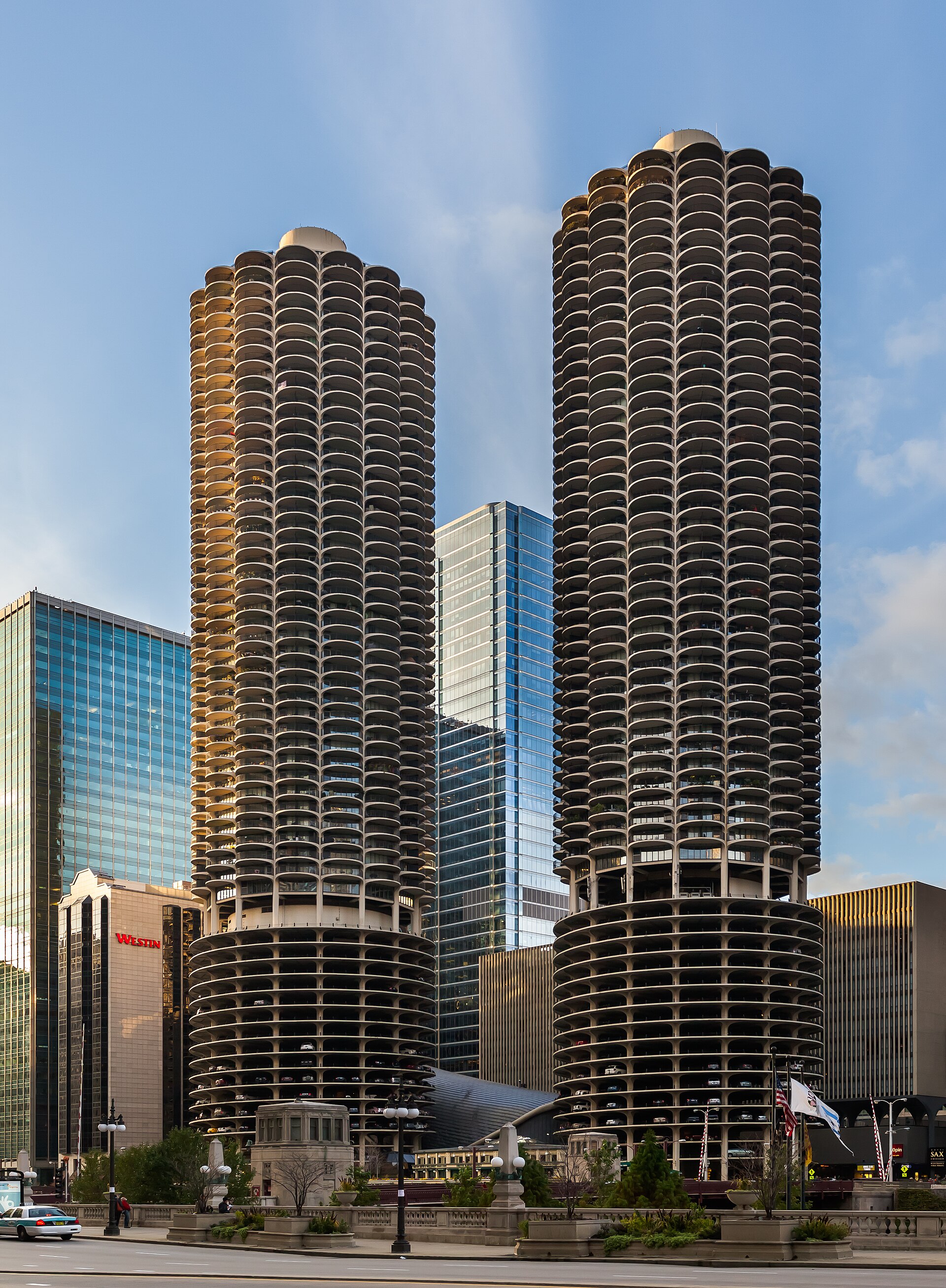
Marina City's twin cylindrical towers — universally known as the 'corn cobs' — are the buildings that made Chicago's riverfront into a postcard. Designed by Bertrand Goldberg and completed in 1964, they were the tallest residential buildings in the world at the time and the first mixed-use high-rises in America, combining apartments, a marina, restaurants, a theatre, a bowling alley, and an ice rink in a single complex designed to keep residents inside the city rather than fleeing to the suburbs.
The design is pure 1960s futurism. The lower 18 floors of each tower are an open-air parking garage — the cars are visible from outside, spiralling up the building like a helix — and the upper 40 floors are pie-shaped apartments that radiate from a central core like petals. Every apartment has a semicircular balcony with river views, and the curved floor plans mean that no two rooms in any apartment are the same shape. It's the opposite of the rectilinear grid that defines most urban housing.
Goldberg, who had studied under Mies van der Rohe but rejected his mentor's obsession with straight lines, believed that curved buildings were more humane than rectangular ones. Marina City was his manifesto — a building that looked nothing like anything that came before and influenced mixed-use urban development for decades after. The towers appear on the cover of the Wilco album 'Yankee Hotel Foxtrot,' which is the most culturally significant thing any Chicago building has done since the Water Tower survived the fire.
Verified Facts
Marina City was completed in 1964 and was the tallest residential building in the world at the time
Designed by Bertrand Goldberg, who studied under Mies van der Rohe
The lower 18 floors of each tower are an open-air parking garage
The towers appear on the cover of Wilco's 'Yankee Hotel Foxtrot'
Get walking directions
300 N State St, River North, Chicago, 60654, United States