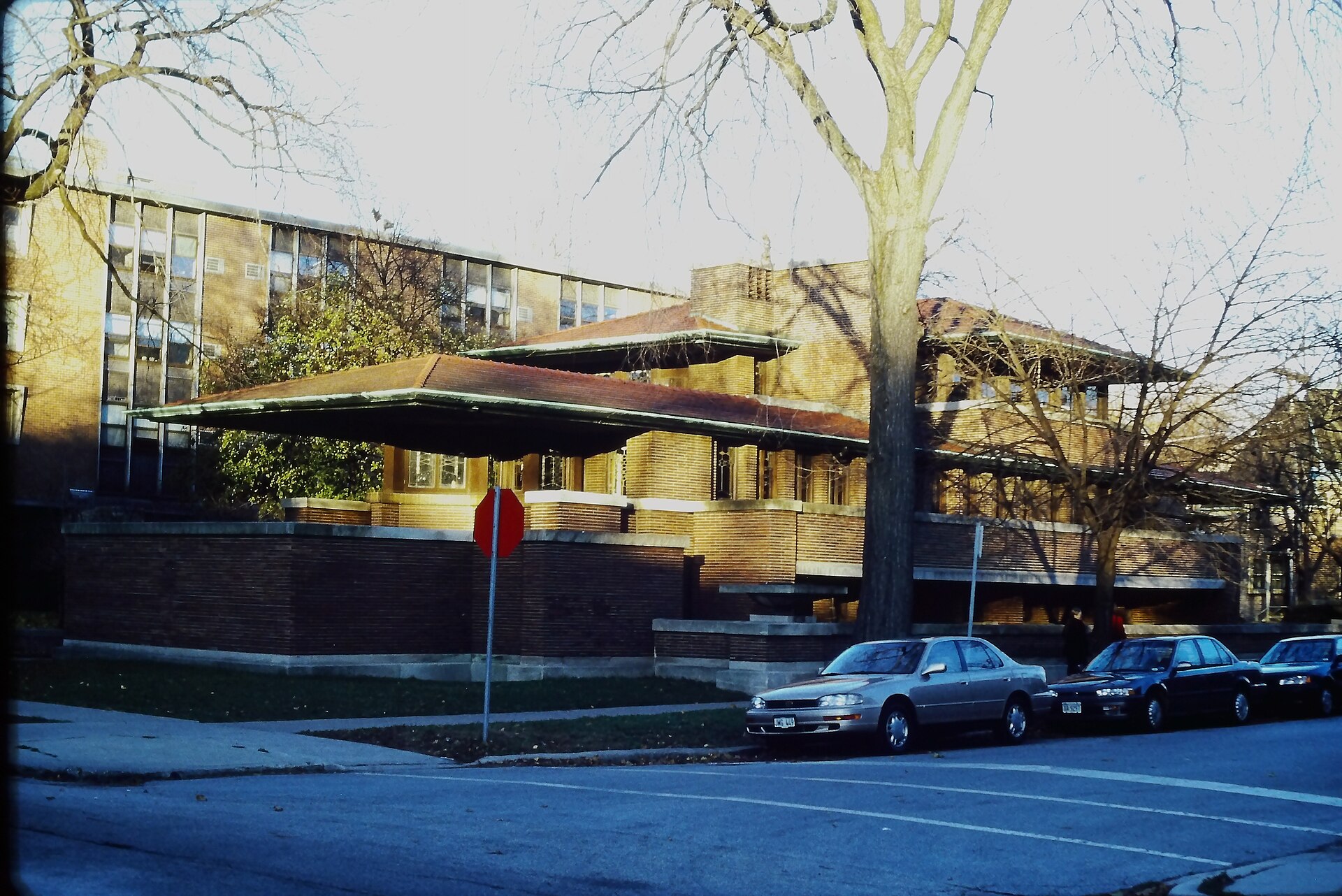
The Robie House is Frank Lloyd Wright's masterpiece — a UNESCO World Heritage Site and the building that defined the Prairie School of architecture with such authority that it's been called one of the ten most significant structures of the 20th century. Built between 1909 and 1910 for businessman Frederick C. Robie, it sits on a corner of the University of Chicago campus in Hyde Park, looking like a spacecraft from a civilisation that valued horizontal lines above all else.
Wright's design eliminates the traditional box. The roof extends in dramatic cantilevers — 20 feet beyond the walls in some places, without visible supports — creating deep overhangs that shade the art glass windows and blur the boundary between inside and outside. The floor plan is organised around a central fireplace rather than corridors, with rooms flowing into each other in a way that was revolutionary in 1910 and still feels modern today. The art glass windows — 174 of them — filter light through geometric patterns that represent abstracted plant forms.
The house nearly didn't survive. It was sold to the Chicago Theological Seminary, which wanted to demolish it for a dormitory. Wright himself campaigned to save it, and it was eventually preserved and restored. Today the Frank Lloyd Wright Trust runs guided tours that explain both the architectural innovations and the domestic reality of living in a house where the genius of the design occasionally conflicted with practical matters like hanging curtains or moving furniture.
Verified Facts
Robie House is a UNESCO World Heritage Site
Built between 1909 and 1910 for Frederick C. Robie
The roof cantilevers extend 20 feet beyond supporting walls
The house contains 174 art glass windows
Get walking directions
5757 S Woodlawn Ave, Chicago, IL 60637