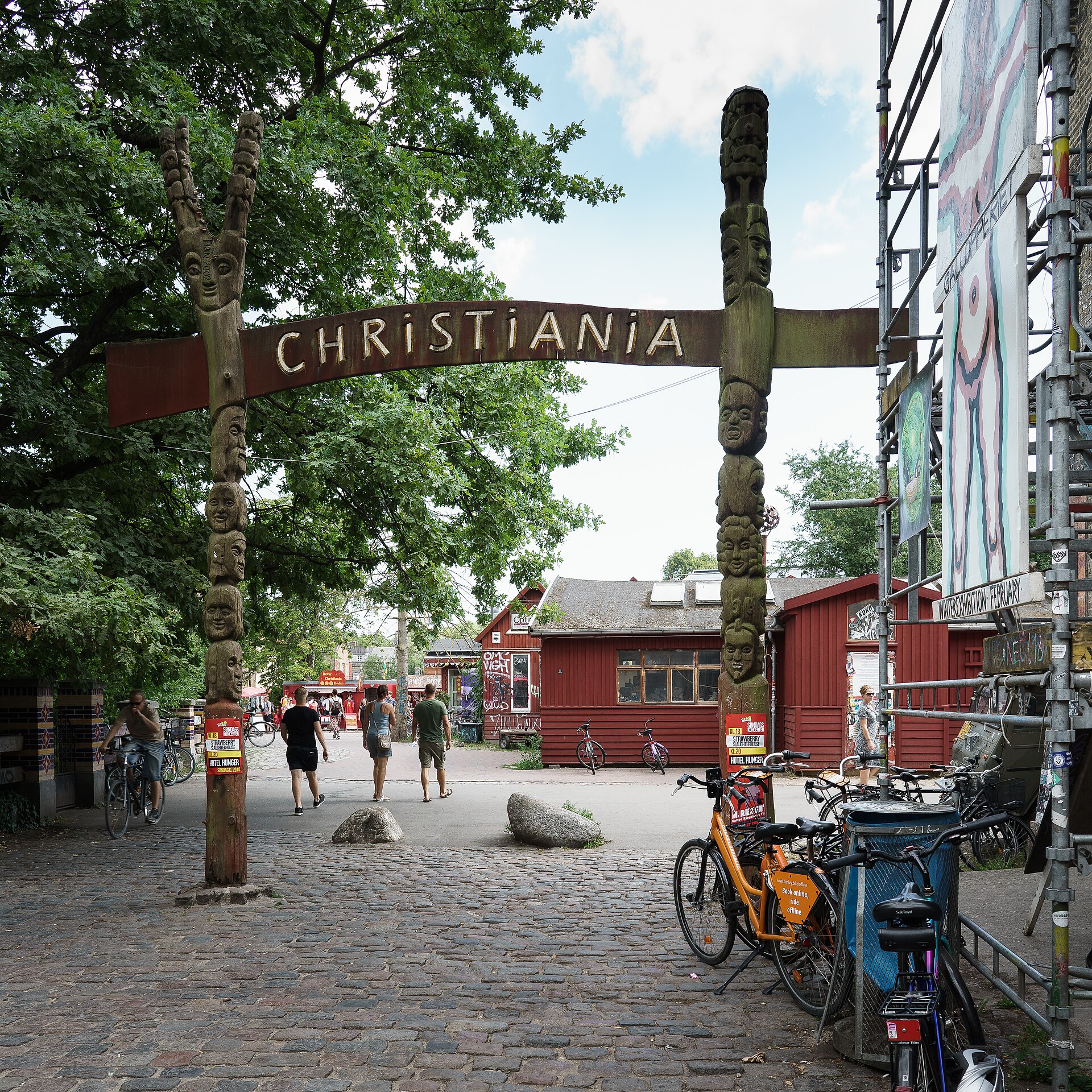
In 1971, a group of squatters broke into an abandoned military barracks on Christianshavn and declared it a free town. Fifty-three years later, Christiania is still there — a self-governing commune of roughly 900 residents occupying 34 hectares of prime Copenhagen real estate, operating under its own laws and governed by consensus at community meetings. No cars are allowed. No private property exists. Decisions are made when everyone in the room agrees, which means some meetings last for days.
The site was originally Bådsmandsstrædes Kaserne, a naval barracks built in 1631 that had been decommissioned and left empty. The squatters — a mix of hippies, homeless people, artists, and political idealists — moved in and created what they called a "social experiment." The Danish government has tried to shut it down, regulate it, normalise it, and sell it multiple times over the decades, but Christiania has survived every attempt. In 2012, the residents collectively purchased the land from the Danish state for 76 million kroner, funded through a foundation.
Walking through Christiania feels like entering a different country within Copenhagen. The architecture is a wild mix of self-built houses, repurposed military buildings, geodesic domes, and structures that defy any building code ever written. Murals cover every available surface. The famous Pusher Street, once an open cannabis market, was dismantled by residents themselves in 2004 after a shooting, though it has gone through cycles of closure and reopening since. Photography is generally discouraged on that particular street.
What makes Christiania genuinely remarkable is that it works. The community runs its own kindergarten, recycling programmes, a music venue (Loppen), workshops, and organic restaurants. The Nemoland outdoor bar is one of Copenhagen's most beloved summertime hangouts. Love it or hate it, Christiania is one of the most radical social experiments in European history — and it's still running.
Verified Facts
Founded in 1971 when squatters occupied the abandoned Bådsmandsstrædes Kaserne naval barracks
Roughly 900 residents live on 34 hectares governed by consensus-based community meetings
Residents collectively purchased the land from the Danish state for 76 million kroner in 2012
Pusher Street's open cannabis market was dismantled by residents in 2004 after a shooting
Get walking directions
Copenhagen, København K, Denmark