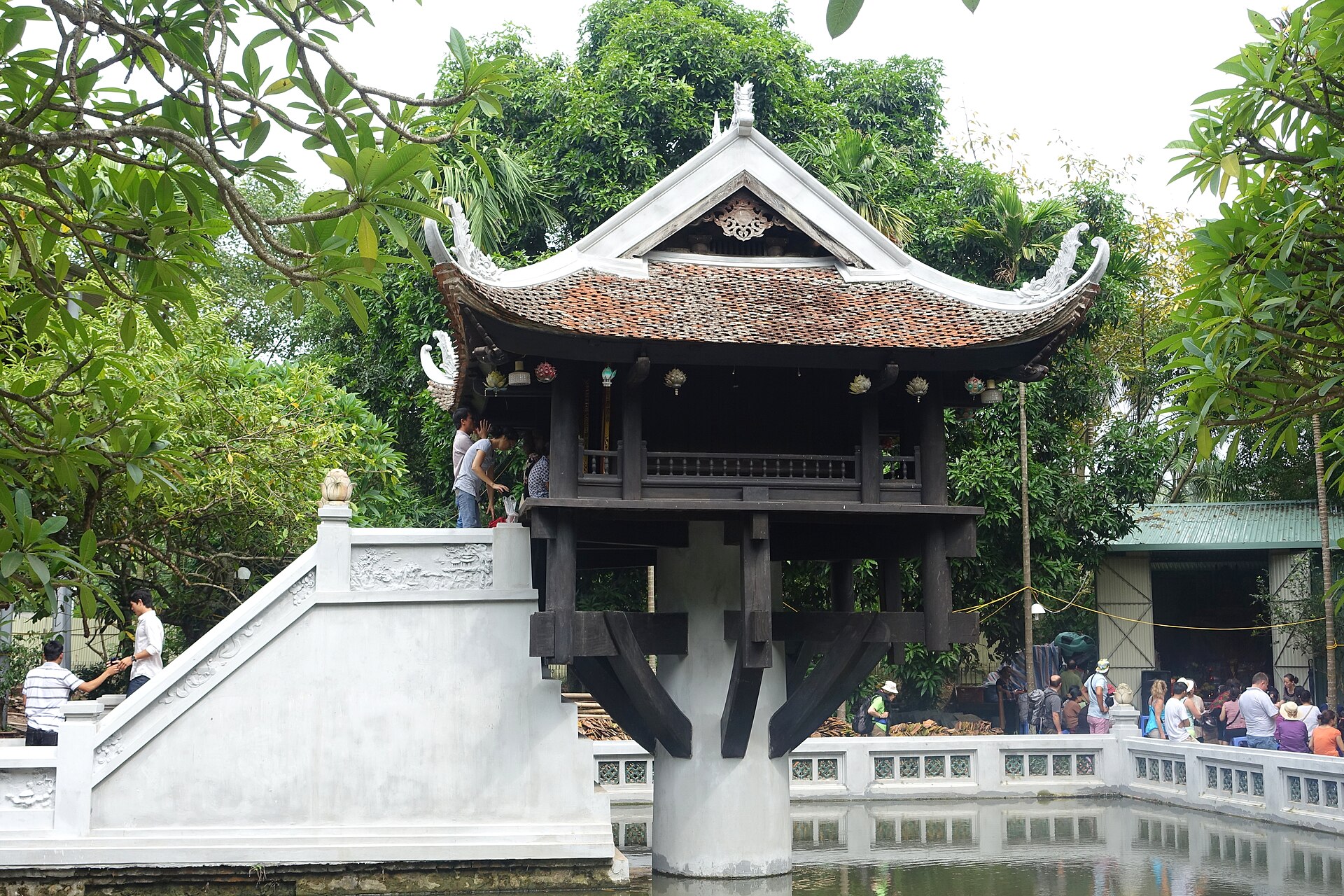
The One Pillar Pagoda is one of Vietnam's most iconic structures — a small Buddhist temple built on a single stone pillar in a lotus pond, designed to resemble a lotus flower rising from the water. The original pagoda was built in 1049 by Emperor Lý Thái Tông, who dreamed that the bodhisattva Quan Âm (Avalokiteśvara) handed him a baby son while seated on a lotus flower. The emperor built the pagoda in gratitude for the subsequent birth of his heir.
The pagoda is tiny — the wooden temple on the pillar measures only about 3 metres square — but its design is unique in Buddhist architecture. The single stone pillar supporting the temple creates the illusion of a lotus blossom floating on the water of the surrounding pond, which was the explicit intention of the 11th-century builders. The current structure is a reconstruction — the French destroyed the original in 1954 as they withdrew from Indochina, and the Vietnamese rebuilt it in 1955.
The pagoda sits in the Hồ Chí Minh complex, adjacent to the mausoleum and the Presidential Palace, and is typically visited as part of the Ho Chi Minh itinerary. The pagoda is free to visit and takes only a few minutes, but its elegance — a single idea (lotus on water) expressed in the simplest possible architecture — makes it one of the most memorable structures in Hanoi despite its diminutive size.
Verified Facts
The original pagoda was built in 1049 by Emperor Lý Thái Tông
The French destroyed the original in 1954
The pagoda was rebuilt by the Vietnamese in 1955
The design represents a lotus flower rising from water
Get walking directions
Chùa Một Cột, Ba Đình, Hanoi