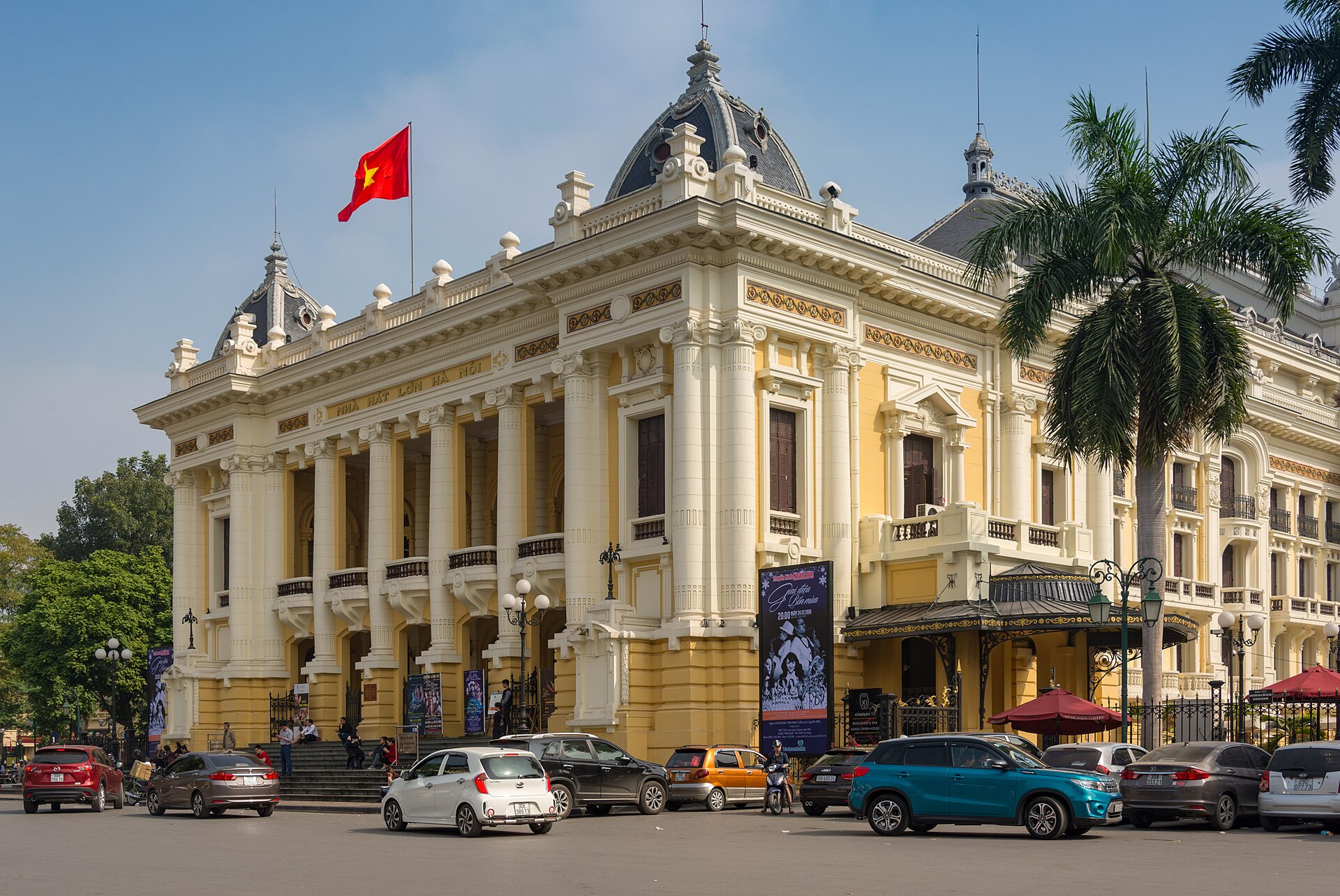
The Hanoi Opera House is the finest colonial building in Vietnam — a Beaux-Arts theatre modelled on the Palais Garnier in Paris, completed in 1911, and designed to bring French high culture to the capital of Indochina. The building's columned facade, mansard roof, and ornate interior — marble staircases, gilded balconies, crystal chandeliers — were intended to make French colonists feel at home and Vietnamese subjects feel awed, and the building achieved both objectives.
The Opera House played a pivotal role in the August Revolution of 1945 — the Việt Minh gathered here on August 19 and marched from the theatre to seize government buildings, ending French colonial rule and establishing the Democratic Republic of Vietnam. The building thus transitioned in a single day from a symbol of colonial culture to a stage for revolutionary history, which is the kind of ironic transformation that Hanoi's architecture specialises in.
The interior was restored in 1997 with French assistance and now hosts Vietnamese and international performances — opera, ballet, traditional Vietnamese music (nhạc cổ truyền), and the water puppet shows (múa rối nước) that are Hanoi's most distinctive performing art. The building sits at the eastern end of Tràng Tiền street, and the broad plaza in front — flanked by the Hilton Hanoi Opera and the luxury boutiques that have colonised the French Quarter — provides the most Parisian streetscape in Southeast Asia.
Verified Facts
The Opera House was completed in 1911, modelled on the Palais Garnier
The Việt Minh gathered here on August 19, 1945 during the August Revolution
The interior was restored in 1997 with French assistance
Water puppetry (múa rối nước) is Hanoi's distinctive performing art
Get walking directions
1 Tràng Tiền, Hoàn Kiếm, Hanoi