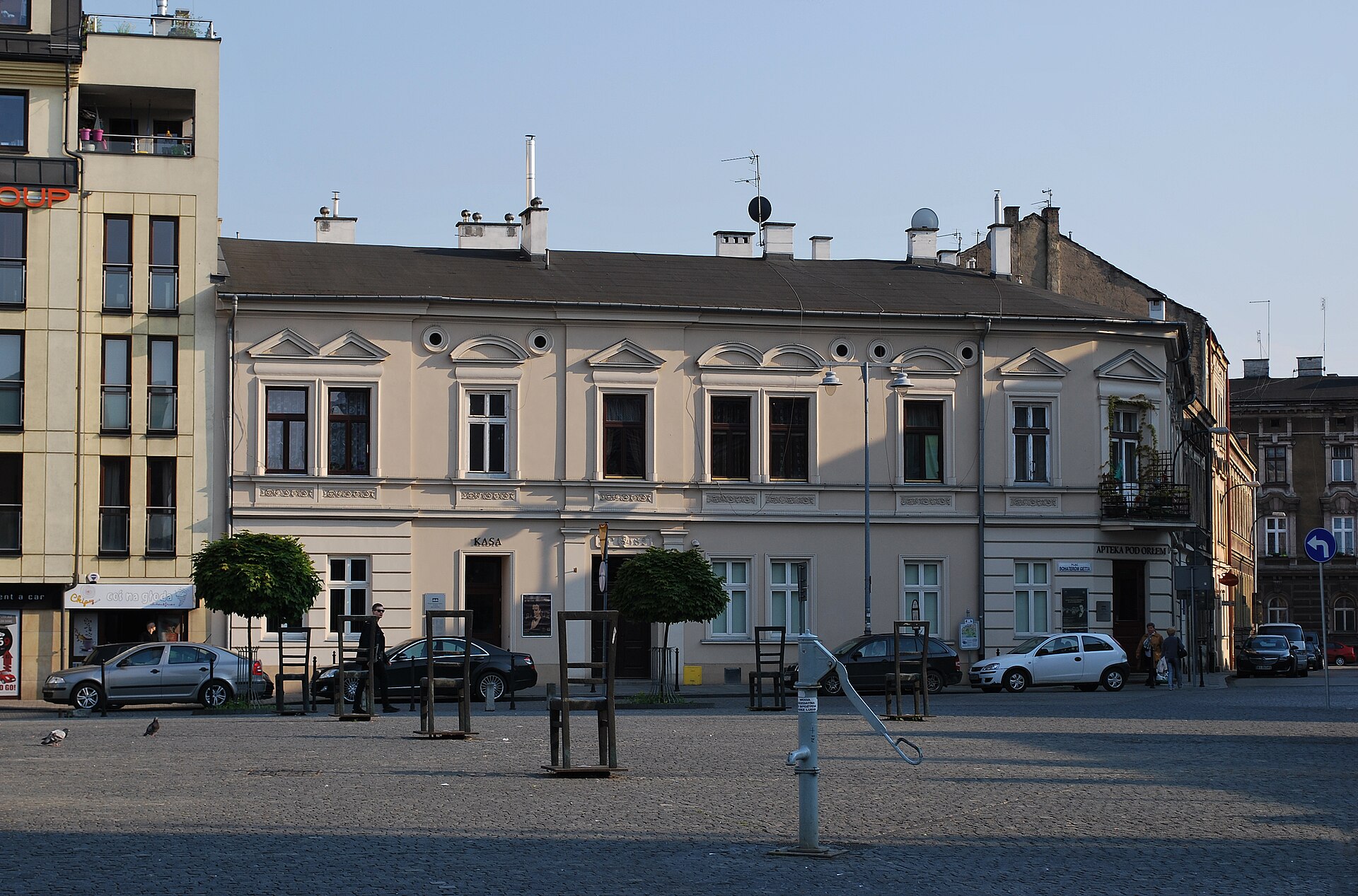
Ghetto Heroes Square is where Kraków confronts its darkest chapter with stark, unforgettable public art. The square, in the Podgórze district south of the river, was the central square of the Jewish ghetto that the Nazis established in March 1941. Today, 70 oversized bronze chairs stand scattered across the empty square — each one representing a thousand of the ghetto's inhabitants. The chairs are vacant. The people are gone.
The memorial, designed by Piotr Lewicki and Kazimierz Łatak and installed in 2005, is devastatingly effective in its simplicity. The chairs face in different directions, some alone, some in groups, all empty. At night they're lit from below, casting long shadows across the square. Children sometimes sit on them, which is encouraged — the memorial is meant to be interacted with, not roped off. The contrast between a playing child and the absence the chair represents is part of the point.
Podgórze itself is worth exploring beyond the memorial. The Pharmacy Under the Eagle, on the corner of the square, is a museum in the building where Tadeusz Pankiewicz — the only non-Jewish Pole permitted to remain in the ghetto — ran his pharmacy as a front for smuggling food, messages, and false documents to ghetto residents. A fragment of the ghetto wall, built in the shape of Jewish tombstones as a deliberate humiliation, survives on Lwowska Street. And Schindler's factory is a 10-minute walk east.
Verified Facts
The ghetto was established by Nazi forces in March 1941
The memorial contains 70 oversized bronze chairs representing the ghetto inhabitants
The memorial was designed by Piotr Lewicki and Kazimierz Łatak, installed in 2005
Tadeusz Pankiewicz was the only non-Jewish pharmacist permitted to remain in the ghetto
A surviving section of the ghetto wall is on Lwowska Street
Get walking directions
Plac Bohaterów Getta, Kraków