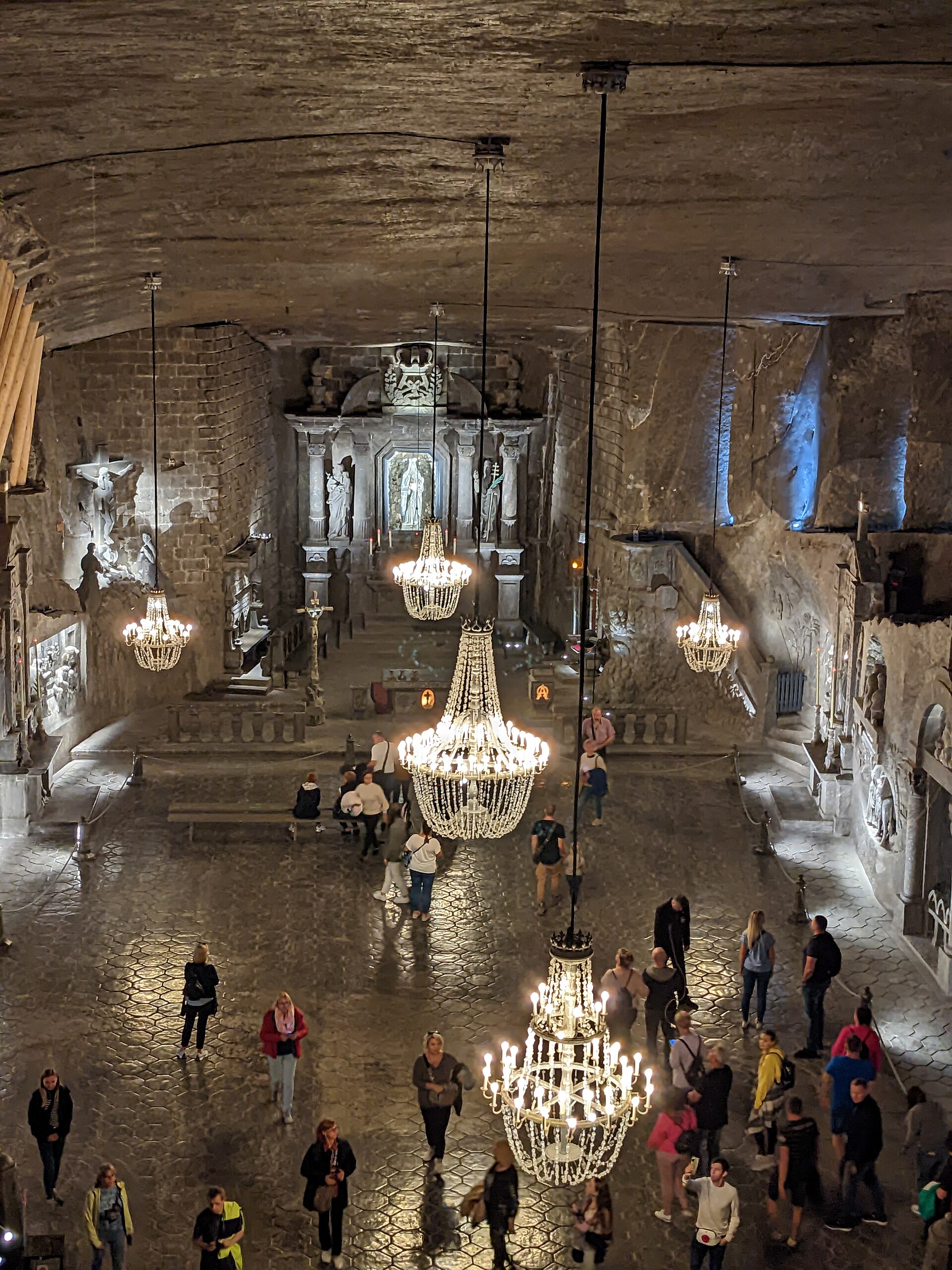
Wieliczka is what happens when miners spend 700 years underground and get bored. This UNESCO World Heritage salt mine, 14 kilometres from Kraków, has been in continuous operation since the 13th century, and over the centuries the miners carved the salt into an underground cathedral, complete with chandeliers, altarpieces, statues, and an entire chapel — all made from rock salt.
The Chapel of St. Kinga, 101 metres below the surface, is the centrepiece. It's the size of a large church, entirely carved from salt — the floor, walls, ceiling, and even the chandeliers (which are made of salt crystals dissolved and reconstituted into translucent forms). The bas-relief scenes on the walls include a salt version of The Last Supper and a salt Nativity scene. Miners carved it over 67 years between 1895 and 1963, working in their spare time as an act of devotion that doubles as the most impressive hobby project in history.
The tourist route covers about 3.5 kilometres over 3 hours, descending 135 metres through chambers connected by wooden staircases and tunnels. The mine extends much further — over 300 kilometres of passages on nine levels — but most of it is off-limits. The temperature underground is a constant 14°C regardless of the season, so bring a layer. The most surreal moment is when the guide turns off the lights in one of the deeper chambers and you experience total darkness — the kind your eyes never adjust to, the kind that miners worked in for centuries with nothing but a candle.
Verified Facts
Wieliczka Salt Mine has been in operation since the 13th century
The Chapel of St. Kinga is located 101 metres underground
The chapel was carved over 67 years between 1895 and 1963
The mine extends over 300 kilometres of passages on nine levels
Wieliczka is a UNESCO World Heritage Site
Get walking directions
Daniłowicza 10, Wieliczka