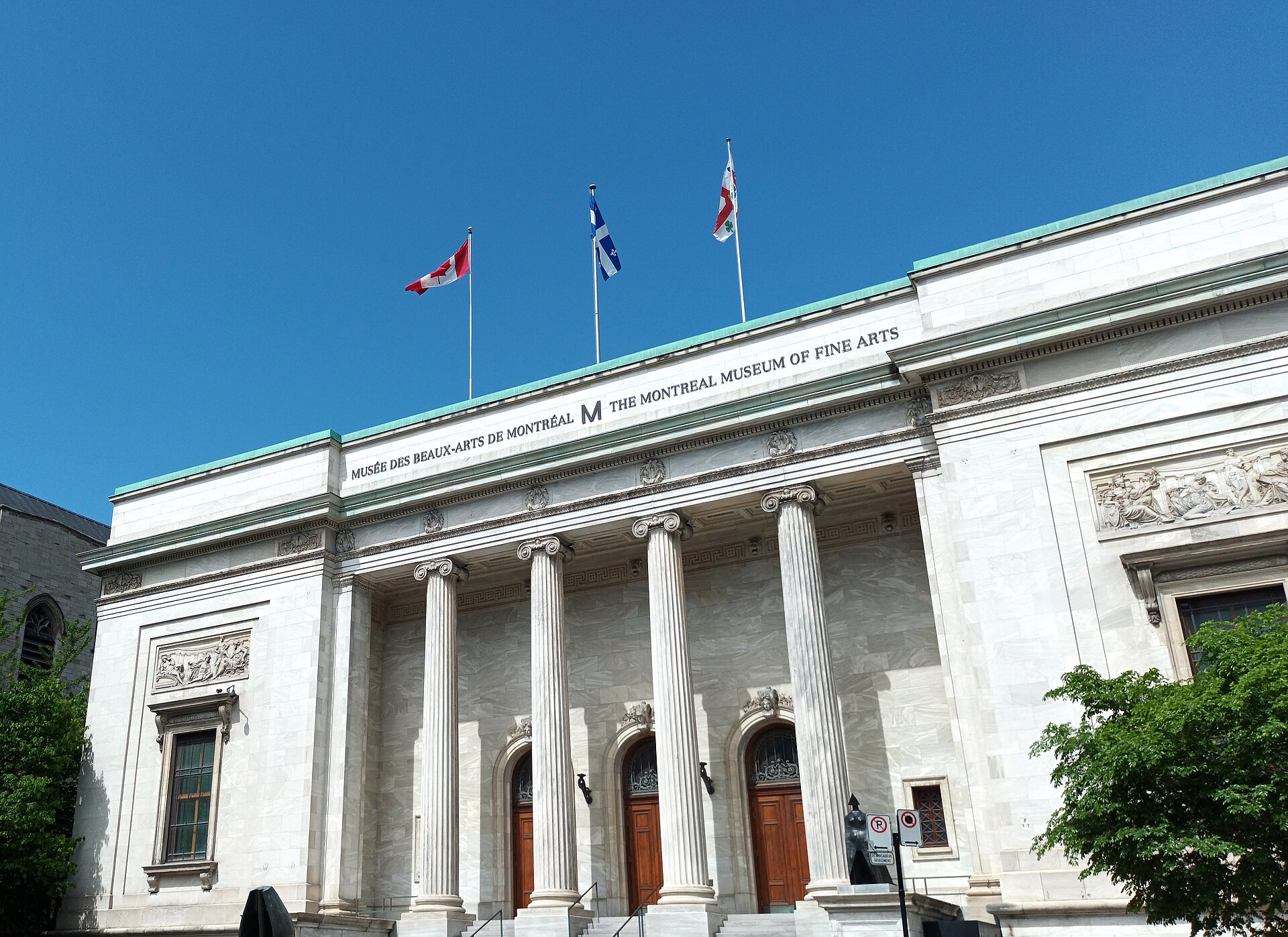
The Montreal Museum of Fine Arts is Canada's most visited art museum and one of the most encyclopaedic collections in North America — 44,000 works spanning five pavilions on both sides of Sherbrooke Street, connected by underground tunnels, covering everything from Old Masters to Inuit art to contemporary installation. The museum's strength is its breadth: it treats Canadian art, international art, and decorative arts as equally important, creating a museum experience that refuses to specialise.
The collection includes works by Rembrandt, Monet, Picasso, and Warhol alongside one of the world's finest collections of Inuit art — stone and bone carvings, prints, and textile works from Arctic communities that represent a unique artistic tradition. The Canadian galleries trace the country's visual culture from colonial portraiture through the Group of Seven's landscape paintings (the defining movement of Canadian art) to contemporary Québécois artists working in video, installation, and photography.
The museum's campus has grown over a century — the original Beaux-Arts pavilion (1912) has been joined by the Jean-Noël Desmarais Pavilion (1991, Moshe Safdie), the Claire and Marc Bourgie Pavilion (a converted church, 2011), and the Michal and Renata Hornstein Pavilion for Peace (2016, Atelier TAG). The expansion across Sherbrooke Street, with visitors crossing between pavilions via underground passages, gives the museum the feel of a cultural district rather than a single building. The permanent collection is free on the first Sunday of every month.
Verified Facts
The museum holds approximately 44,000 works across five pavilions
It is Canada's most visited art museum
The original Beaux-Arts pavilion dates to 1912
The Desmarais Pavilion was designed by Moshe Safdie
Get walking directions
1380 Rue Sherbrooke Ouest, Montreal