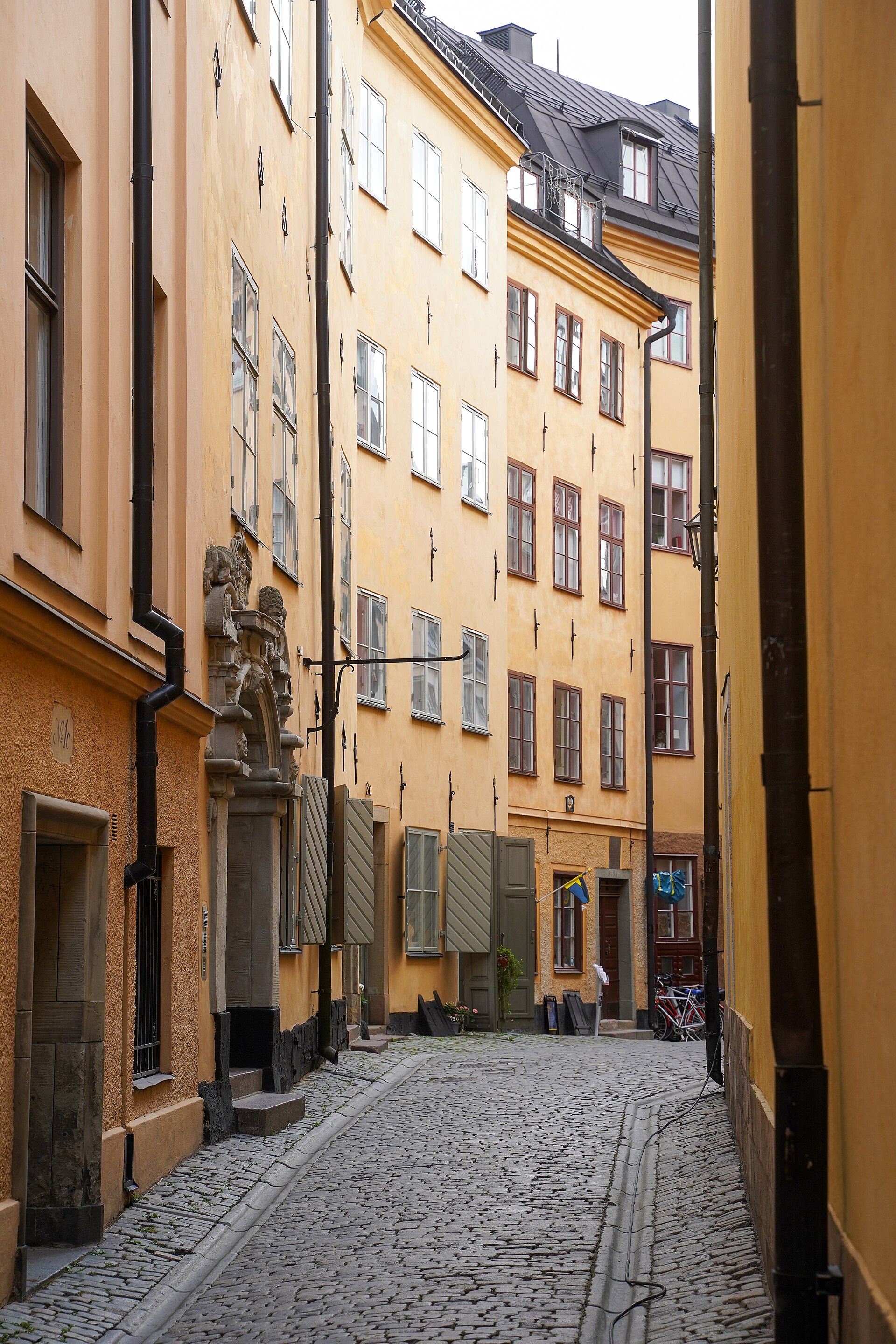
Gamla Stan is one of the best-preserved medieval old towns in Europe — a compact island of narrow cobblestone alleys, ochre and rust-coloured buildings, and the royal palace that has been the political and spiritual centre of Sweden since the 13th century. The district sits on the island of Stadsholmen between the modern city to the north and Södermalm to the south, and walking its streets feels like walking through a scale model of a medieval Scandinavian trading town.
The architecture spans seven centuries — from the 13th-century cathedral (Storkyrkan) and the medieval merchant houses on Österlånggatan through the Baroque Royal Palace (one of the largest in Europe, with 1,430 rooms) to the Nobel Prize Museum on Stortorget, the small square where the Stockholm Bloodbath of 1520 saw Danish king Christian II execute 80 Swedish nobles. The buildings are painted in the warm yellows, oranges, and reds that distinguish Scandinavian old towns from the grey stone of northern European medieval centres.
Gamla Stan is touristy (unavoidably — it's the single most visited area in Stockholm) but rewards exploration beyond the main streets. The alleys south of Stortorget narrow to less than a metre wide (Mårten Trotzigs Gränd, already in the collection, is the narrowest), and the courtyards behind the street facades hide cafés, galleries, and the quiet residential life that persists despite the tourist traffic. The evening, when the day-trippers have left and the cobblestones are lit by the warm glow from restaurant windows, is when Gamla Stan is most atmospheric.
Verified Facts
Gamla Stan sits on the island of Stadsholmen
The Royal Palace has approximately 1,430 rooms
The Stockholm Bloodbath of 1520 saw 80 Swedish nobles executed
Gamla Stan has been continuously inhabited since the 13th century
Get walking directions
Södermalm, Stockholm, Sweden