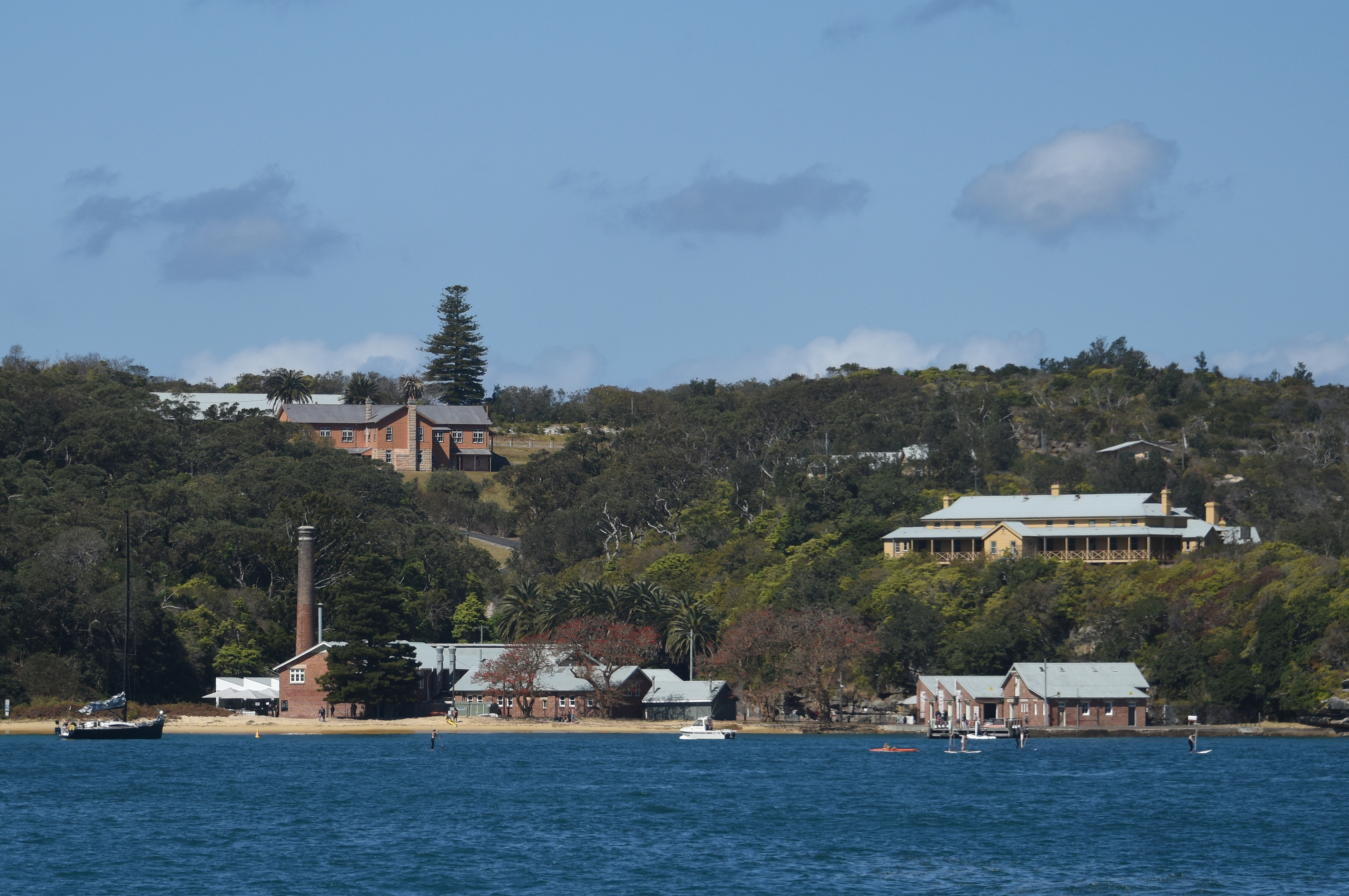
For over one hundred and fifty years, every migrant ship entering Sydney Harbour had to stop at this headland before anyone could set foot on Australian soil. If you had smallpox, bubonic plague, typhus, Spanish flu, or anything else contagious, this is where you stayed. Some of those people never left. Over five hundred people died here.
The station operated from the eighteen-thirties to nineteen eighty-four. Think about that span. It saw the tail end of convict transportation, the gold rush immigration waves, every major pandemic of the nineteenth and twentieth centuries, two world wars, and the post-war migration boom. Every wave of newcomers to Australia passed through the same gates.
Down near the wharf, the sandstone cliffs are covered in over one thousand inscriptions -- names, dates, and ship names carved by quarantined passengers and sailors from the eighteen-hundreds onward. The carvings are in English, Greek, Arabic, Russian, Finnish, and Chinese. Each one was left by someone stuck on this headland, not knowing how long they would be here or whether they would be allowed in. Or whether they would survive.
Here is a detail that says everything about who we are. Quarantined passengers were segregated by the class of berth on their ship. First-class passengers were given comfortable cottages and dined on fine china. Third-class passengers got dormitories and basic rations. Even in quarantine, even when facing the same diseases, the class system held.
The station was repurposed to house Vietnamese refugees in nineteen seventy-five and Cyclone Tracy victims from Darwin in nineteen seventy-six. It finally closed in nineteen eighty-four and is now a hotel where you can sleep in the same buildings where people once waited to find out if they would live or die. The ghost tours are reportedly excellent.
Verified Facts
Operated from the 1830s to 1984; over 500 people died here of various infectious diseases
Over 1,000 inscriptions carved into sandstone cliffs in English, Greek, Arabic, Russian, Finnish, and Chinese
Passengers were segregated by ship berth class, even in quarantine
Repurposed for Vietnamese refugees in 1975 and Cyclone Tracy victims in 1976
Now operates as a hotel (Q Station)
Get walking directions
1 North Head Scenic Dr, Manly, 2095, Australia