Every road distance in Japan is measured from this bridge. Right here, embedded in the pavement, is Japan's road zero marker, placed in nineteen seventy-two. Since sixteen oh four, Nihonbashi has been the official starting point of the five great highways — the Gokaido — that connected Edo to the rest of the country. When a sign somewhere in Japan says 'Tokyo: four hundred kilometres,' this is the point they are measuring from.
The first wooden bridge was completed in sixteen oh three, the same year the Tokugawa shogunate established Edo as Japan's capital. This was the centre of the universe for the most powerful government in Japanese history. Fish markets, merchant houses, and theatres clustered around the bridge. Nihonbashi was where the money was.
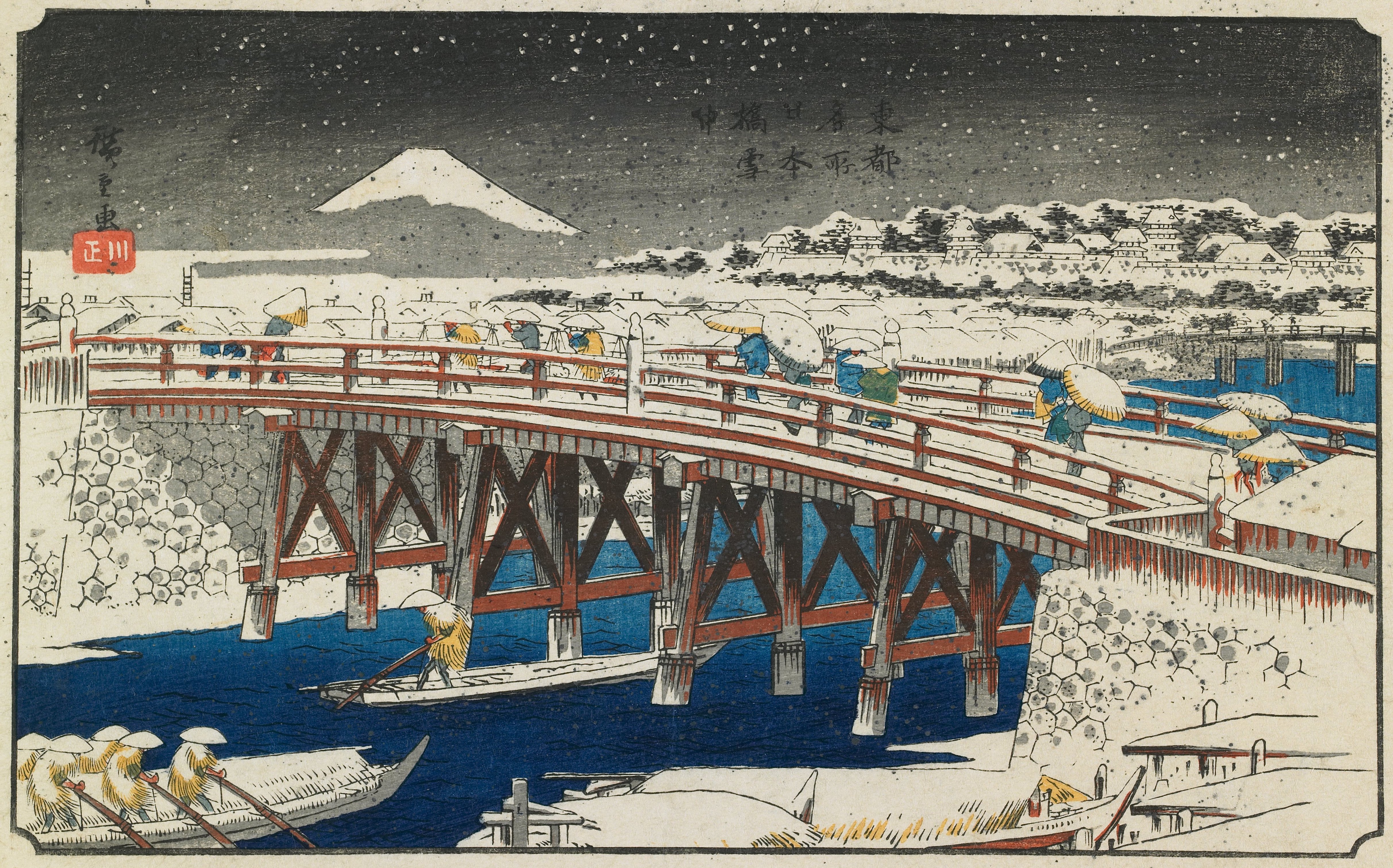
Now look up. That concrete expressway running directly overhead is one of Tokyo's great urban tragedies. Before nineteen sixty-three, you could stand on this bridge and see Mount Fuji. The view was so famous that Hiroshige immortalised it in his woodblock prints. Then, ahead of the nineteen sixty-four Olympics, the government built an elevated highway directly over the bridge, permanently destroying one of Tokyo's most iconic views. They chose efficiency over beauty, and the decision has been controversial ever since.
The current bridge is the stone-and-steel version designed by architect Tsumaki Yorinaka, completed in nineteen eleven. It features ornate bronze dragon pillars and art nouveau lampposts that feel oddly European for central Tokyo. There have been plans for decades to bury the expressway underground and restore the original view of Fuji. Progress has been painfully slow, but the project is supposedly moving forward. Four hundred years of history, buried under a highway. That is modern Tokyo in a nutshell.
Verified Facts
Japan's 'road zero' since 1604, all road distances measured from here
Road origin marker embedded in 1972
Mount Fuji was visible from the bridge until 1963 expressway construction for 1964 Olympics
First wooden bridge completed 1603, same year Tokugawa established Edo as capital
Current stone-on-steel bridge designed by Tsumaki Yorinaka, completed 1911
Get walking directions
Chuo 1-Chōme, Chuo, Nakano, Japan