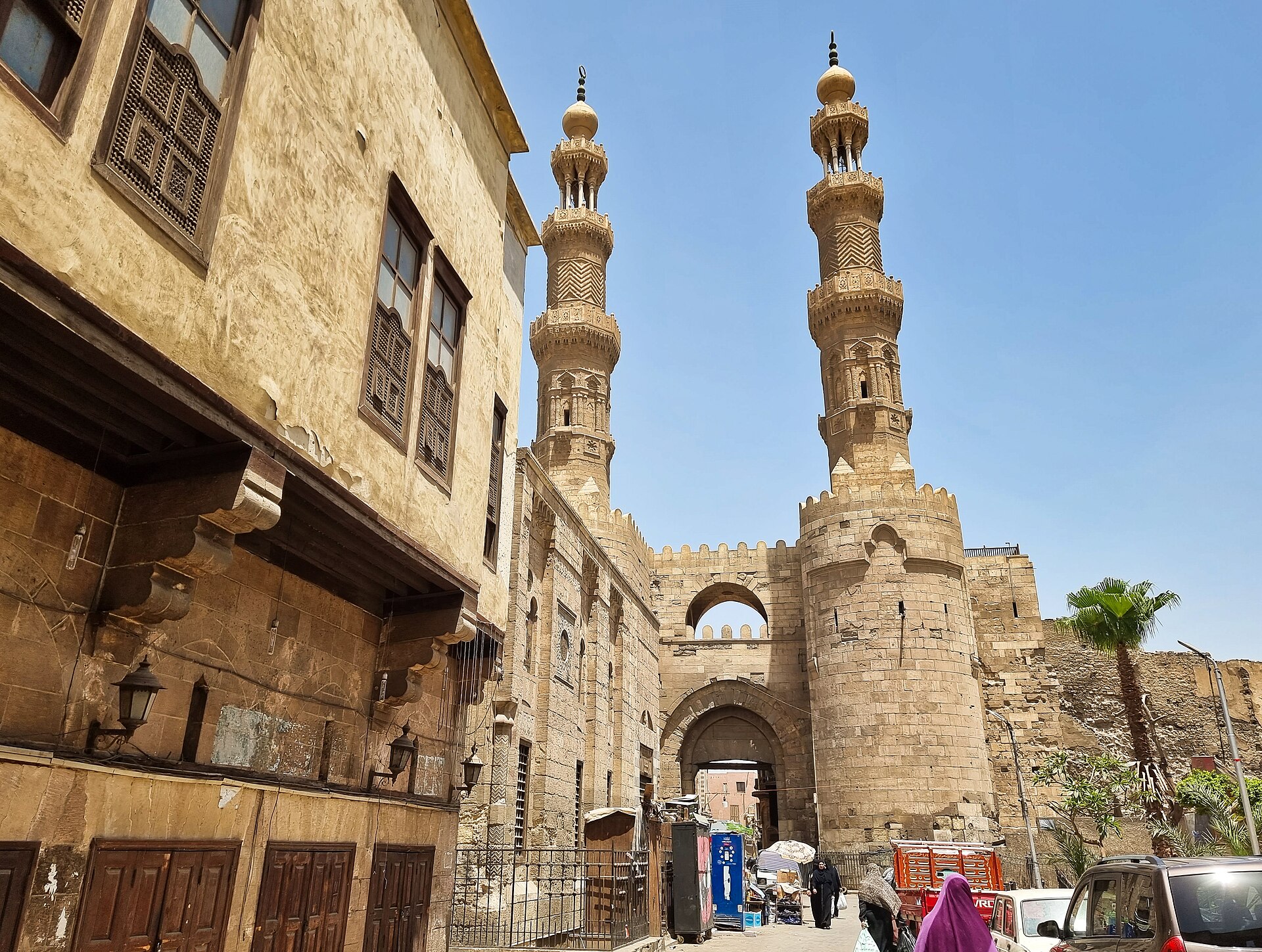
Bab Zuweila is the last surviving gate of the Fatimid city walls — a massive 11th-century stone gateway with twin minarets that marks the southern entrance to Al-Muizz Street and Islamic Cairo's medieval core. The gate was built in 1092 during the Fatimid period and served as the city's southern boundary for centuries, with the minarets added in the 15th century when the Mosque of al-Mu'ayyad was built against the gate's inner walls.
The minarets are climbable (a narrow, spiralling staircase leads to the top of each), and the view from the summit is one of the best in Islamic Cairo — looking north along Al-Muizz Street toward the Fatimid gates of Bab al-Futuh and Bab al-Nasr, with the domes and minarets of a thousand years of Islamic architecture creating a skyline that has barely changed since the Mamluk period. The view south reveals the more modern parts of the city and the contrast between the medieval fabric of Islamic Cairo and the 19th and 20th-century development beyond.
Bab Zuweila was historically the gate where public executions took place — the last Mamluk sultan, Tumanbay II, was hanged from the gate in 1517 after the Ottoman conquest, an event that marked the end of the Mamluk dynasty and the beginning of Ottoman rule in Egypt. The gate's massive proportions (the walls are several metres thick) and the heavy wooden doors (still in place) demonstrate the military architecture that made Fatimid Cairo one of the best-defended cities in the medieval world.
Verified Facts
Bab Zuweila was built in 1092 during the Fatimid period
The minarets were added in the 15th century with the Mosque of al-Mu'ayyad
The last Mamluk sultan was hanged from the gate in 1517
The gate marks the southern entrance to Al-Muizz Street
Get walking directions
Al Moez Ldin Allah Street, Darb Sa'Ada, Cairo, 11639, Egypt