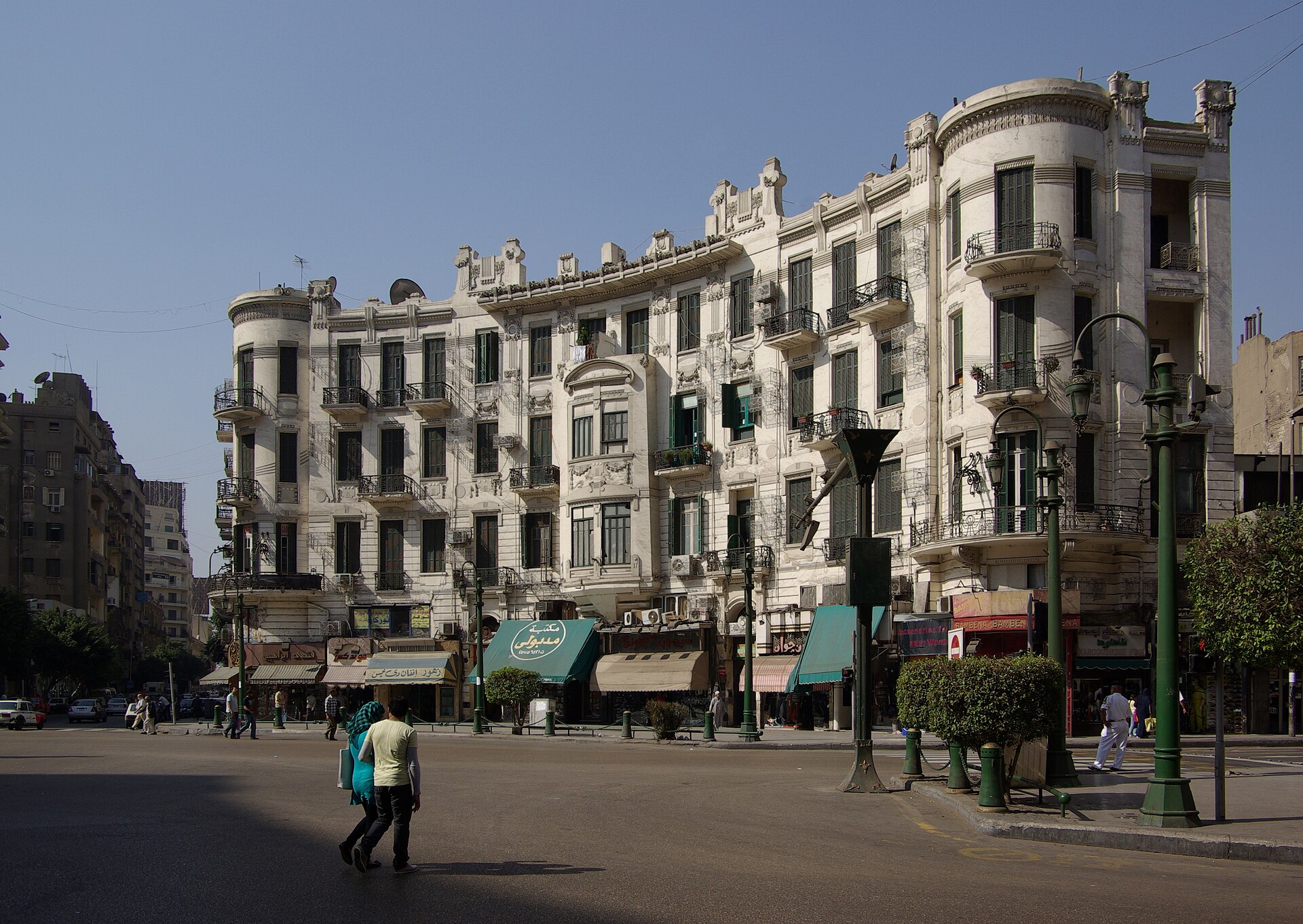
Downtown Cairo is the city's faded European quarter — a grid of Belle Époque, Art Nouveau, and Art Deco buildings designed by European architects in the late 19th and early 20th centuries when Cairo was being rebuilt as a cosmopolitan capital modelled on Paris. The buildings along Talaat Harb Street, Qasr el-Nil, and 26th of July Street were designed to rival European boulevards, and despite decades of pollution, neglect, and the general entropy of a city that has other priorities, the architectural quality remains remarkable.
Talaat Harb Square, the informal centre of downtown, is anchored by the statue of the Egyptian nationalist banker Talaat Harb (who founded the first Egyptian-owned bank) and surrounded by the kind of ornate commercial buildings that would be heritage-listed in any European city but in Cairo are simply the backdrop to daily life. The cafés — particularly Groppi (a legendary Swiss-Egyptian patisserie founded in 1924) and the street-level ahwa (traditional coffee shops) — provide the social infrastructure of a neighbourhood where literary, political, and artistic Cairo has gathered for a century.
Downtown's current state — peeling facades, traffic chaos, and the general atmosphere of a district that was built for a cosmopolitan population that largely left after the 1952 revolution — is either depressing or romantic depending on your tolerance for faded grandeur. The preservation movement is growing, and several buildings have been restored, but the pace of decay continues to outstrip the pace of restoration. Visit now, because downtown Cairo in its current state — magnificent, crumbling, and utterly alive — will not last forever.
Verified Facts
Downtown Cairo was rebuilt in the Belle Époque style in the late 19th century
Groppi patisserie was founded in 1924
Talaat Harb founded Egypt's first Egyptian-owned bank
Many European architects designed the quarter's buildings
Get walking directions
Talaat Harb Street, Al Ismalia, Cairo, 11519, Egypt