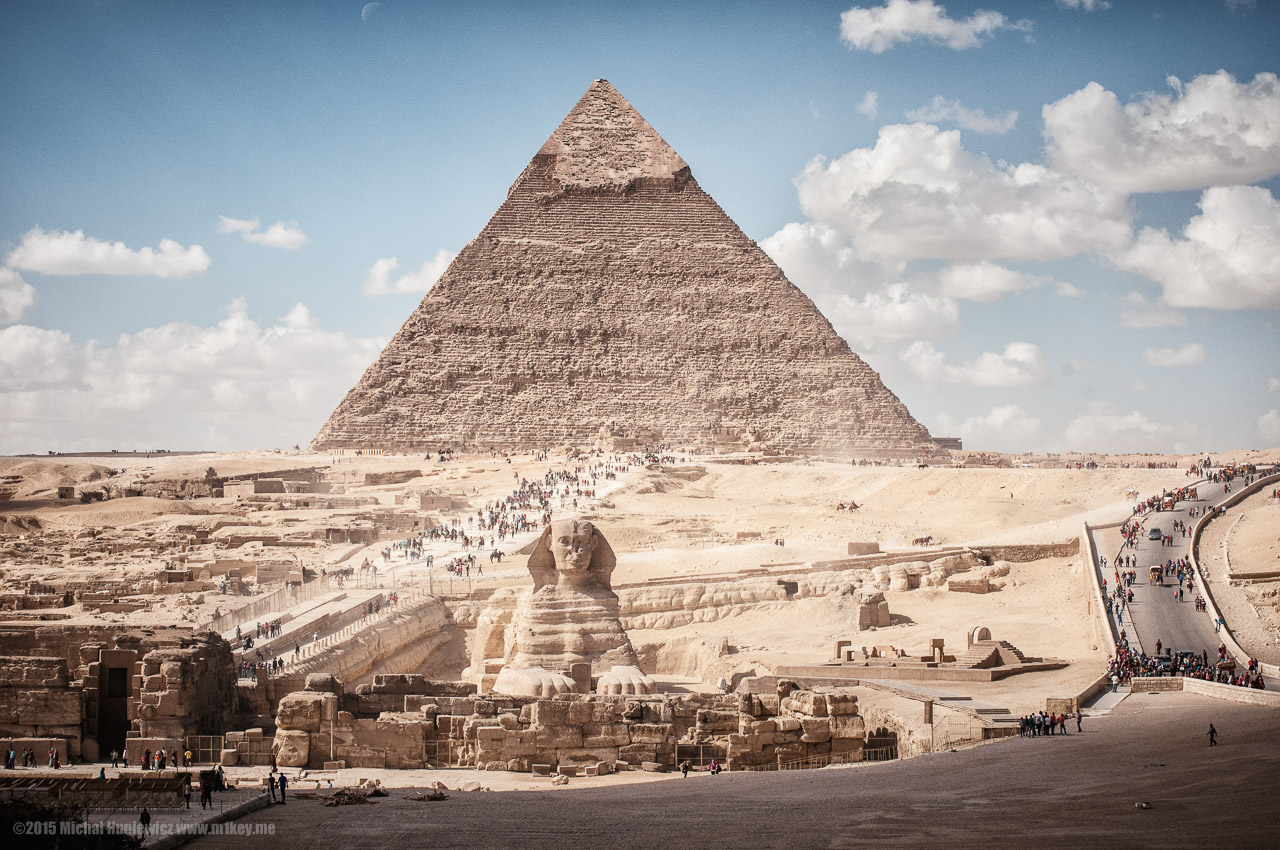
The Pyramids of Giza are the last surviving Wonder of the Ancient World — three monumental tombs built 4,500 years ago for the pharaohs Khufu, Khafre, and Menkaure, standing on a limestone plateau at the edge of the Western Desert with the sprawl of modern Cairo visible in the haze behind them. The Great Pyramid of Khufu, the largest, was the tallest structure on Earth for nearly 4,000 years — 146 metres of 2.3 million limestone blocks, each weighing an average of 2.5 tonnes, assembled with a precision that modern engineers still struggle to fully explain.
The Sphinx, crouching at the base of the Khafre causeway, is carved from a single outcrop of limestone and has been staring east toward the sunrise for 45 centuries. The face — widely believed to represent Pharaoh Khafre, though some scholars disagree — has lost its nose (knocked off by a Sufi zealot in the 14th century, not by Napoleon's soldiers as the myth claims) but retains an expression of serene authority that has made it the most recognisable sculpture in history.
The pyramids are best visited early morning or late afternoon, when the light is warm and the worst of the heat and the tour bus crowds have passed. The interior of the Great Pyramid is accessible (for an additional fee) via a narrow, ascending passage that leads to the King's Chamber — a granite room containing an empty sarcophagus that has been open since the first recorded entry in the 9th century. The Grand Egyptian Museum, opening adjacent to the Giza plateau, will house the largest collection of Egyptian antiquities in the world, including the complete Tutankhamun collection.
Verified Facts
The Great Pyramid was the tallest structure on Earth for nearly 4,000 years
The Great Pyramid contains approximately 2.3 million limestone blocks
The Sphinx's nose was damaged in the 14th century, not by Napoleon
The Grand Egyptian Museum is being built adjacent to the Giza plateau
Get walking directions
Al Ahram Tunnel, First Al Omraneya, Giza, 12551, Egypt