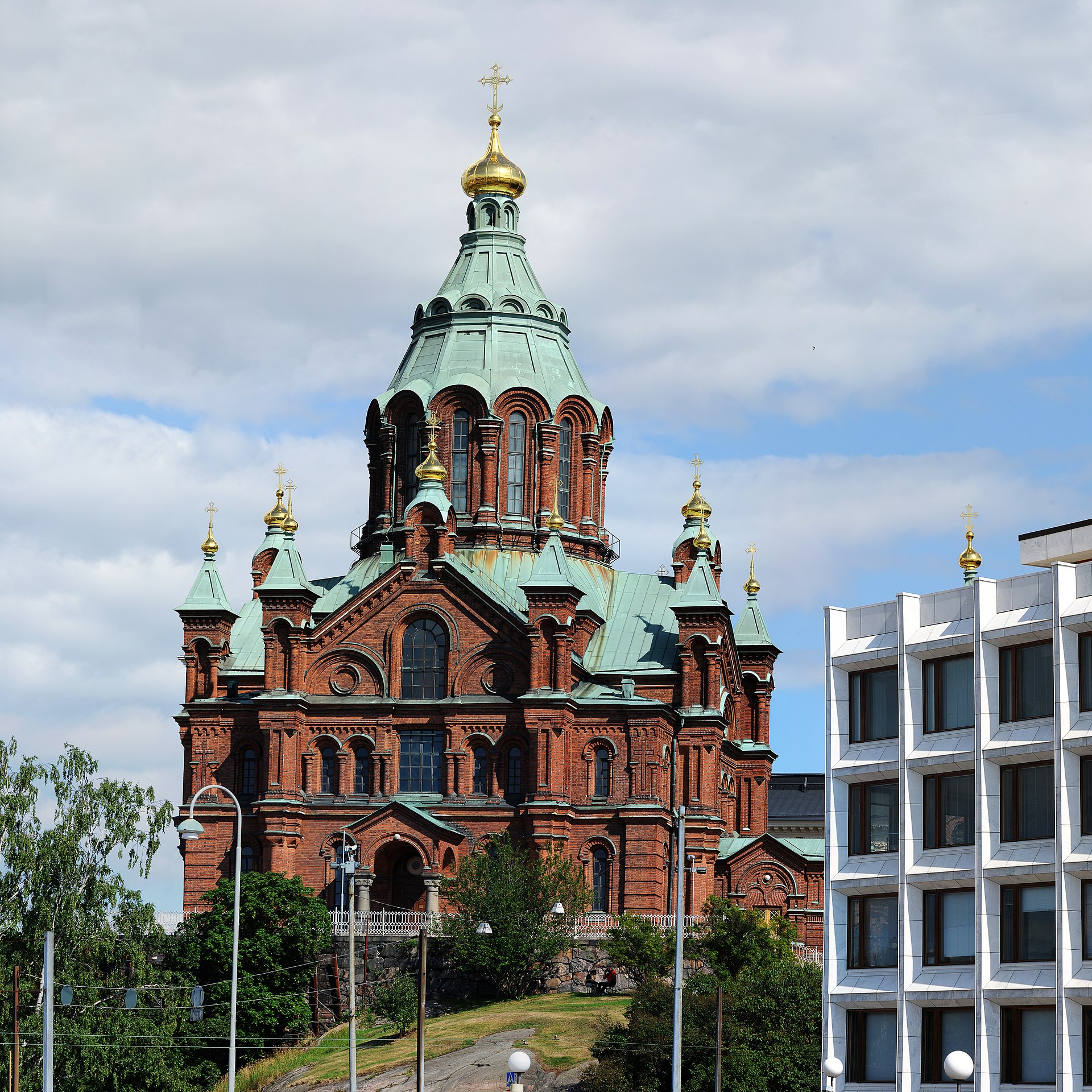
Uspenski Cathedral is the largest Orthodox church in Western Europe — a red-brick Russian Revival structure with golden onion domes that sits on a rocky promontory overlooking the harbour, providing a dramatic counterpoint to the white Lutheran cathedral across the square. The building was designed by Russian architect Aleksei Gornostayev and completed in 1868, during the period when Finland was part of the Russian Empire, and its presence on the Helsinki skyline is a permanent reminder of the eastern cultural influence that distinguishes Finland from its Scandinavian neighbours.
The interior is decorated in the Orthodox tradition — icons covering the walls, an ornate iconostasis (the screen separating the nave from the sanctuary), gilded surfaces, and the smell of incense that fills the space during services. The contrast with the stripped-back Lutheran interior of Helsinki Cathedral is total: where the Lutheran church uses emptiness to create reverence, the Orthodox church uses visual abundance. Both approaches work, and seeing them within the same city provides an education in how architecture expresses theology.
The cathedral sits in the Katajanokka district, a neighbourhood of Art Nouveau apartment buildings that is one of Helsinki's most architecturally rewarding walking areas. The climb to the cathedral terrace provides one of the best harbour views in the city, and the perspective from the top — looking west across the harbour to the Market Square and the Lutheran cathedral — captures Helsinki's position between East and West in a single panorama.
Verified Facts
Uspenski Cathedral is the largest Orthodox church in Western Europe
Completed in 1868, designed by Aleksei Gornostayev
Finland was part of the Russian Empire when the cathedral was built
The cathedral sits in the Katajanokka district
Get walking directions
1 Kanavakatu, Katajanokka, Helsinki, 00160, Finland