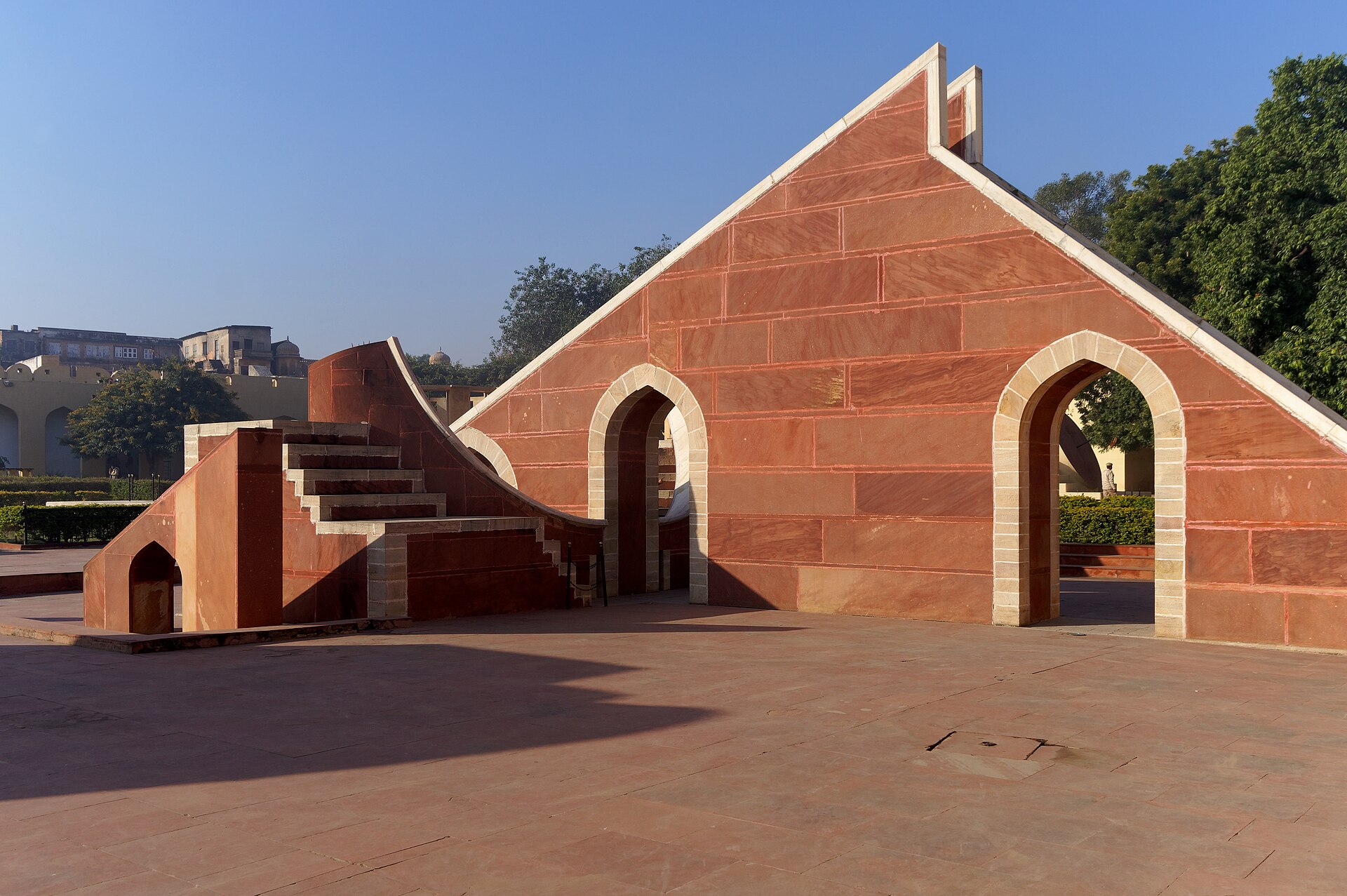
Jantar Mantar is a UNESCO World Heritage astronomical observatory — a collection of 19 stone instruments built between 1727 and 1734 by Maharaja Jai Singh II that are the largest and best-preserved pre-telescopic astronomical observation instruments in the world. The instruments, built from stone and marble at architectural scale, measure time, track celestial bodies, and predict eclipses with a precision that impressed the British astronomers who verified their accuracy in the 19th century.
The Samrat Yantra (Supreme Instrument) is the largest sundial in the world — a 27-metre-high right-angled triangle whose shadow moves at 1mm per second, allowing time to be read to an accuracy of 2 seconds. The Jai Prakash Yantra, a hemispherical bowl inset in the ground with a map of the celestial sphere inscribed on its concave surface, allows an observer to plot the position of any celestial body by standing inside the instrument and reading their own shadow against the markings.
Jai Singh II built five observatories across India (in Jaipur, Delhi, Ujjain, Varanasi, and Mathura), but the Jaipur Jantar Mantar is the largest and best-preserved. The instruments are functional — time can still be read from the sundials, and the astronomical measurements remain accurate — which is the most compelling argument for the sophistication of 18th-century Indian scientific knowledge.
Verified Facts
Jantar Mantar was built between 1727 and 1734 by Jai Singh II
The Samrat Yantra is the world's largest sundial at 27 metres
The observatory is a UNESCO World Heritage Site
Jai Singh II built five observatories across India
Get walking directions
Pink City, Jaipur, 302003, India