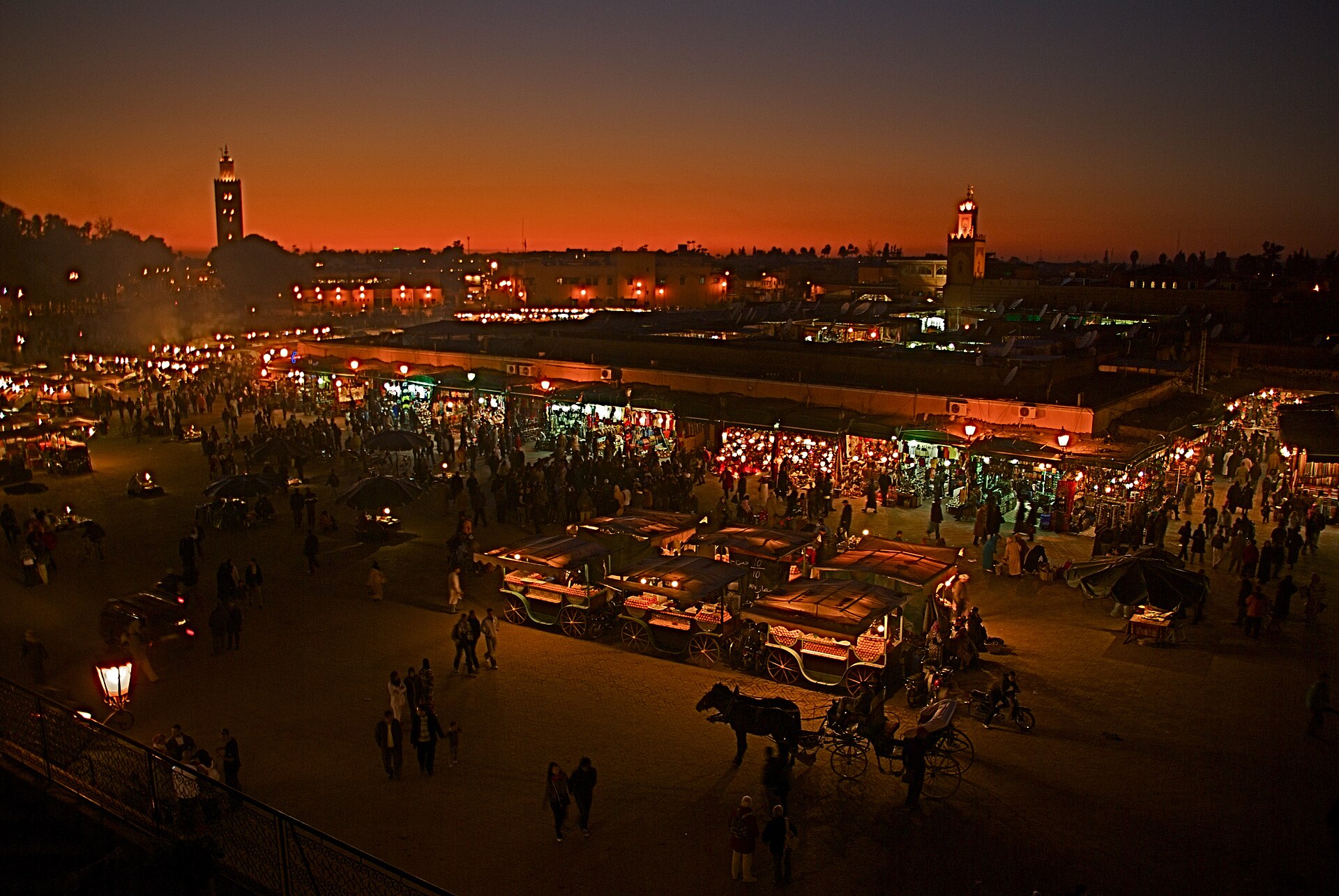
Jemaa el-Fna is the most extraordinary public square in the world — a vast, irregular plaza at the entrance to Marrakech's medina that transforms from a daytime market of orange juice sellers, snake charmers, and henna artists into a nighttime open-air theatre of food stalls, storytellers, musicians, and the general spectacle of a city that has been performing for its own entertainment since the 11th century. UNESCO designated Jemaa el-Fna a Masterpiece of the Oral and Intangible Heritage of Humanity in 2001, recognising it as a living cultural space rather than a fixed monument.
The evening transformation is the main event. As the sun sets, the square fills with over 100 food stalls — each numbered, each specialising in a few dishes — serving grilled meats, snail soup, sheep's head, harira (tomato and lentil soup), fresh bread, and the Moroccan salads (zaalouk, taktouka, carrot and orange) that precede every meal. The smoke from a hundred charcoal grills creates a haze that catches the light from hanging bulbs, and the combined noise of the vendors shouting, the musicians playing, and the crowds negotiating creates an atmosphere that no other square in any city can match.
The square's edges are lined with café terraces — Café de France, Café Glacier — where you can sit above the action and watch the choreography of the square from elevation. The view from the Café de France terrace at sunset, looking across the square to the Koutoubia Mosque's minaret with the Atlas Mountains behind, is one of the most photographed perspectives in Morocco.
Verified Facts
Jemaa el-Fna was designated a UNESCO Masterpiece of Oral and Intangible Heritage in 2001
Over 100 food stalls set up in the square each evening
The square has been a gathering place since the founding of Marrakech in the 11th century
Harira is a traditional Moroccan tomato and lentil soup
Get walking directions
Jemaa el-Fna, Medina, Marrakech