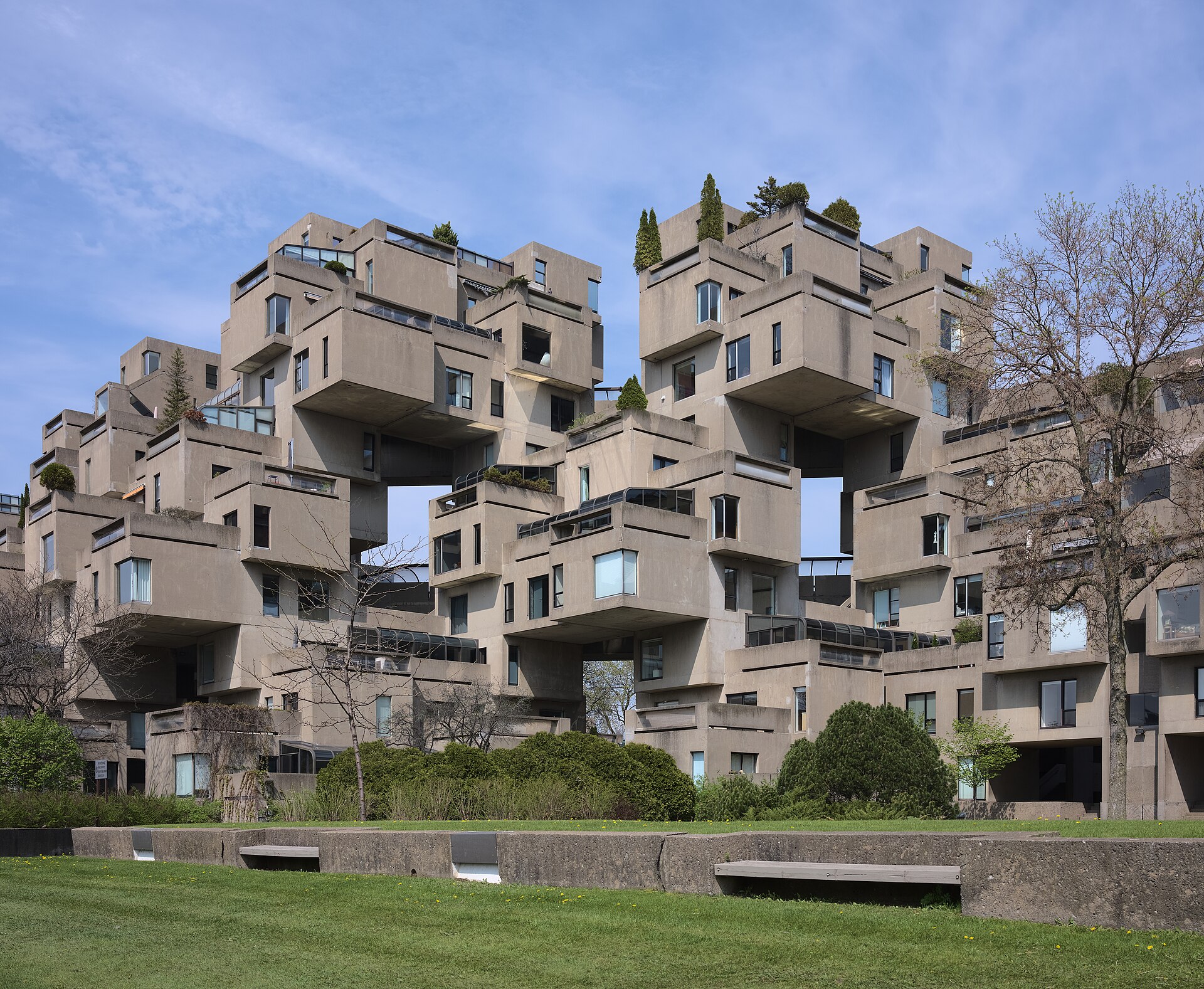
Habitat 67 is one of the most important buildings in 20th-century architecture — a residential complex of 354 identical concrete cubes stacked and interlocked in a seemingly random arrangement that creates 146 apartments, each with its own rooftop garden and views in multiple directions. Designed by Moshe Safdie as his master's thesis project at McGill University and built as a pavilion for Expo 67, it was an attempt to reimagine affordable urban housing, and while it didn't achieve affordability (the apartments are now among the most expensive in Montreal), it proved that high-density living didn't have to mean identical boxes stacked in a tower.
Safdie was 23 when he designed Habitat — an age that makes the building's ambition even more remarkable. Each concrete cube was prefabricated on-site and lifted into position by crane, and the interlocking arrangement ensures that every apartment has outdoor space, natural light from multiple directions, and privacy despite the density. The building sits on a peninsula in the St. Lawrence River, originally the site of Expo 67, and the views from the upper units — across the river to the city skyline — are spectacular.
Habitat 67 is a private residential building and not open for general interior tours (though the Safdie architects' website occasionally offers guided visits). The exterior is fully visible from the surrounding streets and the Old Port, and the best view is from the bike path along the river, where the building's impossible geometry — cubes cantilevered over nothing, gardens hanging in mid-air, the whole structure appearing to defy gravity — is visible in its full surreal glory.
Verified Facts
Habitat 67 was designed by Moshe Safdie for Expo 67
Safdie was 23 years old when he designed the project
The complex contains 354 identical prefabricated concrete cubes forming 146 apartments
It was originally Safdie's master's thesis at McGill University
Get walking directions
2600 Av Pierre-Dupuy, St-Jacques, Montréal, H3C 3R6, Canada