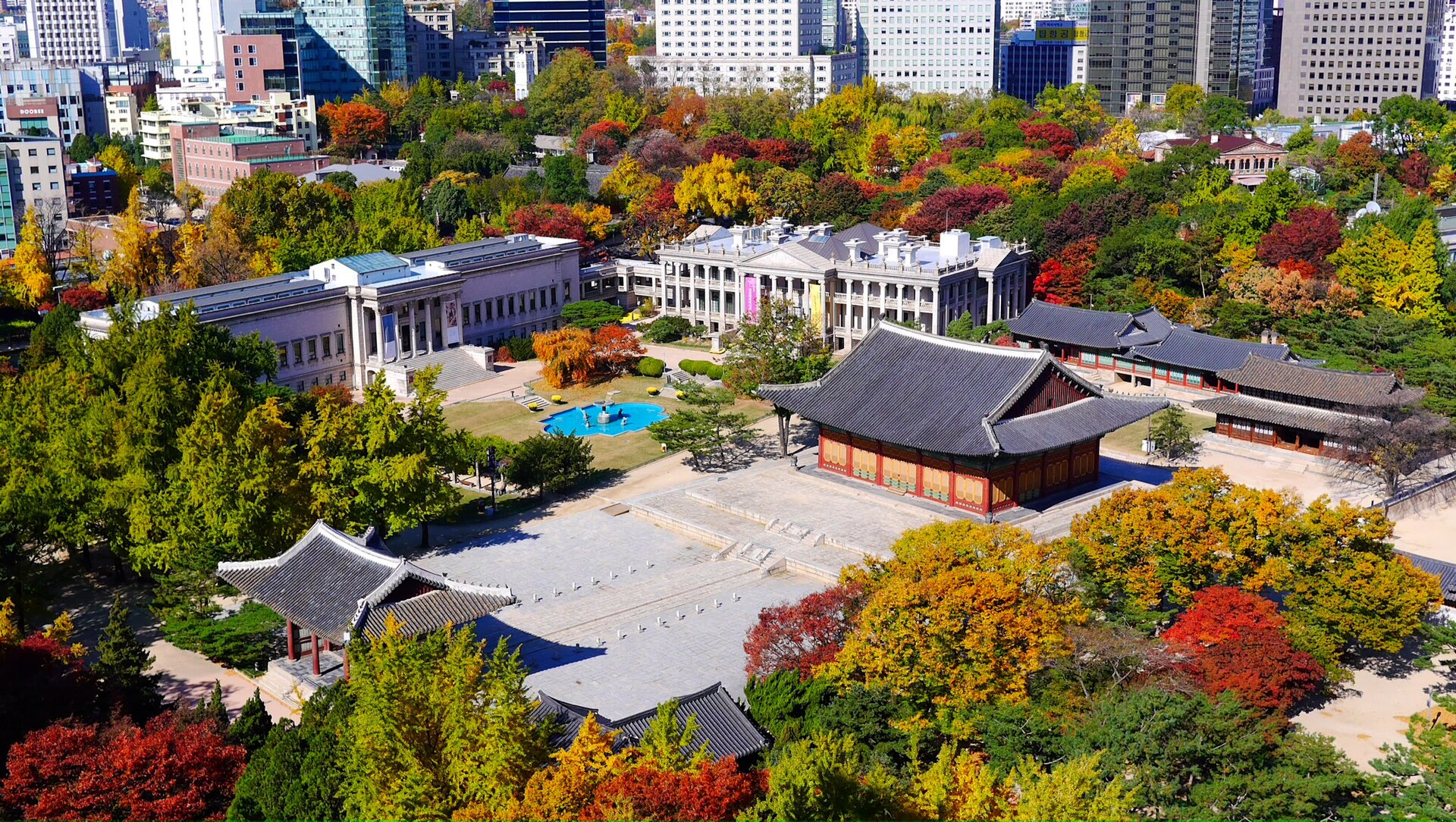
Deoksugung is the most accessible and unusual of Seoul's five palaces — a compact compound in the heart of the business district where traditional Korean palace halls sit alongside Western neoclassical buildings, reflecting the turbulent period in the late 19th and early 20th centuries when Korea was being pulled between Asian tradition and Western modernity.
The Seokjojeon, a three-storey Renaissance-style stone building designed by a British architect and completed in 1910, is the most dramatic example of this hybrid — a European palace building inside a Korean palace compound, built for Emperor Gojong as a modern reception hall. It now houses the Daehan Empire History Museum and is one of the few buildings in Seoul where you can see the architectural collision between East and West in a single structure. The traditional Korean halls — Junghwajeon (the throne hall) and Hamnyeongjeon — sit a few hundred metres away, creating a visual dialogue between two architectural traditions that coexisted uneasily.
The stone wall path (Deoksugung Doldam-gil) that runs along the palace's exterior is one of Seoul's most romantic walks — a tree-lined stone wall path that curves around the palace from City Hall to the Seoul Museum of Art. Korean folklore claims that couples who walk the path together will break up (the path leads to a family court building), but this hasn't stopped it from being perpetually occupied by couples who either don't know the legend or don't believe it. The Changing of the Guard ceremony here, performed in Joseon-era military costume, is smaller and more intimate than Gyeongbokgung's.
Verified Facts
Deoksugung contains both traditional Korean and Western neoclassical buildings
Seokjojeon was designed by a British architect and completed in 1910
The stone wall path (Doldam-gil) is one of Seoul's most popular walking routes
Korean folklore claims couples who walk the path will break up
Get walking directions
Sejong-daero 20-gil, Seoul, South Korea