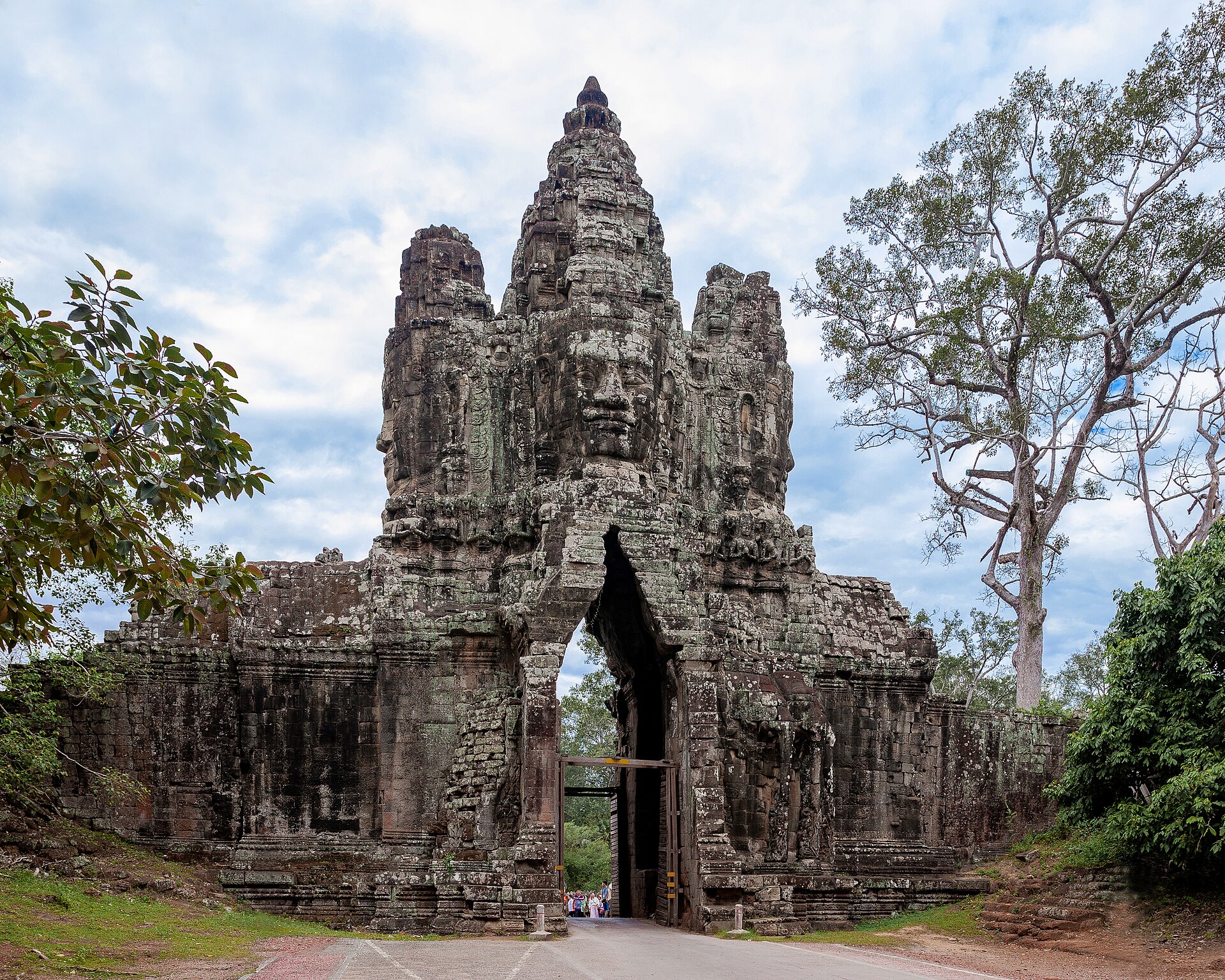
Angkor Thom was the last and most enduring capital of the Khmer Empire — a walled city of 9 square kilometres (larger than most medieval European cities) enclosed by an 8-metre-high wall and a moat, entered through five monumental gates, each flanked by rows of stone gods and demons pulling a giant naga (serpent) in a representation of the Hindu creation myth, the Churning of the Ocean of Milk.
The South Gate is the most visited and most dramatic — a tower carved with four faces (the same smiling Jayavarman VII/Avalokiteshvara faces as Bayon), flanked by 54 devas (gods) on the left and 54 asuras (demons) on the right, each team pulling the body of a seven-headed naga in a tug-of-war that represents the churning of the primordial ocean to produce the elixir of immortality. Driving or cycling through the gate — past the stone armies frozen in their eternal struggle — is one of the most extraordinary entrance experiences in architecture.
Within the walls, Angkor Thom contains the Bayon, the Baphuon (a massive 11th-century temple-mountain recently restored), the Terrace of the Elephants (a 300-metre-long platform carved with life-sized elephants), the Terrace of the Leper King (with its extraordinarily detailed carved walls), and the ruins of the royal palace — a city's worth of monuments that could fill a full day of exploration.
Verified Facts
Angkor Thom covers 9 square kilometres within its walls
The walls are 8 metres high with a surrounding moat
Each gate is flanked by 54 devas and 54 asuras
The Terrace of the Elephants is 300 metres long
Get walking directions
Angkor Archaeological Park, Siem Reap