
Walking Tours in Naples
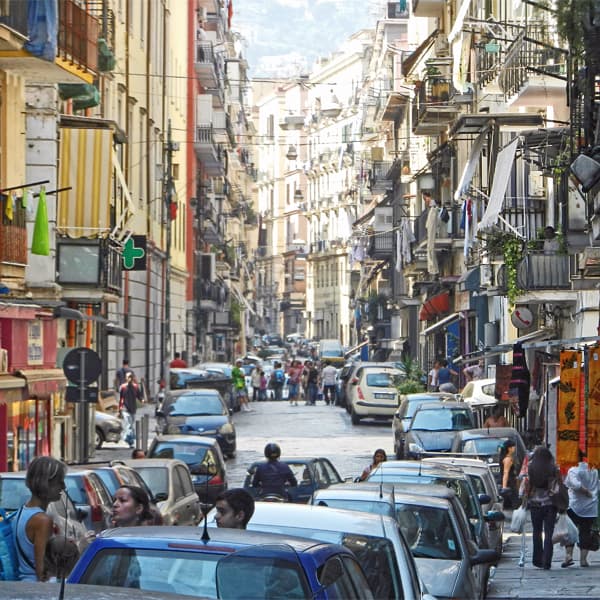
Naples City Walk
A 23-stop walking tour through the heart of Italy. Visit Naples City Walk, Galleria Principe di Napoli , Via Bellini, Teatro Bellini, Piazza Bellini, and Piazza Bellini — with narrated stories at every stop.
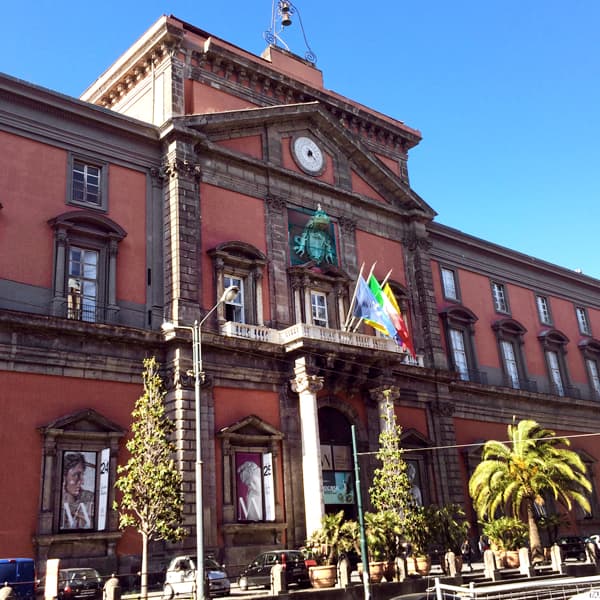
Naples' Archaeological Museum
A guided tour of Naples' Archaeological Museum in Italy with 14 stops. Highlights include Naples' Archaeological Museum , Roman Portrait Busts , and Farnese Collection.
30 Landmarks in Naples
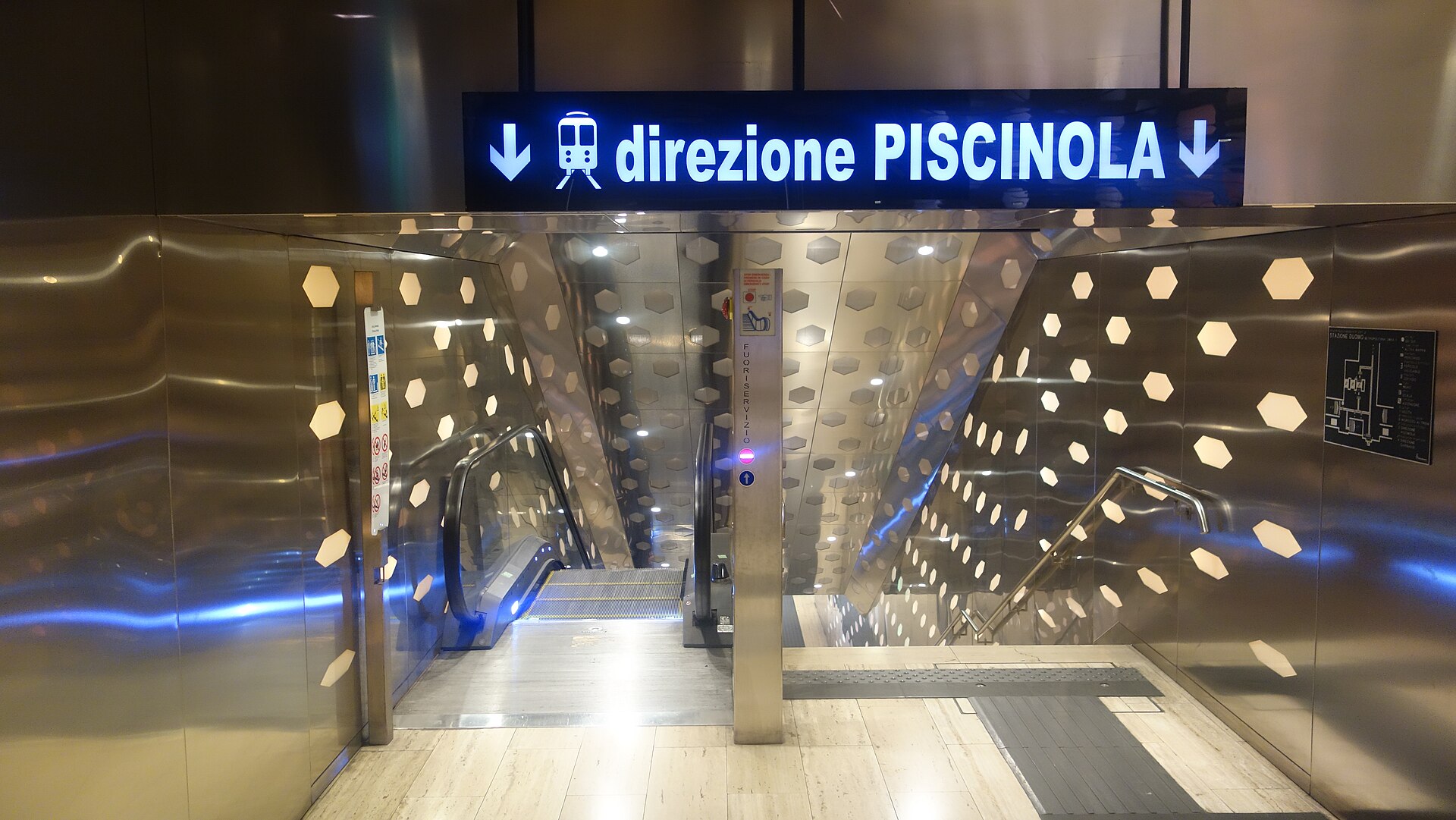
Art Metro Stations
Via Toledo, Municipalità 2, Naples, 80134, Italy
Naples turned its subway system into one of the most ambitious public art projects in Europe, and barely anyone outside Italy knows about it. Starting in the 1990s, the city commissioned internationally renowned architects and artists to design metro stations as immersive art environments rather than functional tunnels. The result is a network of underground galleries that you can visit for the price of a transit ticket — currently about 1.20 euros. The crown jewel is Toledo station, designed by Spanish architect Oscar Tusquets Blanca and opened in 2012. Descending 50 meters below Via Toledo, the station transitions from warm amber light at street level through a crater-like geological zone into a deep blue mosaic sea at the platform level. The effect is like diving underwater: thousands of blue and white tiles create the sensation of being submerged in the Mediterranean. CNN named it the most impressive station in Europe, and it regularly appears on lists of the world's most beautiful metro stations. Università station, designed by Egyptian-born architect Karim Rashid, takes the opposite approach — hot pinks, acid greens, and undulating digital-age forms that look like the inside of a computer designed by someone who really likes candy. It's as divisive as it is bold. Other notable stations include Materdei (designed by Sol LeWitt, who covered the walls in geometric patterns before his death) and Salvator Rosa, which incorporates fragments of a 15th-century city gate into the station architecture. The metro art project now includes over 200 installations by artists from around the world. It's free to look at, functional transportation, and proof that Naples — a city often dismissed as chaotic — is capable of visionary urban planning when it decides to be.
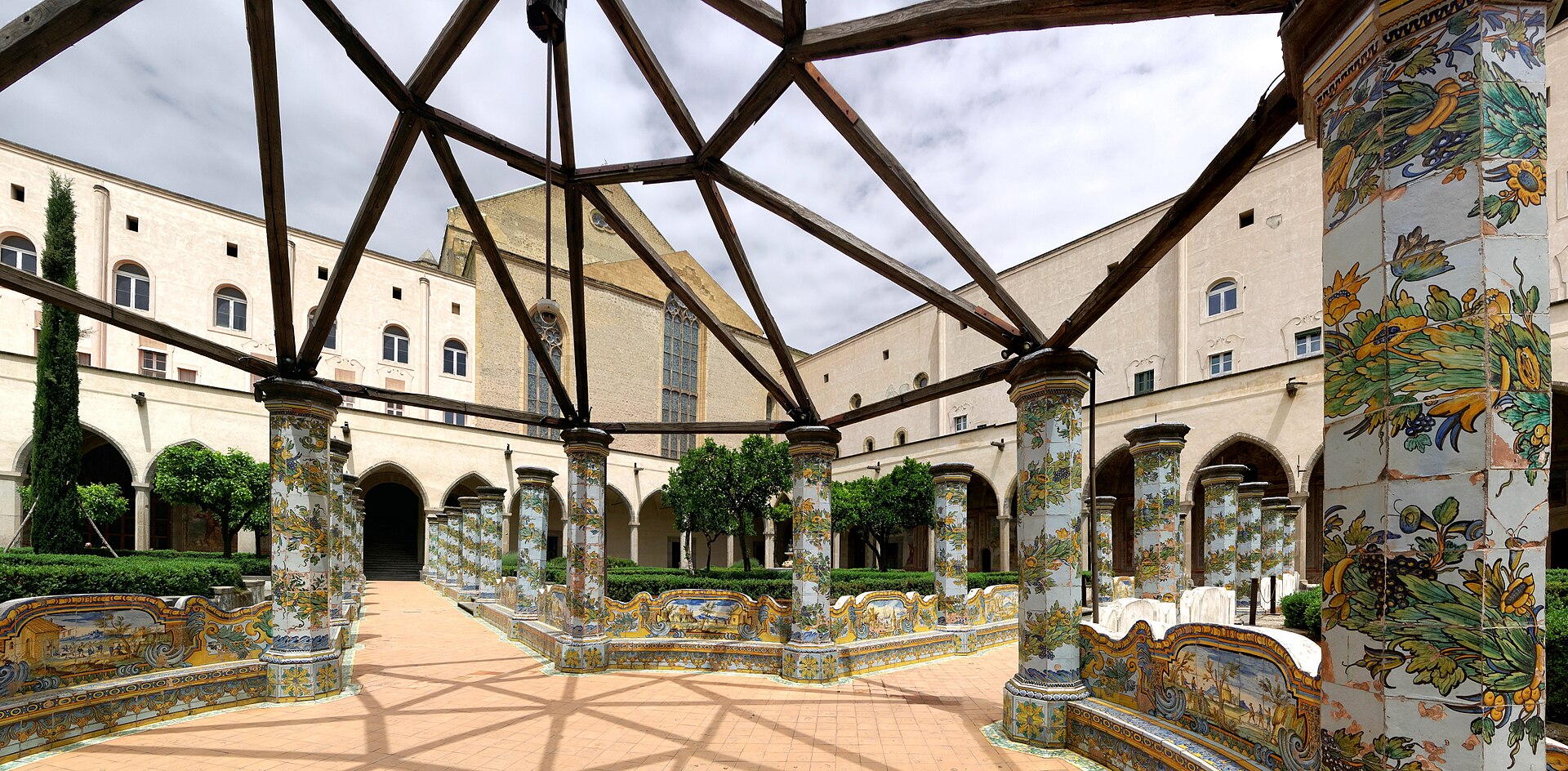
Basilica of Santa Chiara
49C Via Santa Chiara, Municipalità 2, Naples, 80134, Italy
The majolica-tiled cloister behind this church is one of the most photographed spots in Naples, and it's also one of the most improbable. Designed by Domenico Antonio Vaccaro in 1742, the cloister transformed a sober Gothic monastery garden into an explosion of hand-painted ceramic tiles depicting pastoral scenes, mythological vignettes, and floral motifs in vivid yellow, green, and blue. Majolica-covered columns and benches wind through the garden between citrus trees and trailing vines. It looks like someone made a monastery out of Mediterranean pottery. The basilica itself has a grimmer history. Robert of Anjou built it between 1310 and 1340 as the largest church in Naples, intended as the royal church and mausoleum of the Angevin dynasty. The original Gothic interior was lavish, but in the 18th century, Baroque architects covered everything in ornate decoration. Then, on August 4, 1943, Allied incendiary bombs struck the church, and the resulting fire burned for two days, destroying the Baroque additions and most of the medieval frescoes. What survived was a skeleton. The postwar reconstruction stripped the church back to its original Gothic bones, creating the austere, spacious interior you see today. Some medieval tombs survived the fire, including the elaborate monument to Robert of Anjou behind the main altar — one of the largest royal funerary monuments in medieval Italy. The king is shown enthroned among saints and angels, still presiding over the church he built, seven centuries after his death. The cloister tiles, miraculously, survived the bombing largely intact. Walk through them slowly — each panel tells a different story, and the cumulative effect, surrounded by the scent of lemon trees, is one of the most peaceful moments Naples can offer.
Bourbon Tunnel (Tunnel Borbonico)
4 Vico del Grottone, Municipalità 1, Naples, 80132, Italy
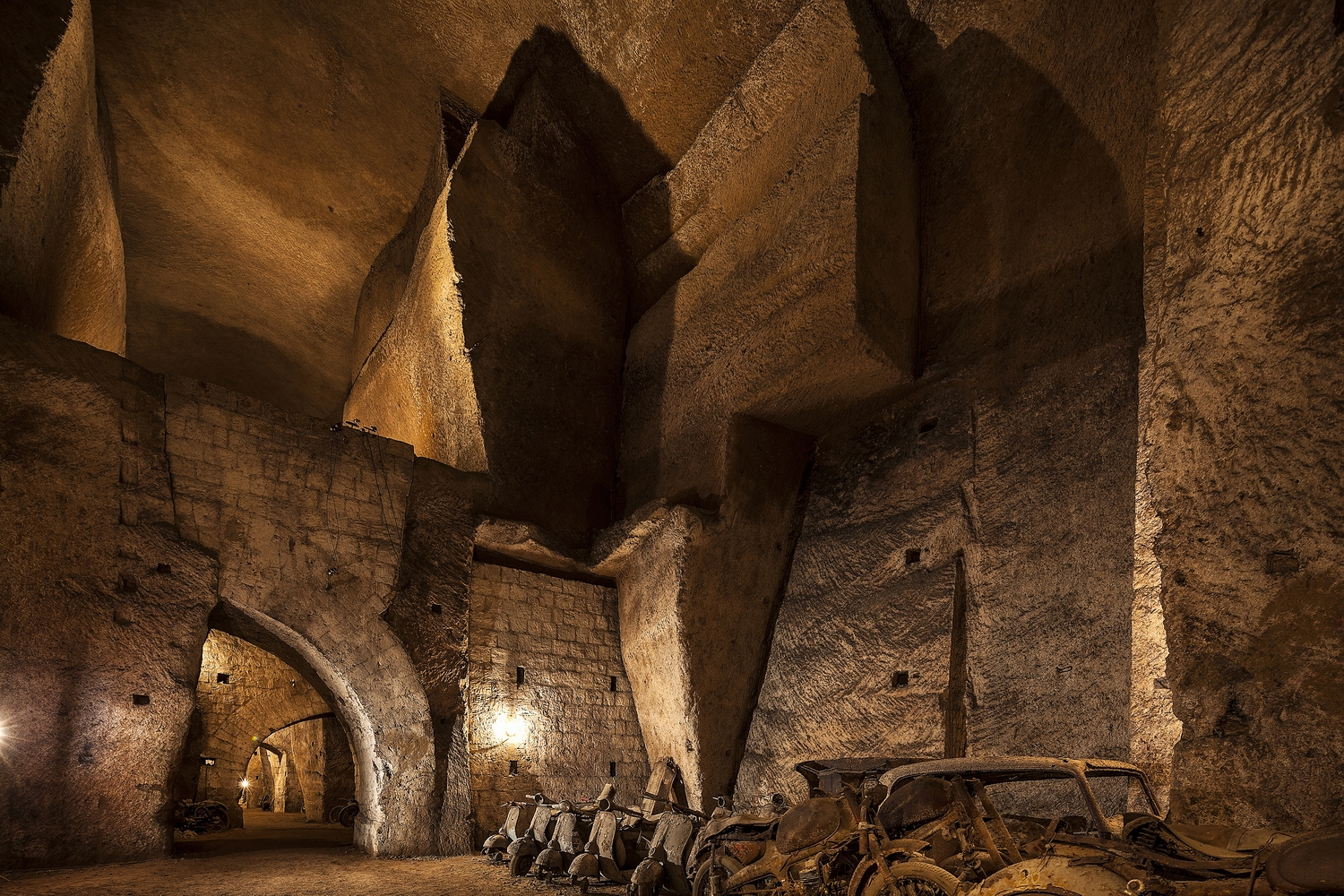
King Ferdinand II was paranoid, and for good reason. The 1848 revolution had nearly toppled the Bourbon monarchy, and he wanted an escape route — a secret tunnel connecting the Royal Palace to the military barracks near the waterfront, so the royal family could flee if the mob came again. He commissioned the tunnel in 1853, carving through 40 meters of tuff rock beneath the Pizzofalcone hill. The tunnel was never completed. Ferdinand died in 1859, the Bourbons fell in 1860, and the half-finished escape route was abandoned. But the abandoned tunnel connected to something much older: a vast network of 16th-century cisterns and aqueducts that had supplied water to the city for centuries. During World War II, this entire underground complex became an air-raid shelter for thousands of Neapolitans. The scale of what's down here is startling — cavernous cisterns where families lived for days, narrow passages connecting to the ancient Roman aqueduct, and a bizarre collection of vehicles discovered during modern excavation: 1940s cars, motorcycles, and even a Fiat 508 that were dumped underground after the war and sealed away for decades. The adventure tour route takes you on a raft across an underground cistern, paddling through dark water in a space last used by Roman engineers two millennia ago. The standard tour is less extreme but no less atmospheric, threading through dimly lit tunnels where wartime graffiti shares wall space with 17th-century stonework. The whole experience is a perfect metaphor for Naples itself: a project started for one purpose, abandoned, repurposed in a crisis, forgotten, rediscovered, and turned into something nobody originally imagined. Nothing in this city ever serves just one function.
Cappella Sansevero
19 Via Francesco De Sanctis, Municipalità 2, Naples, 80134, Italy
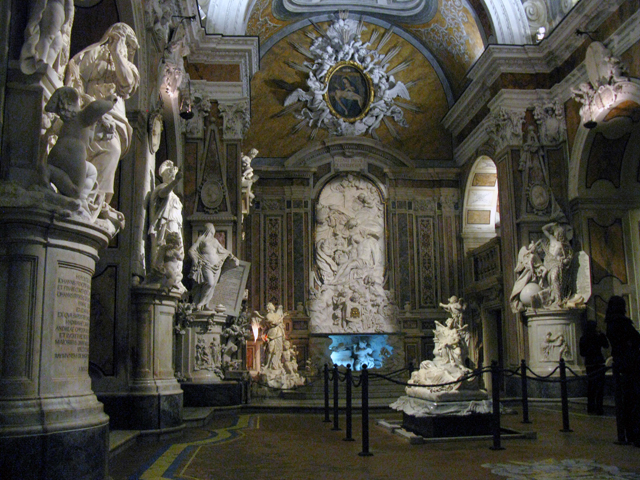
There is a marble sculpture in this chapel that has made grown adults weep. The Veiled Christ, carved by Giuseppe Sanmartino in 1753, depicts the dead body of Jesus covered by a transparent veil — except the veil isn't real. It's marble. Every fold, every wrinkle, every place where the fabric clings to skin is carved from a single block of stone, and it is so impossibly lifelike that for centuries people refused to believe it was sculpture. They insisted the chapel's patron, Prince Raimondo di Sangro, had used alchemy to petrify a real cloth veil draped over marble. Di Sangro was the kind of 18th-century aristocrat who made everyone nervous. A Freemason Grand Master, inventor, alchemist, and the prince of one of Naples' oldest families, he turned the family chapel into something between a church and a science experiment. The Anatomical Machines in the basement — two skeletons with their entire circulatory systems preserved in what appears to be metallic wire — are still not fully explained. Di Sangro claimed he injected a special substance into the veins of two servants (consensually, he insisted), and the results have baffled scientists for 250 years. Every sculpture in the chapel tells a story. Antonio Corradini's Modesty shows a woman draped in a marble veil so fine you can see the inscription on the tablet she holds. Francesco Queirolo's Disillusion depicts a man struggling free from a marble net carved from a single block — a feat considered so technically impossible that Queirolo was reportedly told by other sculptors it couldn't be done. The chapel is small and gets crushingly crowded. Go early, stand in front of the Veiled Christ, and look at the face. You'll forget it's stone.
Castel dell'Ovo
3 Via Eldorado, Municipalità 1, Naples, 80132, Italy
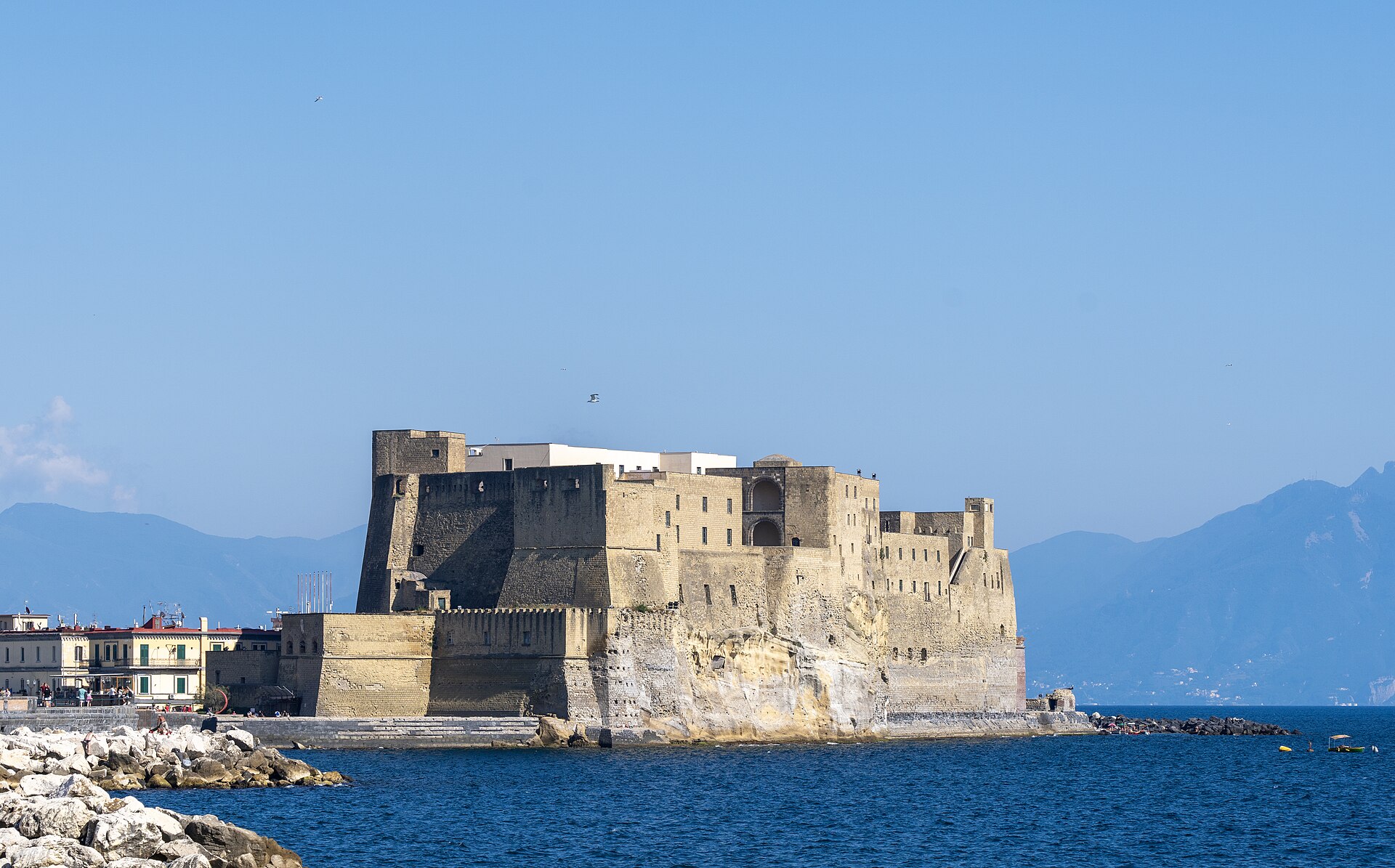
Naples' oldest castle is built on a legend involving a magic egg, a Roman poet, and the potential destruction of an entire city. According to medieval lore, the poet Virgil — who in Neapolitan tradition was not just a writer but a powerful sorcerer — hid a magical egg in the foundations of the fortress. As long as the egg remains intact, Naples stands. If it breaks, the city falls. The castle is called Castel dell'Ovo — Castle of the Egg — and to this day, nobody has gone looking for it. Just in case. The real history is nearly as dramatic. The rocky islet of Megaride where the castle sits was the original landing point of Greek colonists from Cumae around the 7th century BC — this is literally where Naples began. In the 1st century BC, the Roman general Lucullus built a spectacular villa here, famous for its gardens and its fish ponds. The villa was later fortified, and over the centuries the site has been a monastery, a royal residence, a treasury, and a prison. The last Norman king of Naples, Conradin, was held here before his execution in 1268. The current structure dates mostly to Aragonese renovations in the 15th century, though the bones of much older buildings are visible everywhere. The castle ramparts offer one of the most spectacular free views in Naples — Vesuvius across the bay, Capri on the horizon, the entire curve of the lungomare stretching away to the west. Below the castle walls, the tiny harbor of Borgo Marinari is lined with seafood restaurants where you can eat grilled octopus while staring at the same water the Greeks sailed into 2,700 years ago. Entry to the castle itself is free, which in Naples is practically a miracle.
Castel Nuovo (Maschio Angioino)
Via Vittorio Emanuele Terzo, Municipalità 1, Naples, 80133, Italy
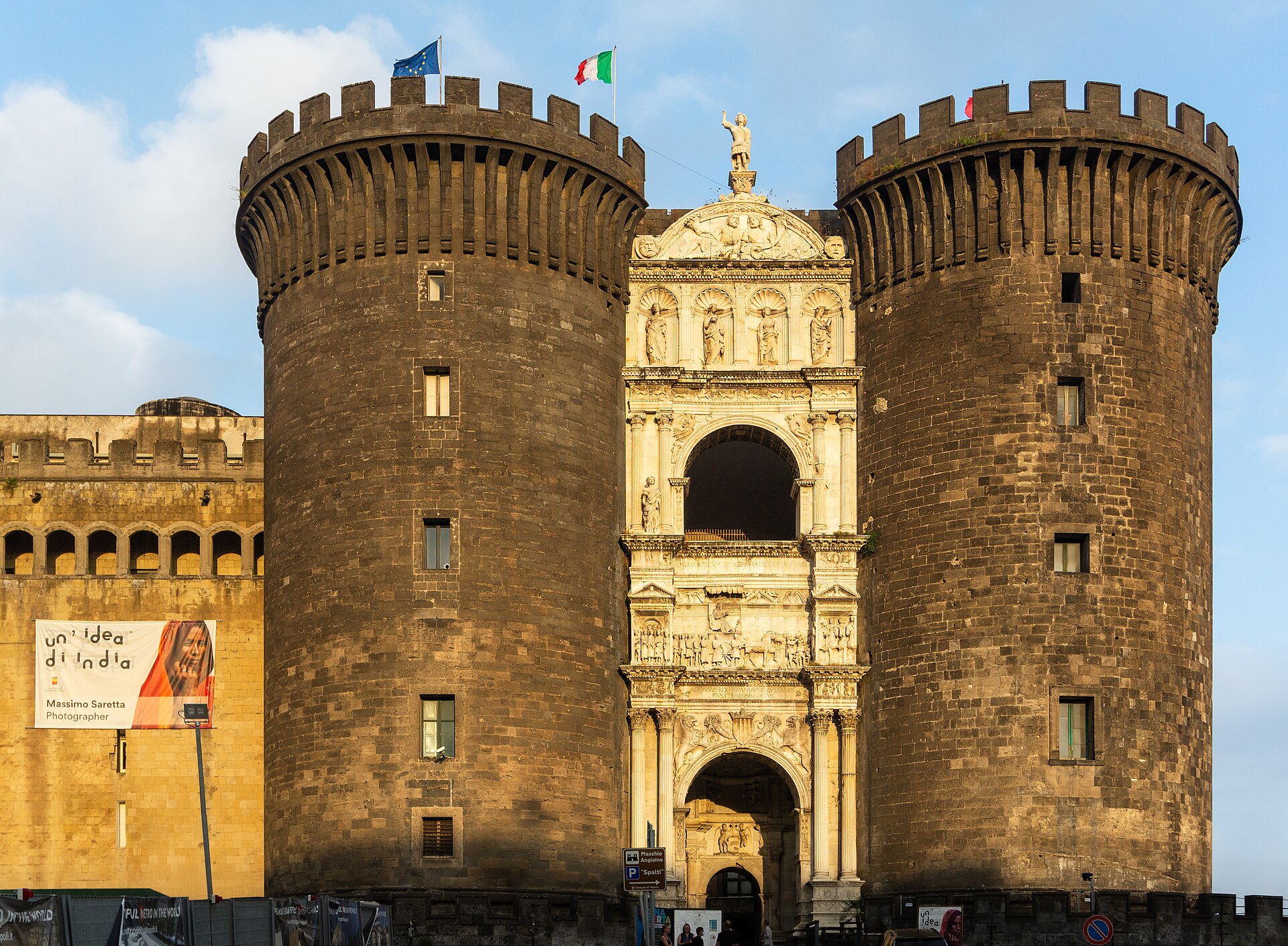
The white marble triumphal arch wedged between the dark towers of this castle is one of the strangest architectural collisions in Italy. On one side you have a brooding medieval fortress with five massive cylindrical towers, built in 1279 by Charles I of Anjou as a royal residence and statement of military dominance. On the other, you have a delicate Renaissance arch celebrating Alfonso V of Aragon's triumphal entry into Naples in 1443, carved with classical reliefs and cherubs. It's like someone glued a wedding cake to a prison. But that's Naples in a nutshell — brutal power and astonishing beauty sharing the same address. Castel Nuovo has been a throne room, a parliament, a fortress, and a cultural salon, sometimes all at once. Under King Robert of Anjou in the early 14th century, the castle hosted Petrarch, Boccaccio, and Giotto, who painted frescoes in the Palatine Chapel — the only part of the original interior that survives. Giotto's frescoes were largely destroyed in later renovations, though fragments remain in the chapel's Gothic vaulted ceiling. The castle saw some of Naples' most violent episodes. In 1486, King Ferrante I invited a group of rebellious barons to a feast in the great hall, then had them arrested and executed — an event known as the Conspiracy of the Barons. The Sala dei Baroni, where it happened, is now used for Naples city council meetings, which locals find darkly appropriate. Today the castle houses the Civic Museum with paintings and sculptures from the 14th to 19th centuries. But most people come just to stand in front of it and gawk at those towers and that improbable arch, which somehow work together despite every rule of architecture saying they shouldn't.
Castel Sant'Elmo
22 Via Tito Angelini, Municipalità 5, Naples, 80129, Italy
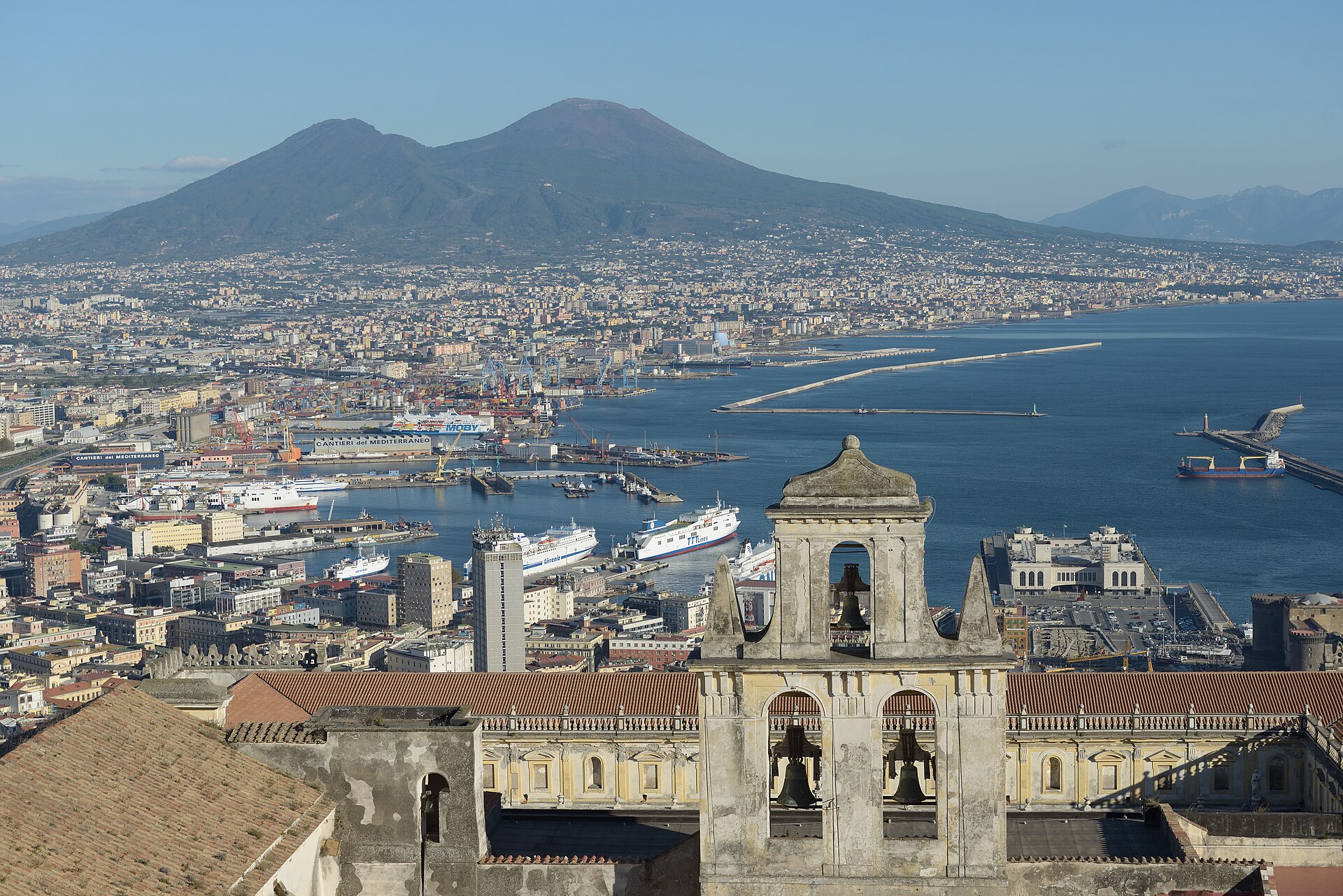
From the air, this fortress looks like a six-pointed star carved out of the volcanic hilltop. That shape — a double-tenaille design — was revolutionary when the Spanish viceroy Pedro de Toledo rebuilt it in 1537, turning a crumbling 14th-century Angevin watchtower into one of the most formidable military installations in the Mediterranean. The entire castle is hewn from the living tuff rock of Vomero hill, which means the building and the hill are essentially the same thing. Attacking it would mean attacking the mountain itself. For centuries, Castel Sant'Elmo was the key to controlling Naples. Whoever held this hilltop controlled the city below, and every invading army — Aragonese, Spanish, French — made it their first target. It was also a prison: philosophers, revolutionaries, and political dissidents were locked up here from the 16th century onward. The 1799 Neapolitan Revolution ended here, with republican leaders making their last stand in the castle before Bourbon forces retook the city and executed many of them. It remained a military prison until 1952. The star-shaped ramparts provide a 360-degree panorama that's arguably the single best viewpoint in Naples. On a clear day you can see from the Phlegraean Fields in the west to the Sorrentine Peninsula in the south, with Vesuvius dead center and the islands of Capri, Ischia, and Procida scattered across the bay. Photographers come up here at golden hour and stay until dark. Since 2010, part of the castle has housed the Museo del Novecento Napoli, a contemporary art museum. The juxtaposition of modern installations inside a 500-year-old military fortress built into volcanic rock is peak Naples — a city that refuses to let anything serve just one purpose.
Catacombs of San Gennaro
13 Via Capodimonte, Municipalità 3, Naples, 80136, Italy
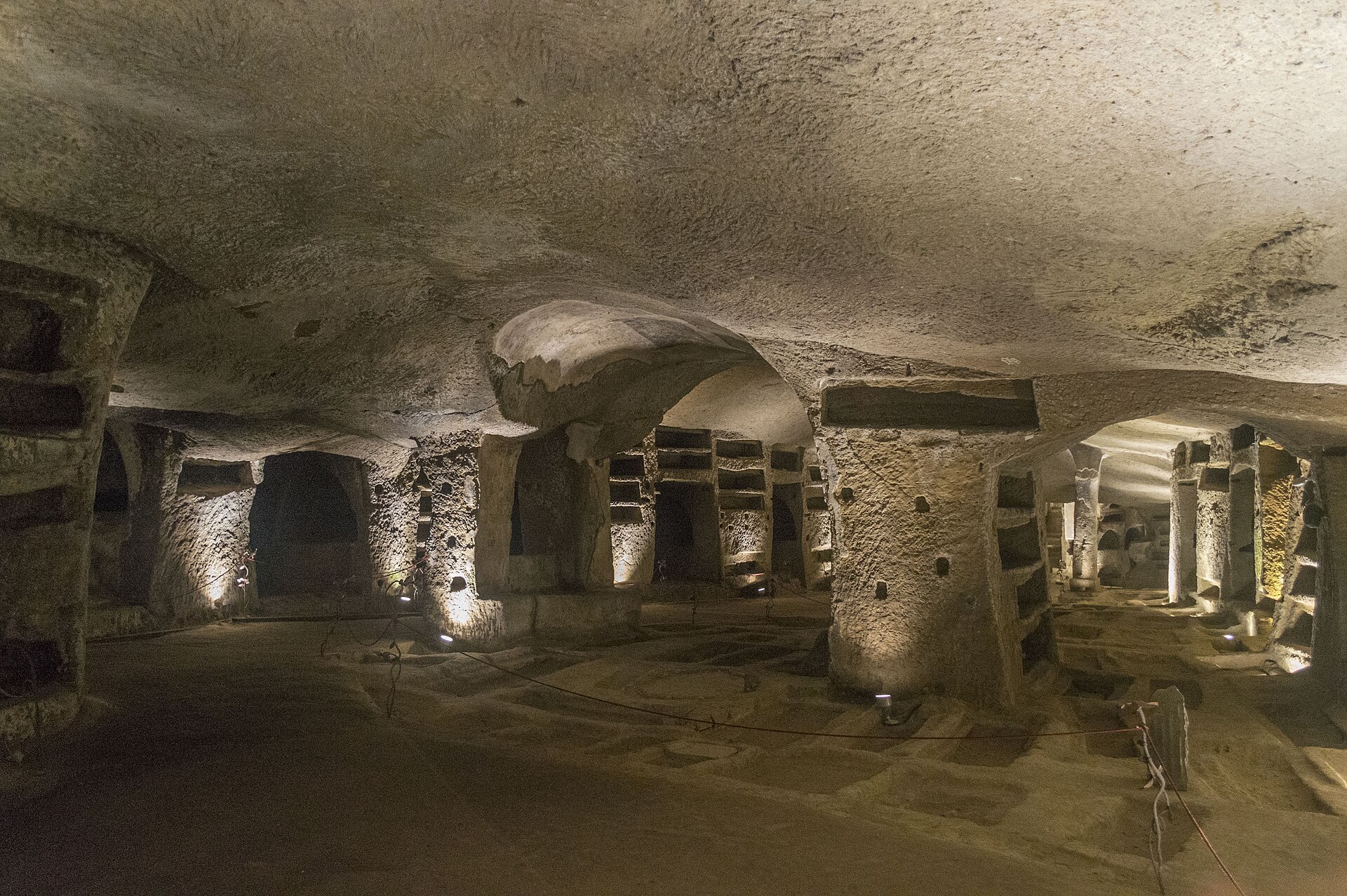
Beneath the Capodimonte hill lies the largest underground early Christian burial site in southern Italy, and it's been down here since the 2nd century AD. The Catacombs of San Gennaro started as the private tomb of a noble family, but when the remains of Sant'Agrippino — Naples' first patron saint — were brought here in the 3rd century, everyone wanted to be buried nearby. Then in the 5th century, the relics of San Gennaro himself arrived, and the place exploded into a major pilgrimage site. Suddenly being buried here was the most prestigious thing you could do with your body after death. The catacombs are arranged on two levels carved into the soft tuff rock, and they're dramatically larger than anything you'd see in Rome. The upper catacomb features the Crypt of the Bishops, where successive bishops of Naples were buried in arched niches decorated with 5th-century mosaics and frescoes that are among the oldest examples of Christian art in Italy. One fresco shows the earliest known portrait of San Gennaro, complete with his halo — painted centuries before the blood miracle became the city's defining ritual. What makes visiting these catacombs special is who runs them. In 2006, a youth cooperative called La Paranza took over management from the church, staffing the tours with young people from the Rione Sanita neighborhood above — one of Naples' poorest and most marginalized communities. The catacombs became an engine of social renewal, generating jobs and tourism revenue for a district that mainstream Naples had largely written off. The transformation has been remarkable. Rione Sanita, once avoided by tourists, now draws thousands of visitors who descend into the ancient dead and emerge into a neighborhood that's very much alive.
Certosa di San Martino
5 Largo San Martino, Municipalità 5, Naples, 80129, Italy
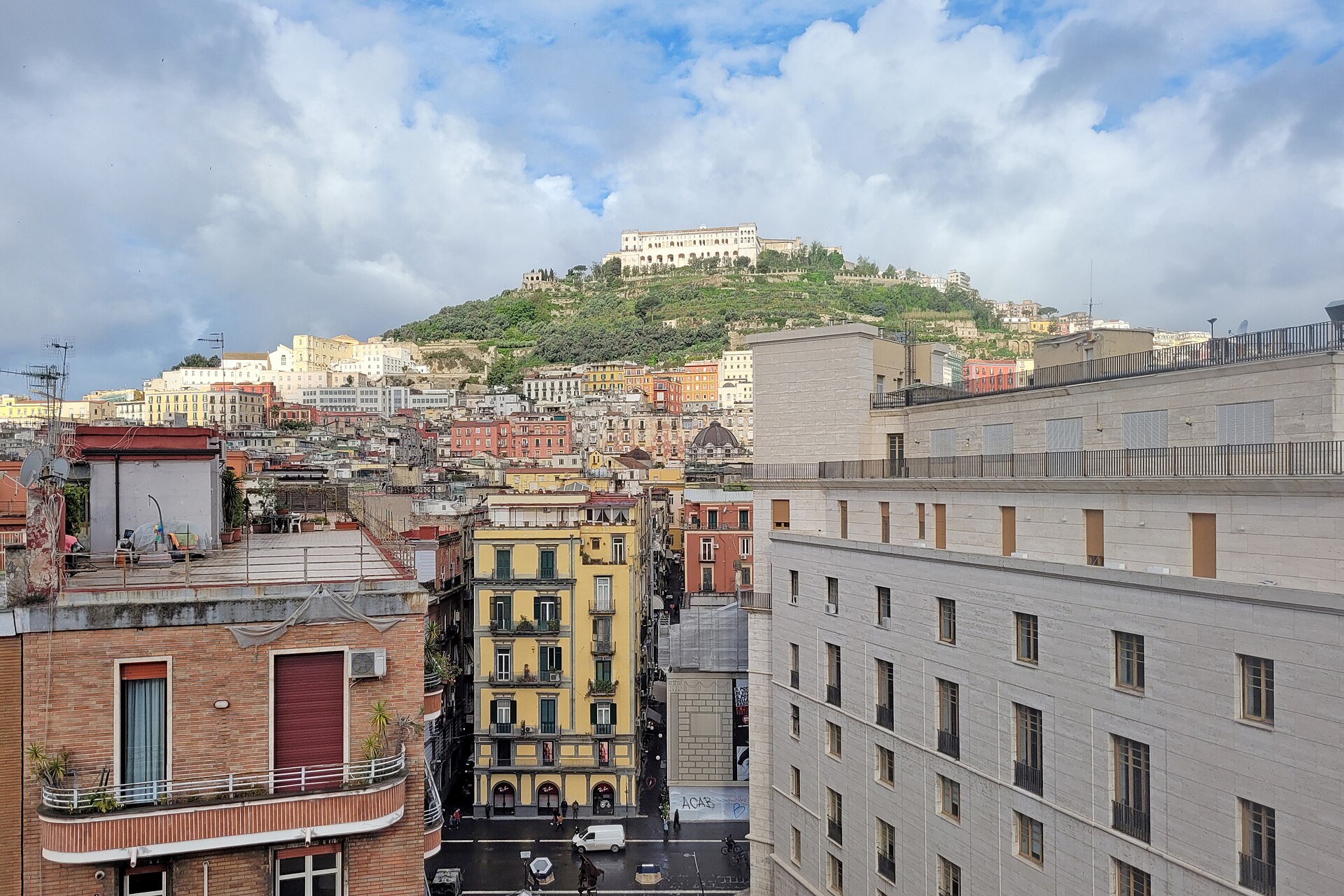
The Carthusian monks who lived here for five centuries had the best view in Naples and they knew it. Perched on the Vomero hill with the entire bay spread out below — Vesuvius, Capri, the city tumbling down to the waterfront — the Certosa di San Martino was designed to be a place where silence and beauty would strip away everything worldly. The monks took a vow of solitude, spent most of their time alone in individual cells with private gardens, and were forbidden from speaking except during brief communal periods. They looked at that view every day and told no one how they felt about it. The monastery was founded in 1325 by Charles of Anjou and completed under Queen Joan I in 1368, but the building you see today is mostly the work of architect Cosimo Fanzago, who spent the better part of the 17th century transforming it into one of the most extravagant Baroque complexes in southern Italy. The church interior drips with marble inlay, gilded stucco, and paintings by Jusepe de Ribera, Luca Giordano, and other masters who competed ferociously for monastic commissions. After the suppression of religious orders in the 19th century, the Certosa became a state museum in 1866, and its collection of Neapolitan nativity scenes — the Sezione Presepiale — is considered the finest in the world. The star piece is the Cuciniello Presepe, a massive 18th-century scene with hundreds of figures set against a Neapolitan landscape. But honestly, most people come for the terraced gardens and the view. Stand on the belvedere at sunset when Vesuvius turns pink and the city lights start flickering on below, and you'll understand why monks chose this spot to contemplate eternity.
Fontanelle Cemetery
80 Via Fontanelle, Municipalità 2, Naples, 80136, Italy
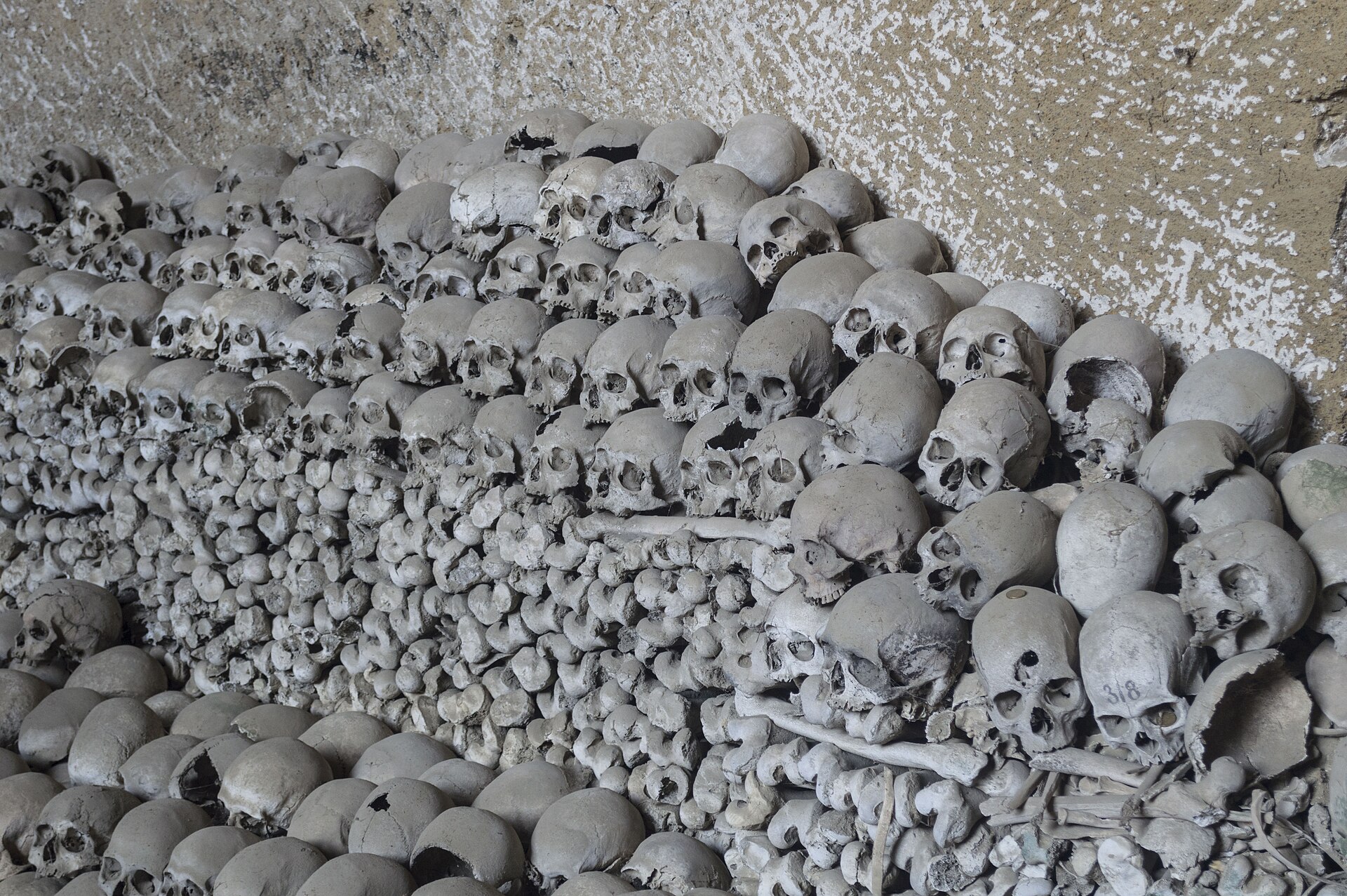
This is not a normal cemetery. It's a cave — a vast tuff cavern in the hillside of the Materdei neighborhood — filled with the skulls and bones of roughly 40,000 anonymous dead, stacked in neat rows like macabre library shelves. Most of them wound up here because there was nowhere else to put them. During the devastating plague of 1656, which killed half the population of Naples, the city's churches ran out of burial space. Bodies were collected and dumped in this abandoned quarry. More arrived after the cholera outbreaks of the 1800s. But the truly strange part is what happened next. In the 19th century, a cult of devotion sprang up around the skulls. Ordinary Neapolitans would "adopt" a skull — clean it, give it a name, place it in a small wooden box or marble case, leave flowers and prayers. In return, the adopted soul (anima pezzentella, or "poor little soul") was expected to intercede from purgatory on behalf of its living patron: help find a husband, cure an illness, win the lottery. People reported receiving winning numbers in dreams from their adopted skulls. The practice blurred the line between Catholic devotion and folk magic in ways that made the Church deeply uncomfortable. In 1969, Cardinal Ursi declared the skull cult superstitious and ordered the cemetery closed. It remained shuttered for decades, reopening only in 2010 after extensive restoration. The cult is officially discouraged, but fresh flowers still appear on certain skulls, and locals still whisper about which ones are the most generous with favors. The cavern itself is enormous — three vast galleries stretching into the hillside, with pale light filtering through high openings. It's one of the most hauntingly beautiful places in a city that specializes in beautiful haunting.
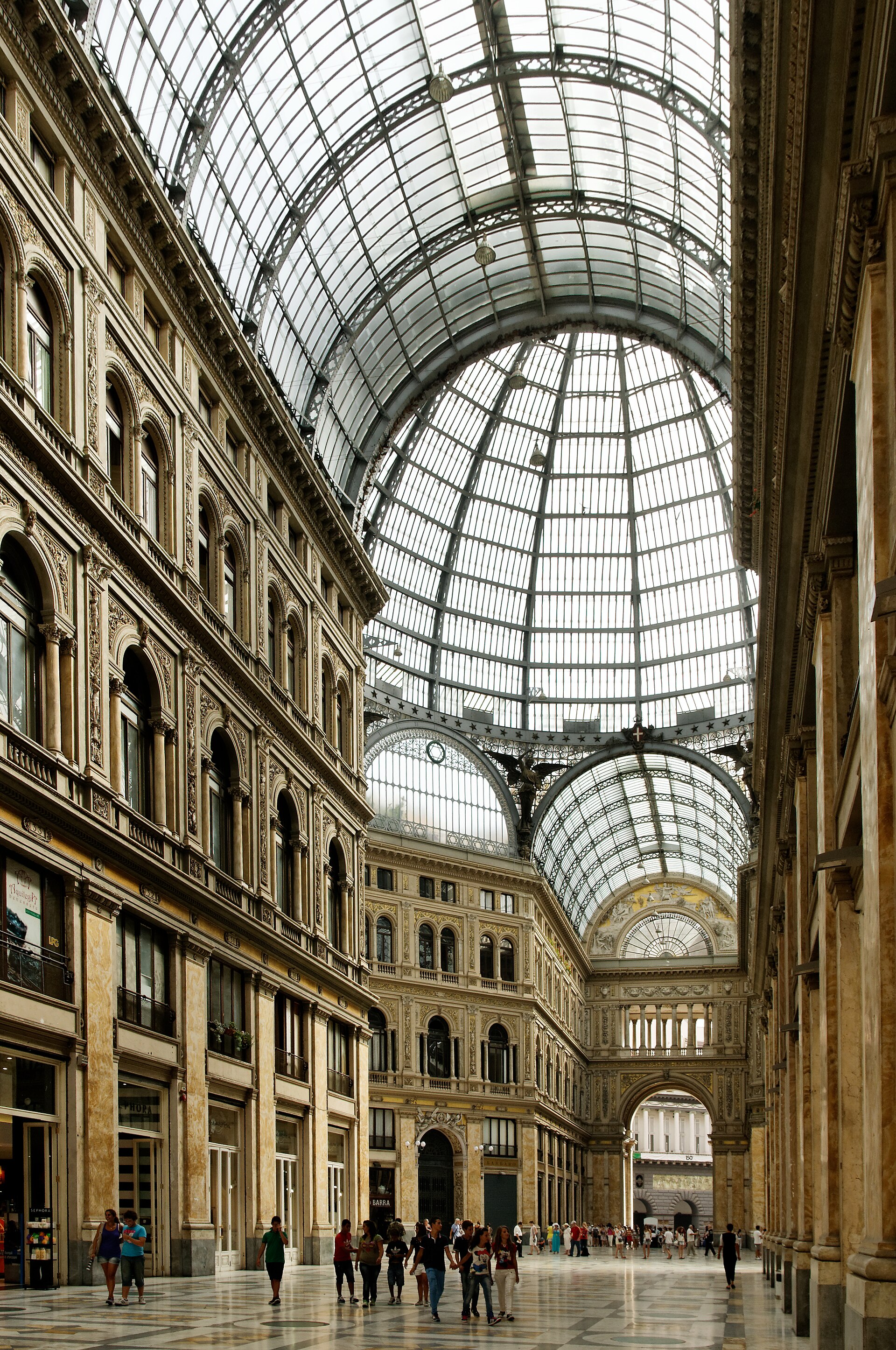
Galleria Umberto I
Via San Carlo, Municipalità 1, Naples, 80132, Italy
Naples built this soaring glass-and-iron arcade for the worst possible reason: a cholera epidemic. The 1884 outbreak killed over 7,000 Neapolitans and exposed the horrifying conditions in the dense, sunless slum neighborhoods behind the waterfront. The city launched the risanamento — a massive urban renewal program that demolished entire districts — and the Galleria Umberto I, built between 1887 and 1890, was the jewel of the reconstruction. The message was clear: Naples was modern, hygienic, and open for business. The design borrows heavily from Milan's Galleria Vittorio Emanuele II, which had opened in 1877, but the Neapolitan version has its own personality. The glass dome soars 57 meters above the marble floor, which features a compass rose and zodiac wheel inlaid in colored stone. Four wings radiate from the central octagon, lined with shops, cafes, and offices. It was designed by Emanuele Rocco and sits directly across from the Teatro San Carlo, creating an axis of cultural glamour that stretches from opera house to shopping arcade. For decades, the Galleria was the social heart of bourgeois Naples — the place to see and be seen, to drink coffee, to conduct business in the warm light filtering through the iron-ribbed glass roof. Like many grand European arcades, it faded in the 20th century as shopping moved to malls and high streets. Some shops closed, the marble got dingy, and the Galleria acquired a reputation more for its homeless population than its architecture. Recent restoration has brought it back. The marble has been cleaned, new shops have opened, and the extraordinary engineering of the glass roof — which survived Allied bombs, earthquakes, and a century of neglect — can be properly appreciated again. Look up. That dome is worth the visit alone.
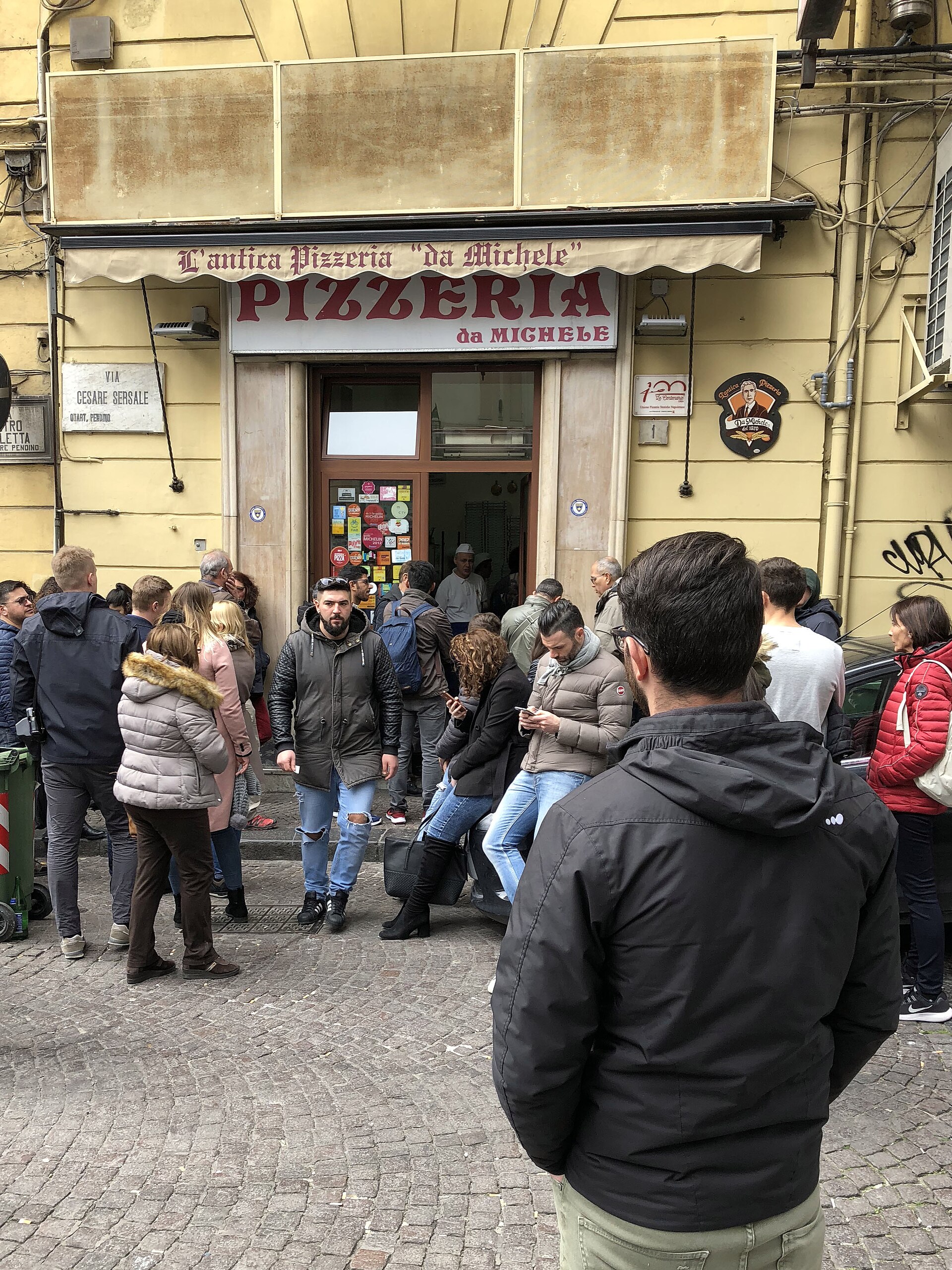
L'Antica Pizzeria da Michele
1 Via Cesare Sersale, Municipalità 2, Naples, 80139, Italy
There are only two things on the menu: margherita and marinara. That's it. No toppings. No variations. No salads, no desserts, no appetizers. The Condurro family has been running this pizzeria since 1870 and in five generations they have never seen a reason to add a third option. When Elizabeth Gilbert ate here in "Eat Pray Love" and the resulting movie scene sent tourist numbers into the stratosphere, they still didn't change the menu. You get tomato with mozzarella, or tomato without mozzarella, and you sit down and be grateful. The logic is purist to the point of philosophy. Michele Condurro, the family patriarch whose name stuck, believed pizza was a perfect food that needed exactly two expressions. The dough is made from the same recipe — flour, water, salt, yeast, and a long slow rise — and cooked in a wood-fired oven at roughly 450 degrees Celsius for about 60 seconds. The result is a pizza with a charred, pillowy cornice, a thin soupy center, and the kind of tomato sauce that tastes like tomatoes are supposed to taste but almost never do. The queue is legendary. During peak season, you can wait an hour or more on the narrow street outside, ticket number in hand, watching locals with connections skip the line through back doors. The interior is bare — fluorescent lights, paper-covered tables, zero ambiance — because ambiance would imply that anything other than the pizza matters. It doesn't. Da Michele has spawned imitators worldwide, from London to Tokyo, but the original on Via Cesare Sersale remains a pilgrimage site. Whether it's actually the best pizza in Naples is a fight this description will not be starting. But if you have to choose one place, the five-generation argument is persuasive.
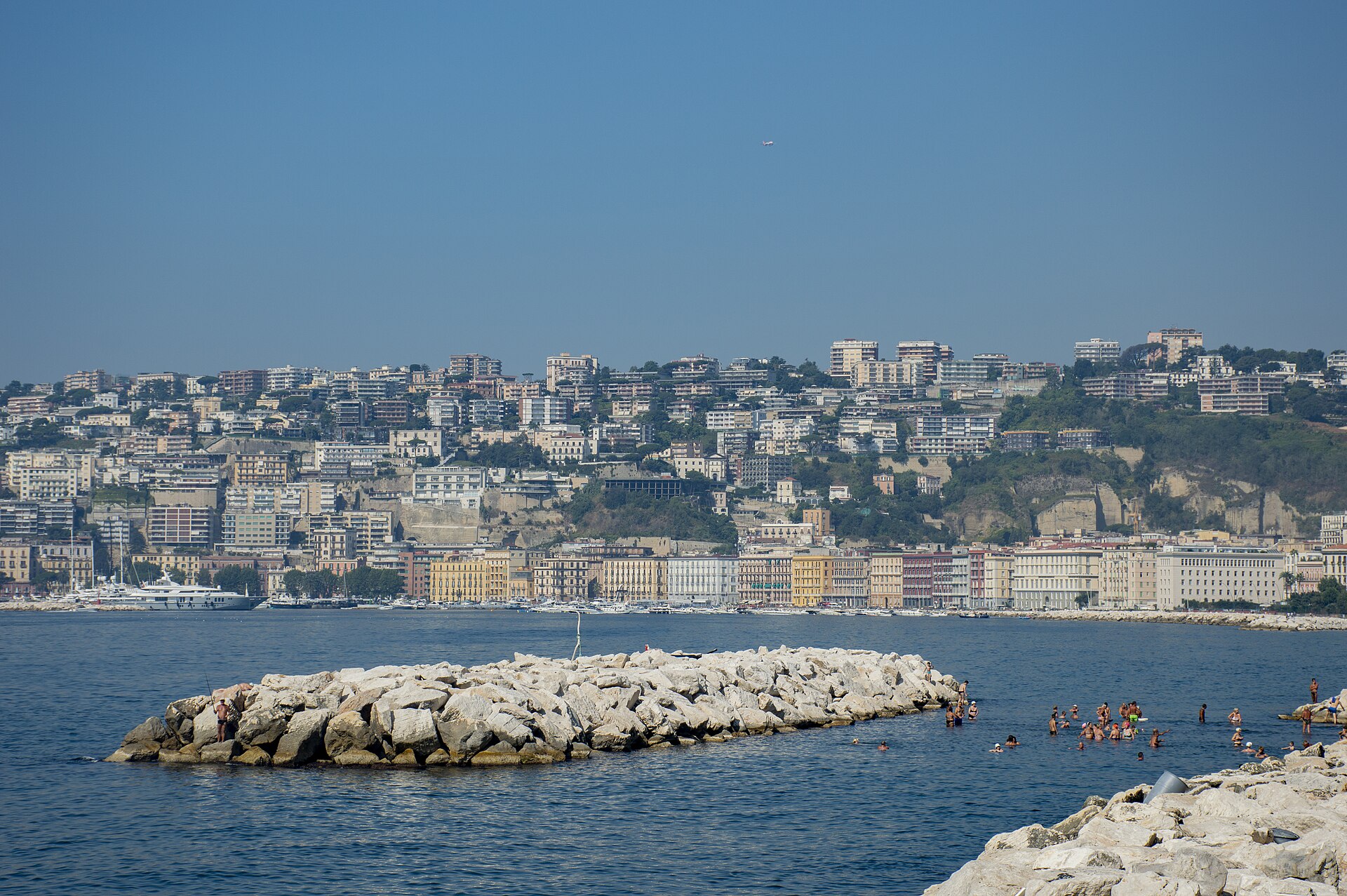
Lungomare (Waterfront Promenade)
Via Partenope, Municipalità 1, Naples, 80121, Italy
The Lungomare di Napoli is regularly cited as one of the most beautiful urban waterfront walks in the world, and for once the hype is justified. Stretching roughly three kilometers from Castel dell'Ovo to Mergellina, this seafront promenade gives you Vesuvius on your left, the islands of Capri and Ischia ahead, and the chaotic beauty of Naples climbing the hills to your right. On a clear evening, when the sunset turns the bay gold and Vesuvius glows purple, it is genuinely hard to believe this view is real. The promenade follows Via Partenope — named for the siren who, according to Greek mythology, drowned herself here after Odysseus resisted her song. Her body washed up on this shore, and the Greeks named their colony Parthenope in her honor before later refounding it as Neapolis. Every step you take along this waterfront is walking on mythology. The seafront was pedestrianized in 2012 by Mayor Luigi de Magistris, sparking a furious controversy (Neapolitans love their cars the way they love their saints — possessively and loudly). But the result transformed the lungomare into the city's living room. Families stroll here on Sunday afternoons, joggers circle at dawn, couples claim benches at sunset, and impromptu soccer games break out on the wider sections. Along the way you pass the Villa Comunale — Naples' oldest public park, opened in 1781 — and the Stazione Zoologica Anton Dohrn, one of the oldest marine biology research stations in the world, founded in 1872. But mostly you just walk, and look at the bay, and understand why Neapolitans say "Vedi Napoli e poi muori" — see Naples and die — because once you've seen this, everything else is a letdown.
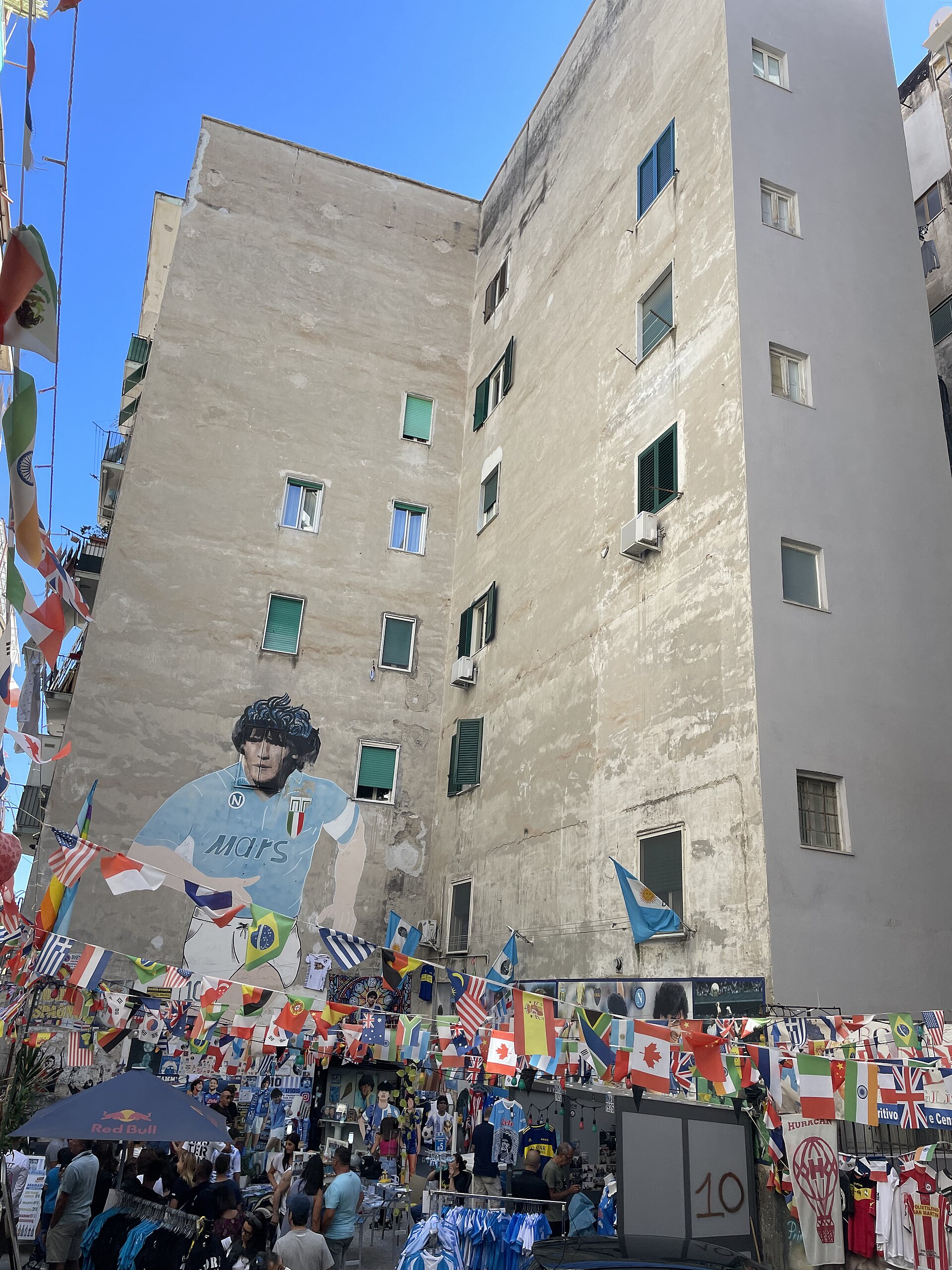
Maradona Mural & Shrine
Via Emanuele de Deo, Municipalità 2, Naples, 80134, Italy
In the narrow streets of the Quartieri Spagnoli, there is a shrine to a man who is not a saint by any official measure, but try telling that to the Neapolitans who leave candles, flowers, scarves, and prayers here every day. Diego Armando Maradona arrived at SSC Napoli in 1984, when the club was a perennial bottom-dweller and Naples was openly despised by the wealthy north of Italy. Seven years later, he had led Napoli to two Serie A titles, a UEFA Cup, and an Italian Super Cup, and in the process became something no athlete should have to be: the embodiment of an entire city's dignity. The main shrine on Via Emanuele De Deo in the Quartieri Spagnoli started small — a corner with a photograph and a few candles — and grew into a permanent installation with murals, plaques, and offerings that locals maintain with the same devotion they give to the Madonna. When Maradona died on November 25, 2020, the neighborhood erupted in grief. Thousands gathered in the streets, fireworks exploded, and the shrine was buried in flowers, flags, and handwritten letters from grown men who wept openly. Larger murals by street artist Jorit Agoch appear throughout the city — the most famous one in the Quartieri shows Maradona's face in photorealistic detail, twenty meters tall, staring out from a building facade with the intensity of a Byzantine icon. The resemblance to religious imagery is intentional. In Naples, Maradona fills the same role saints traditionally fill: he is the protector, the miracle worker, the one who proved that the powerless could win. Naples renamed the San Paolo stadium to Stadio Diego Armando Maradona in 2020. The city council voted unanimously. Nobody objected.
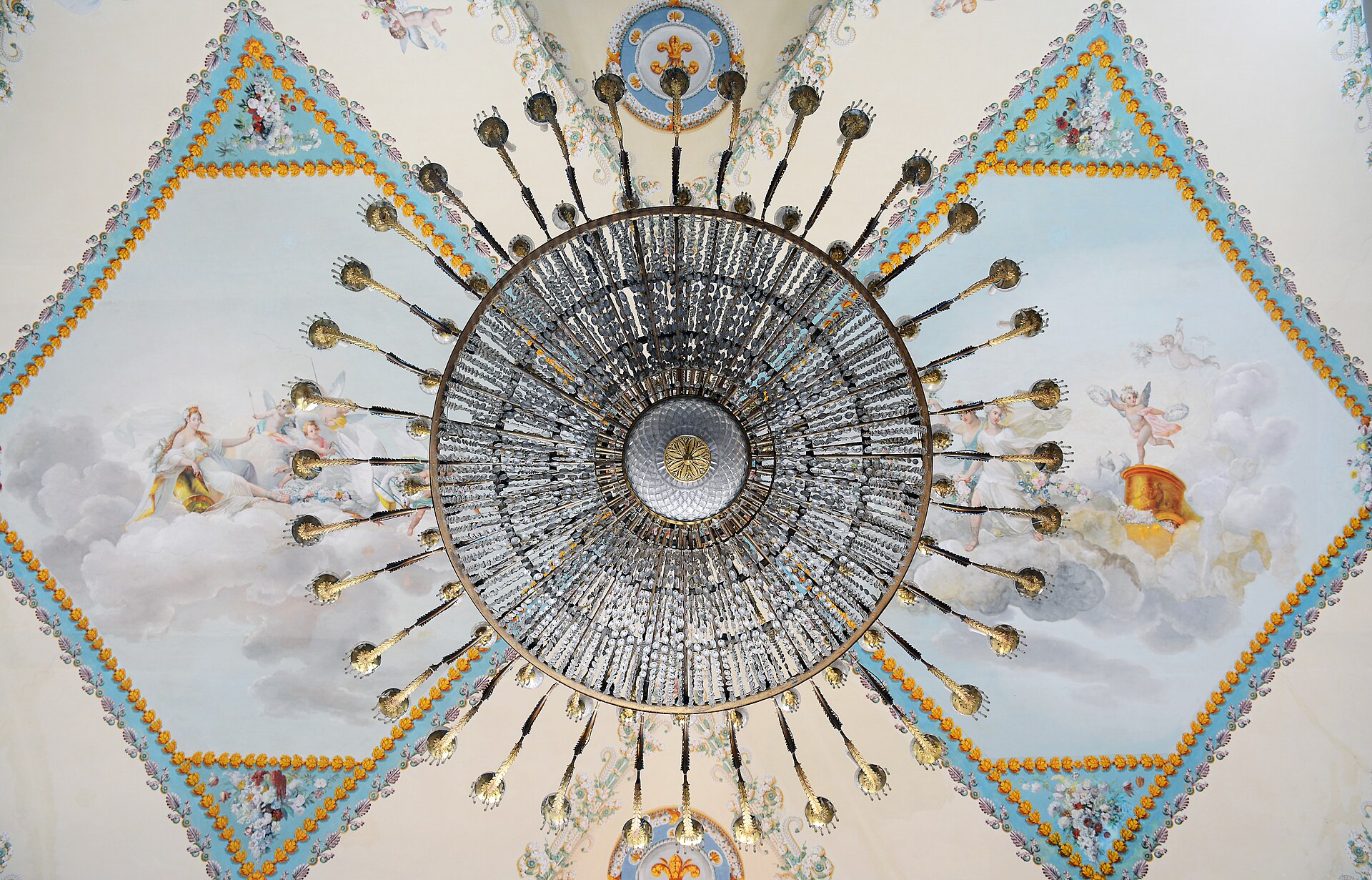
Museo di Capodimonte
2 Via Lucio Amelio, Municipalità 3, Naples, 80131, Italy
Charles of Bourbon had a problem most people would envy: he'd inherited the Farnese Collection — one of the greatest accumulations of Renaissance and Baroque art ever assembled — from his mother, and his existing palace was too small to hold it. So in 1738, he built a new one on the Capodimonte hill, surrounded by a royal hunting estate that is now one of the largest urban parks in Europe at 134 hectares. The palace took over a century to complete, but the art collection started moving in almost immediately. What the Farnese amassed is staggering. Titian's portraits of Pope Paul III and his grandsons, Caravaggio's "Flagellation of Christ" (originally painted for the church of San Domenico Maggiore and moved here in the 1970s), Masaccio's "Crucifixion," Bellini's "Transfiguration," and entire rooms of Parmigianino, Correggio, and El Greco. The collection spans from the 13th to the 18th century and rivals the Uffizi in Florence, yet receives a fraction of the visitors. On a weekday morning, you might have a Caravaggio to yourself. The palace itself is painted a distinctive salmon pink that's visible from across the city, and its second-floor Royal Apartments preserve the Bourbon decorative scheme — porcelain rooms, silk-wallpapered halls, and a remarkable collection of armory. The third floor houses a contemporary art collection with works by Andy Warhol and other 20th-century artists, proving that Capodimonte has never stopped collecting. The surrounding park, the Real Bosco di Capodimonte, is where Neapolitans come to escape the city without leaving it. Ancient trees, walking paths, and views back toward the bay make it one of the few green spaces in a city that is otherwise solidly, gloriously built-up.
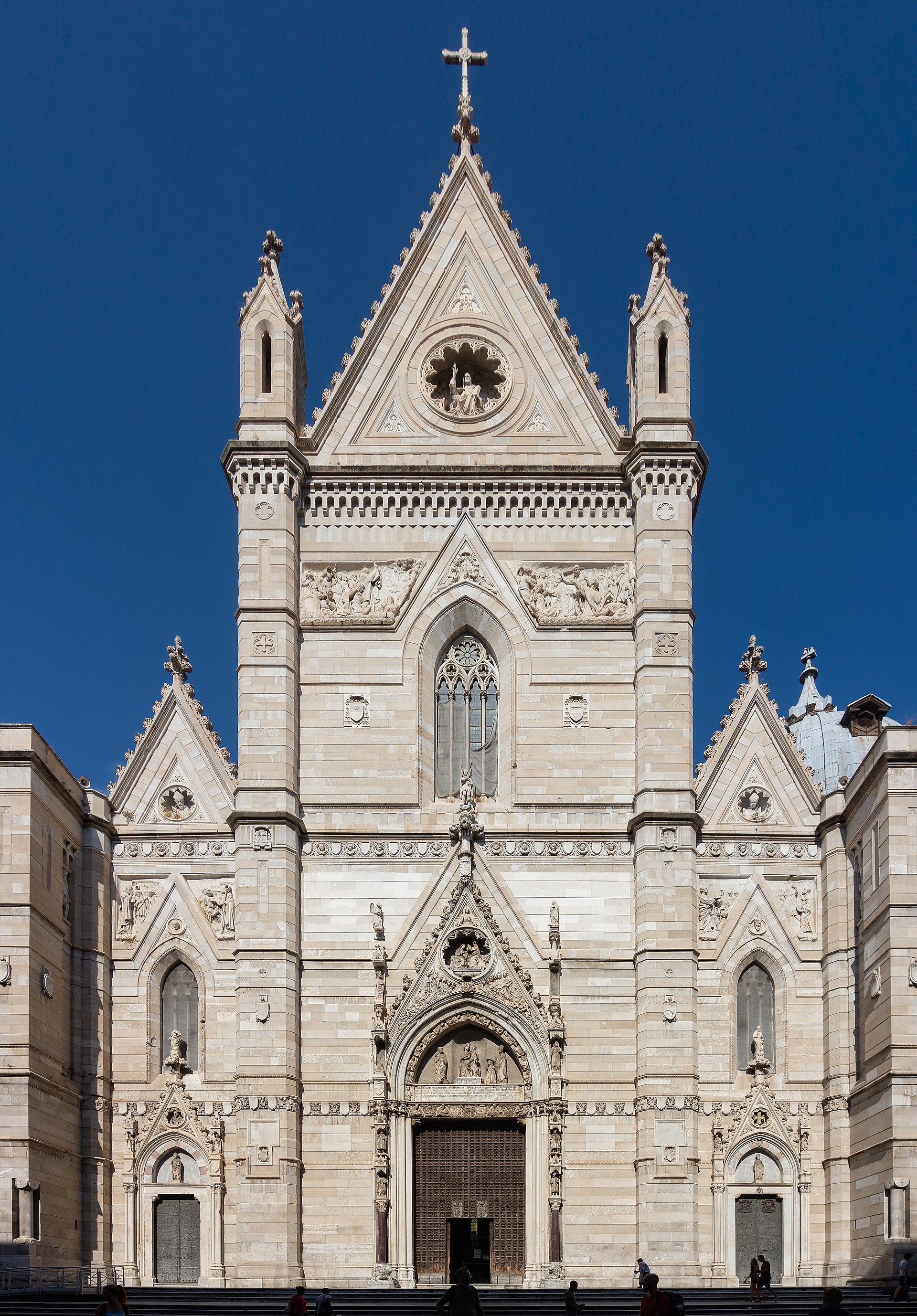
Naples Cathedral (Duomo di San Gennaro)
147 Via Duomo, Municipalità 4, Naples, 80138, Italy
Three times a year, the entire city of Naples holds its breath and stares at a vial of dried blood. If the blood of San Gennaro liquefies — as it has done, with a few terrifying exceptions, since at least 1389 — Naples will be safe. If it doesn't, disaster is coming. The blood failed to liquefy before the 1980 earthquake that killed nearly 3,000 people in southern Italy, and again in September 2020 at the start of the COVID-19 pandemic. Neapolitans do not treat this as folklore. They treat it as news. The cathedral itself was begun in the late 13th century under Charles I of Anjou and consecrated around 1315, though it incorporates much older structures — step inside the Basilica of Santa Restituta, accessible through the left nave, and you're in a 4th-century church built on top of a Greek temple to Apollo. Dig further and there's a Roman building underneath that. Naples is a layer cake of civilizations, and the Duomo is where you can see the strata most clearly. The Chapel of the Treasury of San Gennaro, added in the 17th century, is so lavish it practically constitutes its own church. The silver bust reliquary containing the saint's skull is encrusted with jewels, and the treasury's art collection includes works by Domenichino and Jusepe de Ribera. The chapel was built after a plague in 1527 killed an estimated 60,000 Neapolitans, and the city vowed to build the most magnificent shrine it could if San Gennaro would intercede. Rick Steves puts Via Duomo on his Naples walking route, and the cathedral is the reason. Come for the architecture, but come on a miracle day — the first Saturday of May, September 19th, or December 16th — and you'll witness something no other city on earth can offer.
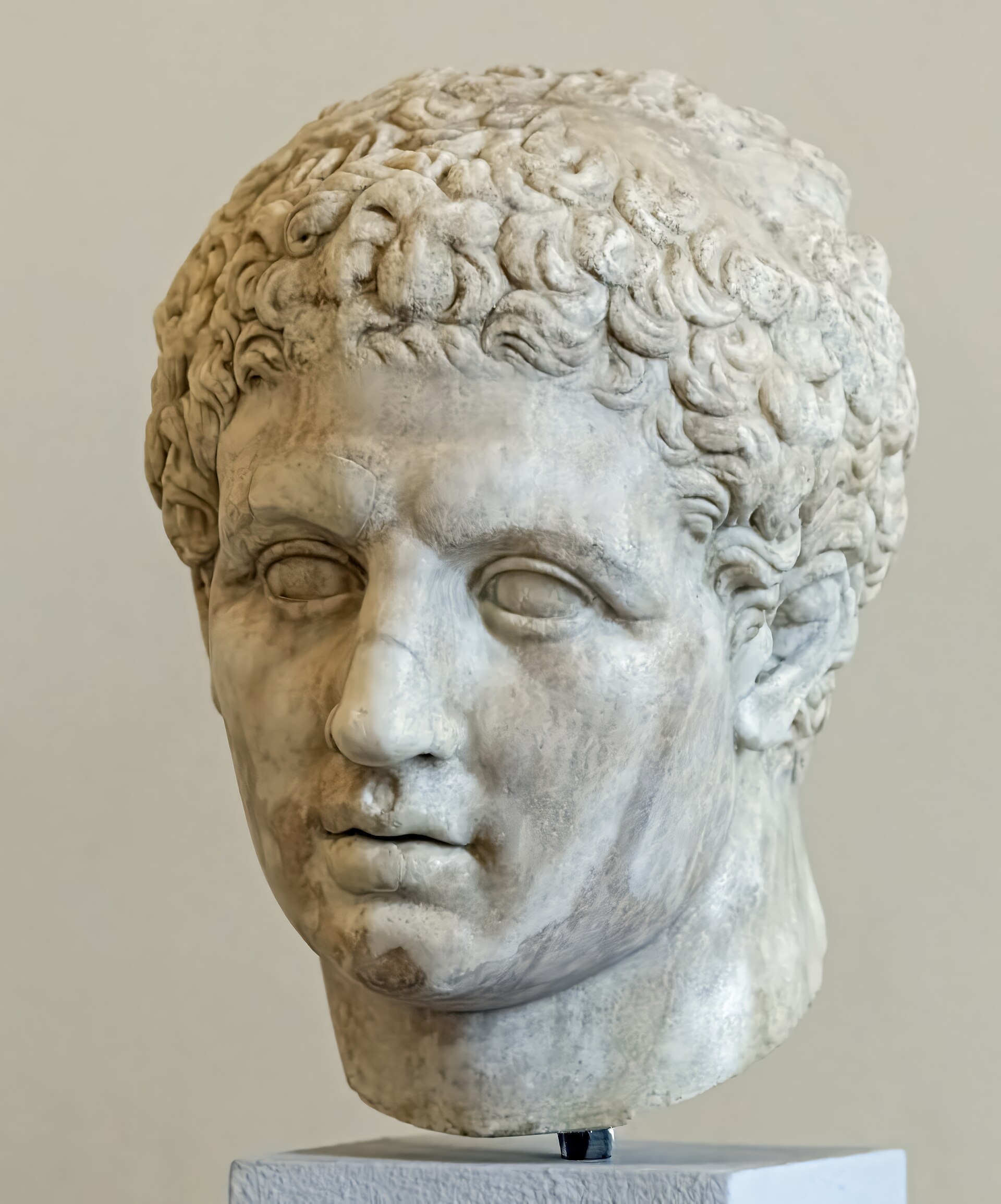
Naples National Archaeological Museum
19 Piazza Museo Nazionale, Municipalità 3, Naples, 80135, Italy
If you want to understand what daily life looked like in a Roman city two thousand years ago, this is the single most important building on earth. The Naples Archaeological Museum holds the largest collection of Roman artifacts ever assembled, and most of it was pulled directly from Pompeii and Herculaneum after Vesuvius buried them in 79 AD. We're talking mosaics ripped from dining room floors, bronze statues frozen mid-stride, surgical instruments, cookware, dice, and an entire cabinet of erotic art that was kept locked away from the public for centuries. That locked room — the Gabinetto Segreto, or Secret Cabinet — tells you a lot about how attitudes have shifted. When archaeologists first uncovered sexually explicit frescoes and sculptures from Pompeii in the 1700s, the Bourbon kings were so scandalized they sealed the collection behind a door that required special royal permission to open. It stayed restricted on and off for over two hundred years, finally opening permanently to the public in 2000. The artifacts inside aren't gratuitous — they're a window into Roman attitudes about fertility, religion, and humor that were utterly normal at the time. The building itself started life as a cavalry barracks in 1585, became the University of Naples in 1616, and was converted into a museum in 1777 by Ferdinand IV. The Farnese Collection — a staggering haul of classical sculpture accumulated by Pope Paul III's family — anchors the ground floor, including the Farnese Hercules and the Farnese Bull, one of the largest surviving sculptures from antiquity. Rick Steves calls this a must-see, and he's right. Budget at least two hours, and don't skip the mosaics from the House of the Faun — the Alexander Mosaic alone, depicting Alexander the Great battling Darius III, contains roughly 1.5 million individual tesserae.
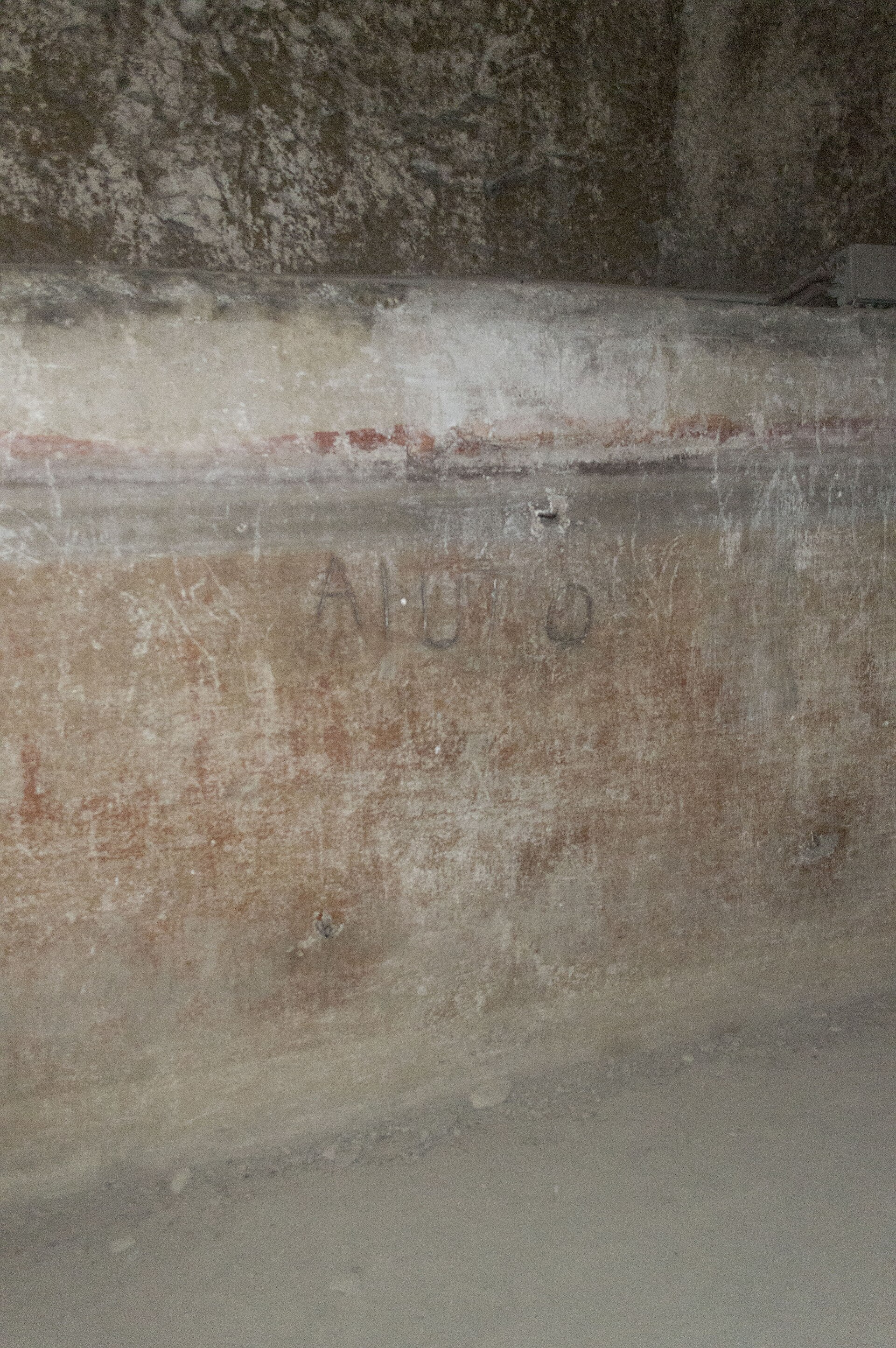
Naples Underground (Napoli Sotterranea)
68 Piazza San Gaetano, Municipalità 4, Naples, 80138, Italy
Forty meters beneath the traffic and chaos of modern Naples, there's an entire second city. The Greeks started digging it in the 3rd century BC, quarrying the soft tuff stone to build the city above. The Romans expanded the tunnels into a massive aqueduct system that supplied water to the entire city for over 2,300 years — an engineering achievement that makes modern infrastructure look embarrassingly temporary. The system was still in use until the 1885 cholera epidemic, when authorities sealed it over sanitation fears. During World War II, this forgotten underworld found a desperate new purpose. When Allied bombs rained on Naples, roughly 200,000 people sheltered in the ancient tunnels and cisterns. You can still see their scratched graffiti on the walls, along with crude furnishings and personal items left behind. One section has been left exactly as it was found — beds, tables, children's toys — a frozen snapshot of families huddled underground while their city burned above them. The tour takes you through claustrophobic passages — at one point you squeeze through a gap barely 50 centimeters wide, lit only by a candle — and opens into cavernous cisterns with cathedral-high ceilings. There's a Roman theater buried down here too, parts of which are accessible through the basements of private homes. One resident literally has a Roman stage under her kitchen, discovered in the 1990s during renovation work. The experience is disorienting in the best way. You enter through a doorway on a busy piazza, descend eighty steps, and suddenly you're in a world that has existed under Naples' feet for millennia while life carried on above, oblivious.
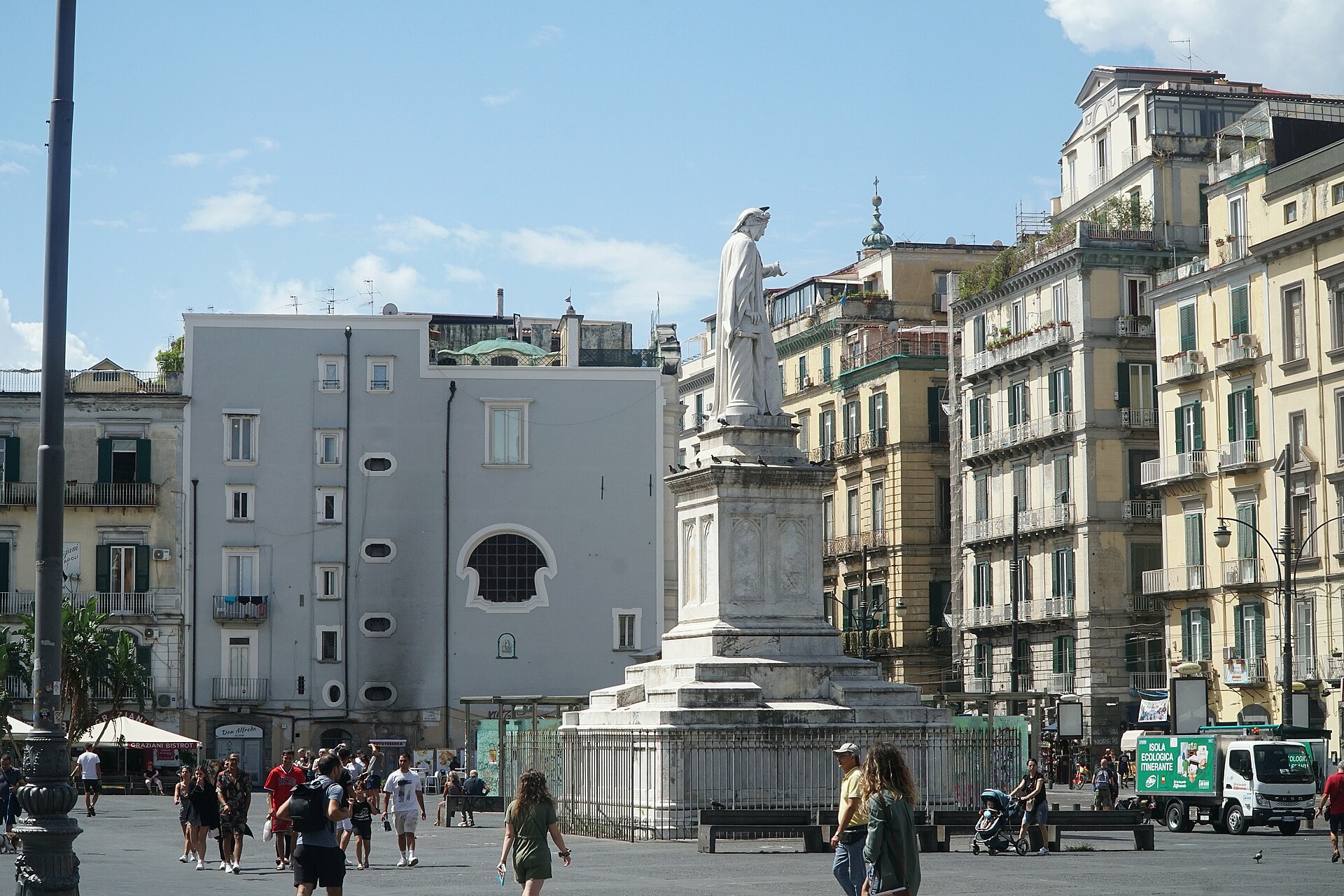
Piazza Dante
Municipalità 2, Naples, Italy
Before it was Piazza Dante, this was the Largo del Mercatello — the "little market" — and for centuries it was where Naples came to buy, sell, argue, and occasionally riot. The semicircular colonnade that curves around the eastern side was designed by Luigi Vanvitelli in 1757 for Charles III of Bourbon, originally intended to frame a massive statue of the king. The statue was never built, the Bourbons fell, and in 1871 a statue of Dante Alighieri was plunked in the center instead, giving the square its current name. Vanvitelli's colonnade is a masterclass in political architecture that outlived its original purpose. Twenty-six statues representing the virtues of Charles III line the rooftop, silently praising a king nobody here cares about anymore. But the architecture works regardless — it creates a theatrical backdrop that makes the piazza feel like a stage set, which is fitting because this square has always been a place of public performance, from market vendors to political rallies. Today Piazza Dante is a major transit hub — the Art Metro station beneath it, designed by Gae Aulenti, is one of the most beautiful subway stations in the world, all clean lines and natural light. The square sits at the junction between the old city and the Spanish Quarter, and it's the gateway Rick Steves uses to funnel visitors into Spaccanapoli through the old Port'Alba gate, where you'll find Naples' historic row of bookshops, established in 1625. The square buzzes at all hours. Students from the nearby university cluster on the benches, elderly men play cards at outdoor tables, and the whole place smells of coffee and sfogliatelle from the surrounding pastry shops.
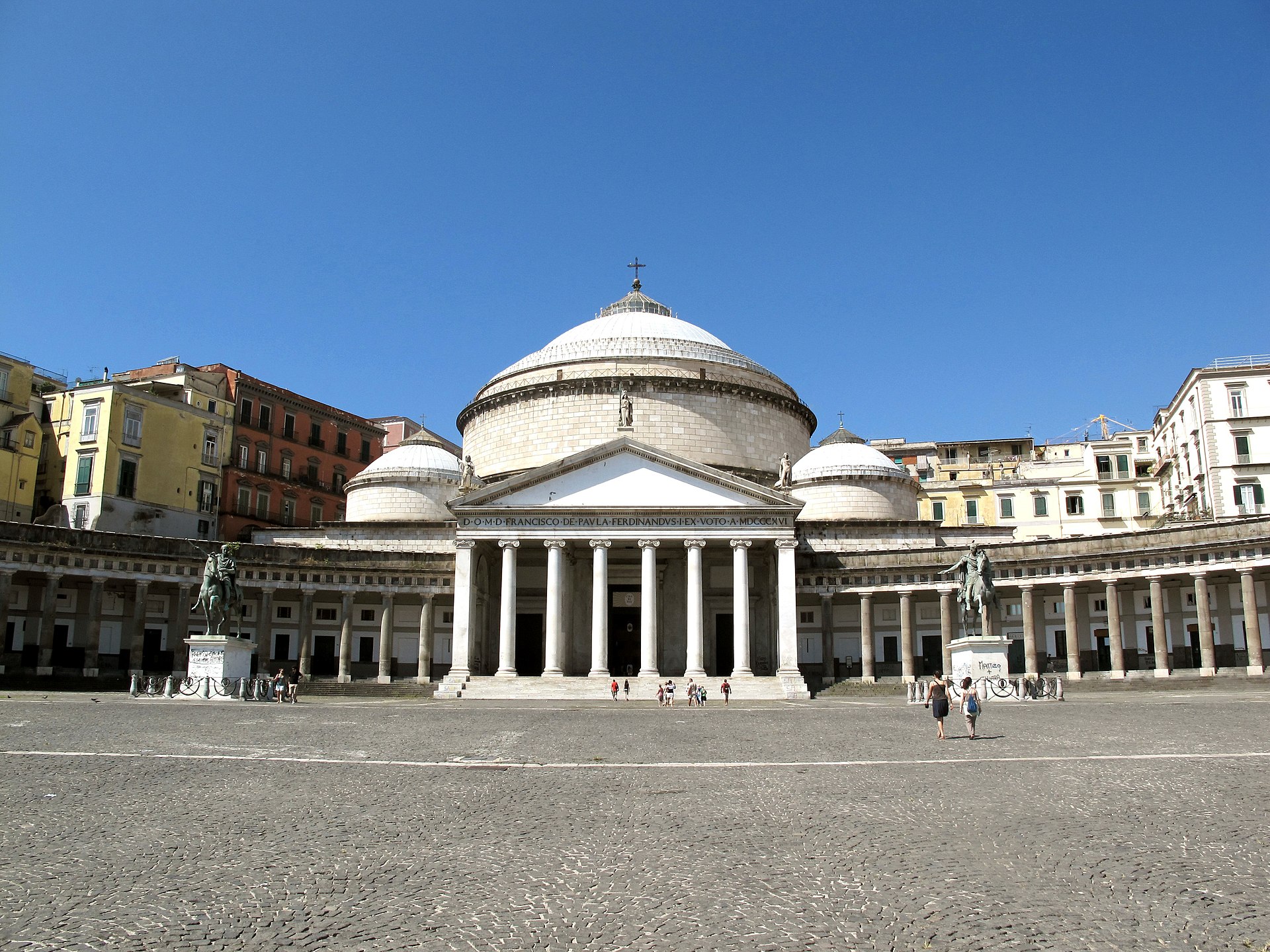
Piazza del Plebiscito
Piazza del Plebiscito, Municipalità 1, Naples, 80132, Italy
For most of its history, this enormous piazza was a car park. Seriously. One of the grandest public squares in Europe spent decades as a chaotic parking lot until the city finally pedestrianized it in 1994 for the G7 summit. Neapolitans, who had grown up thinking of it as a traffic nightmare, suddenly rediscovered an astonishing civic space that rivals St. Peter's Square in scale. The semicircular colonnade of the Basilica of San Francesco di Paola dominates the western side, and it's no accident that it looks like a miniature Pantheon — that was exactly the intention. Ferdinand I commissioned it in 1816 as a thanksgiving for getting his throne back after Napoleon's brother-in-law Joachim Murat was executed and Bourbon rule was restored. The message was clear: the old order is back, and it brought columns. Construction dragged on until 1846, but the result is genuinely magnificent — 38 Ionic columns forming a colonnade 150 meters wide. Facing the basilica across the piazza is the Royal Palace, its long facade studded with eight statues of the various dynasties that ruled Naples, from the Normans to the Savoys. There's a famous local legend: try to walk blindfolded from one equestrian statue to the other in a straight line. Nobody can do it — the piazza is so vast and subtly sloped that everyone drifts off course. Rick Steves uses this square as a starting point for his Naples walk, and it's the right call. Stand here and you have the Royal Palace, the opera house, the sea, and the sweep of the bay all within a few steps.
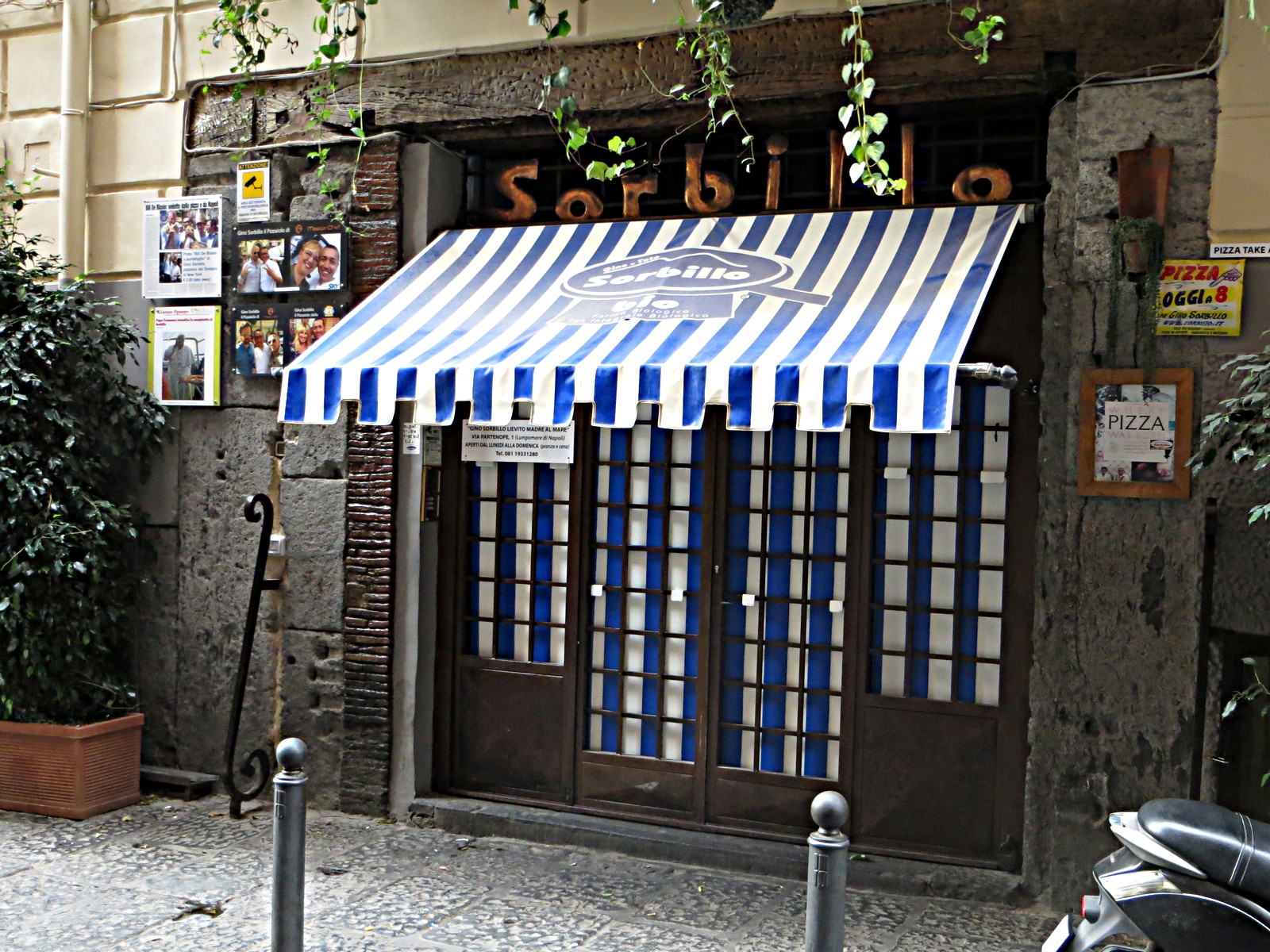
Pizzeria Sorbillo
Via dei Tribunali 32, 80138 Naples
Gino Sorbillo is the 19th of 21 children, all born to pizza-making parents, who were themselves born to pizza-making parents. When your family tree is basically a dough recipe, you don't have a lot of career ambiguity. The Sorbillo dynasty has been making pizza on Via dei Tribunali since 1935, and Gino — charismatic, outspoken, and frequently in the press — has turned the family name into arguably the most recognized pizza brand in Italy. His flagship pizzeria sits on Via dei Tribunali, the ancient decumanus that runs parallel to Spaccanapoli one block north. Unlike the purist minimalism of Da Michele, Sorbillo offers a full menu of creative toppings — but the base remains sacred. Long-fermented dough, San Marzano tomatoes from the slopes of Vesuvius, fior di latte mozzarella from Agerola, and a wood-fired oven that hits temperatures most home ovens can only dream about. The cornice comes out tall, blistered, and almost impossibly light. In January 2019, someone detonated a bomb at the pizzeria's entrance in what was widely interpreted as a Camorra intimidation attempt. Sorbillo reopened three days later to a crowd of supporters, and the incident only amplified his status as a folk hero standing up for honest Neapolitan business against organized crime. He's spoken publicly about refusing extortion payments and has become a symbol of resistance. The queue here rivals Da Michele, but the atmosphere is completely different — louder, more chaotic, more social. Sorbillo himself often works the room. The eternal Naples question of "Michele or Sorbillo?" is essentially a personality test: do you prefer silent perfectionism or showmanship? Either way, you're eating the best pizza on earth.
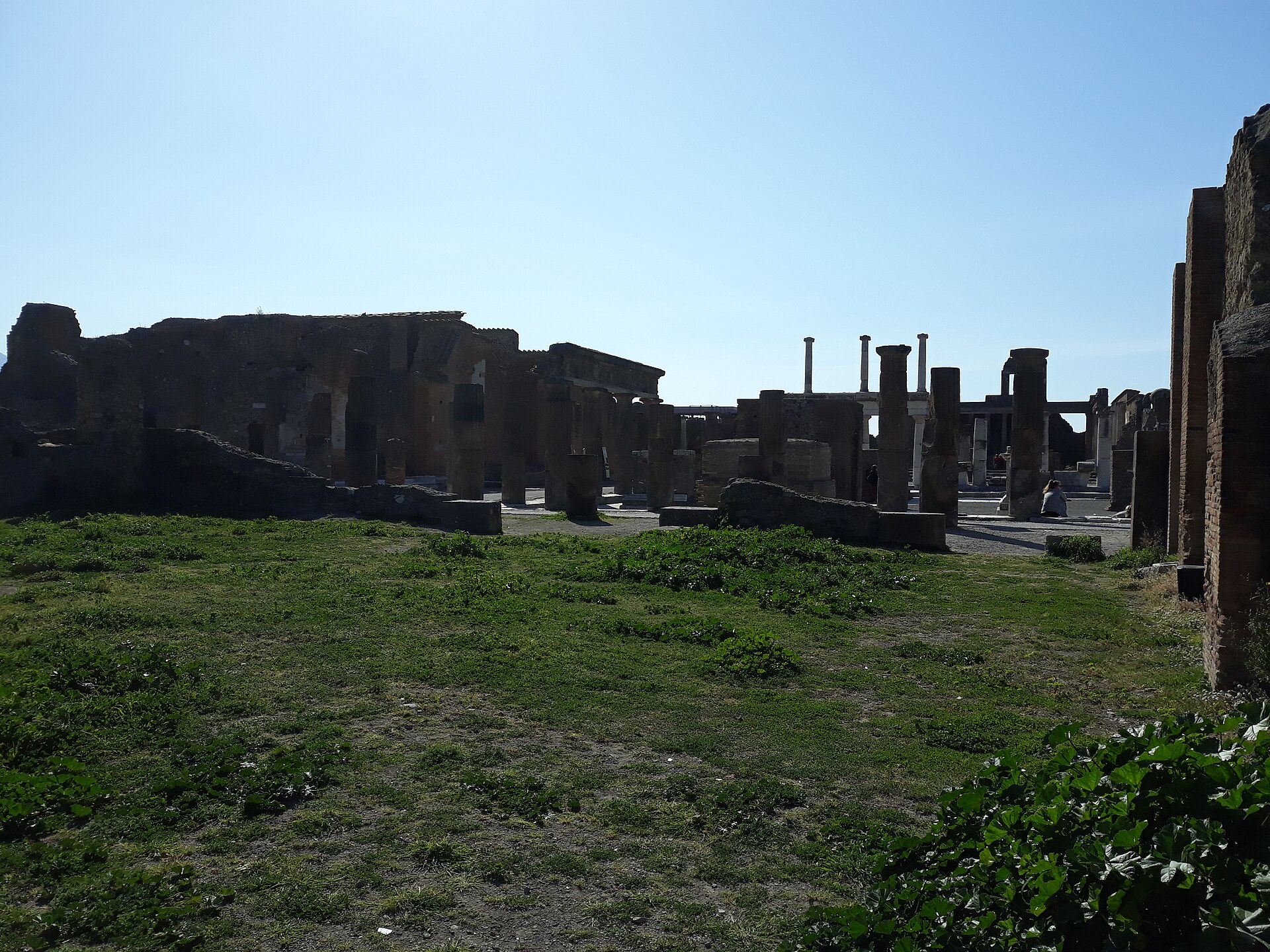
Pompeii Archaeological Park
Porta Marina, Via Villa dei Misteri, 80045 Pompei
On August 24, 79 AD, Mount Vesuvius erupted and buried an entire Roman city under six meters of volcanic ash and pumice. Roughly 2,000 people died — many of them preserved in the exact positions they were in when the pyroclastic surge hit: shielding children, clutching valuables, curled against walls. When archaeologists began systematic excavation in 1748, they discovered something unprecedented: a complete Roman city frozen in time, from its bakeries to its brothels, its election graffiti to its plumbing. Pompeii is the single most important archaeological site for understanding daily Roman life. The preserved streets still show chariot ruts worn into the stone, and the stepping stones at crossroads (designed to keep pedestrians out of the sewage that ran in the gutters) are still in place. The House of the Faun, one of the largest private residences in the Roman world, had the Alexander Mosaic on its floor — now at the Naples Archaeological Museum. The Lupanar (brothel) has explicit frescoes above each room that served as a pictorial menu. The Forum was the beating heart of civic life, surrounded by temples, markets, and government buildings. The site is enormous — 44 hectares of excavated city, with about a third still unexcavated. You could spend an entire day and still miss major structures. The Villa of the Mysteries, near the northwest entrance, contains some of the finest surviving Roman wall paintings, depicting what appear to be the initiation rites of a Dionysian mystery cult in vivid, unsettling detail. Pompeii is 25 minutes from Naples by the Circumvesuviana train. Roughly 2.5 million visitors come each year, making it Italy's most visited archaeological site after the Colosseum. Go early, bring water, and wear good shoes — you'll be walking on 2,000-year-old stone streets.
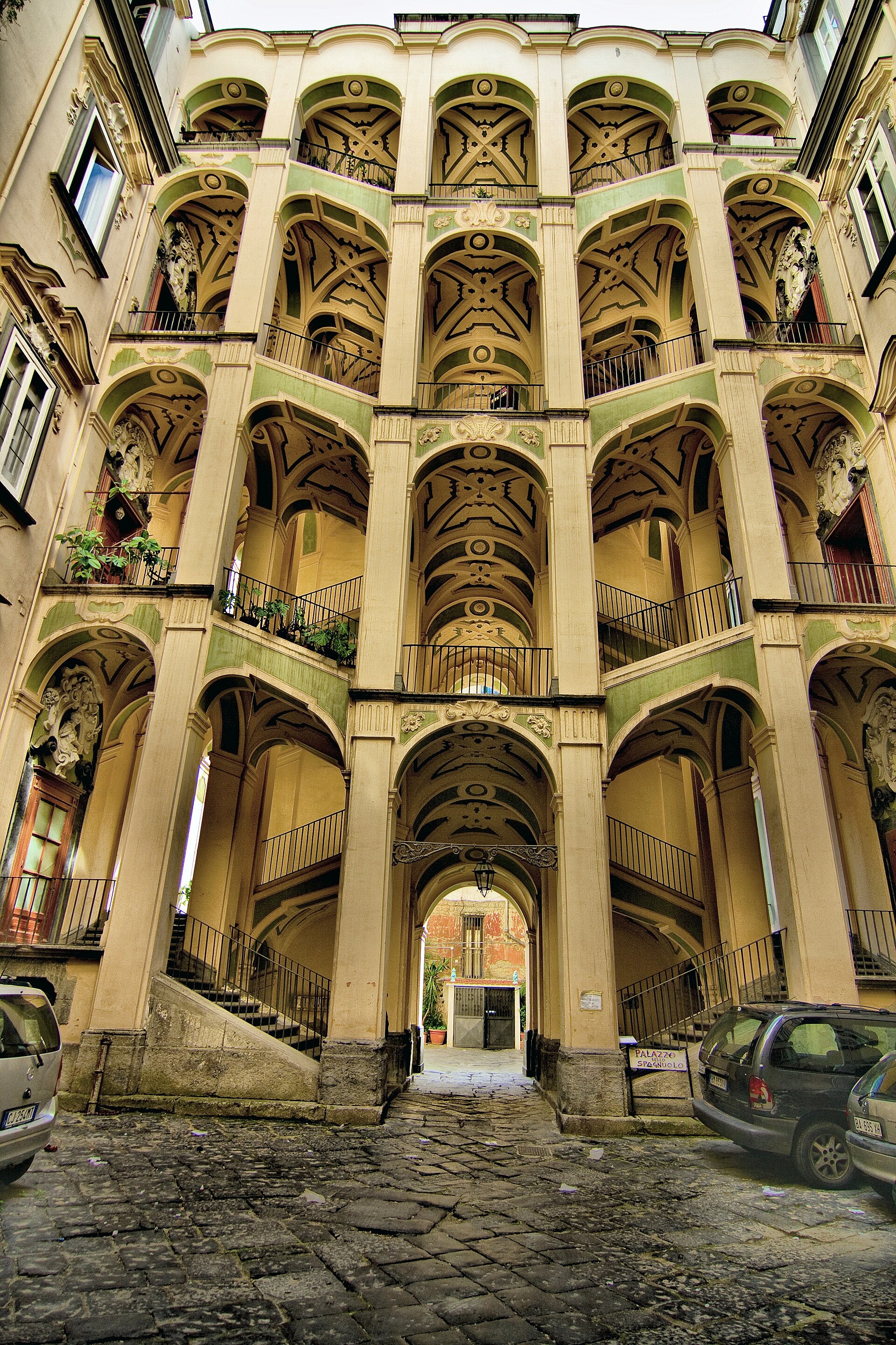
Rione Sanita
Rione Sanità, 80136 Naples
This is the neighborhood Naples forgot, and then remembered just in time. Rione Sanita sits in a valley below the Capodimonte hill, physically cut off from the rest of the city when an elevated bridge — the Ponte della Sanita, built in 1809 under Napoleon's brother-in-law Joachim Murat — literally bypassed it overhead. For two centuries, the neighborhood was isolated, impoverished, and controlled by the Camorra. Guidebooks told tourists to avoid it. Most did. Then something remarkable happened. In 2006, a parish priest named Father Antonio Loffredo decided the neighborhood could save itself through its own cultural heritage. Working with young locals, he established the La Paranza cooperative, which took over the Catacombs of San Gennaro and turned them into a professionally managed tourist attraction. Revenue stayed in the neighborhood. Jobs were created. A derelict palazzo was restored as a community center. A boutique hotel opened. Street art murals by artists including Jorit and Bosoletti began appearing on building facades, turning crumbling walls into open-air galleries. The transformation is ongoing and far from complete — Sanita is still poor, still gritty, still authentically Neapolitan in ways that can make tourists uncomfortable. But it's also one of the most exciting urban regeneration stories in Italy. The Palazzo dello Spagnolo, a spectacular 18th-century building with a famous double-ramp staircase designed by Ferdinando Sanfelice, stands at the neighborhood's heart and has become a symbol of its revival. Walking through Sanita feels like seeing a city in transition — one foot in its troubled past, one in a cautiously hopeful future. It's the most interesting neighborhood in Naples, which is saying something in a city where every neighborhood thinks it's the most interesting.
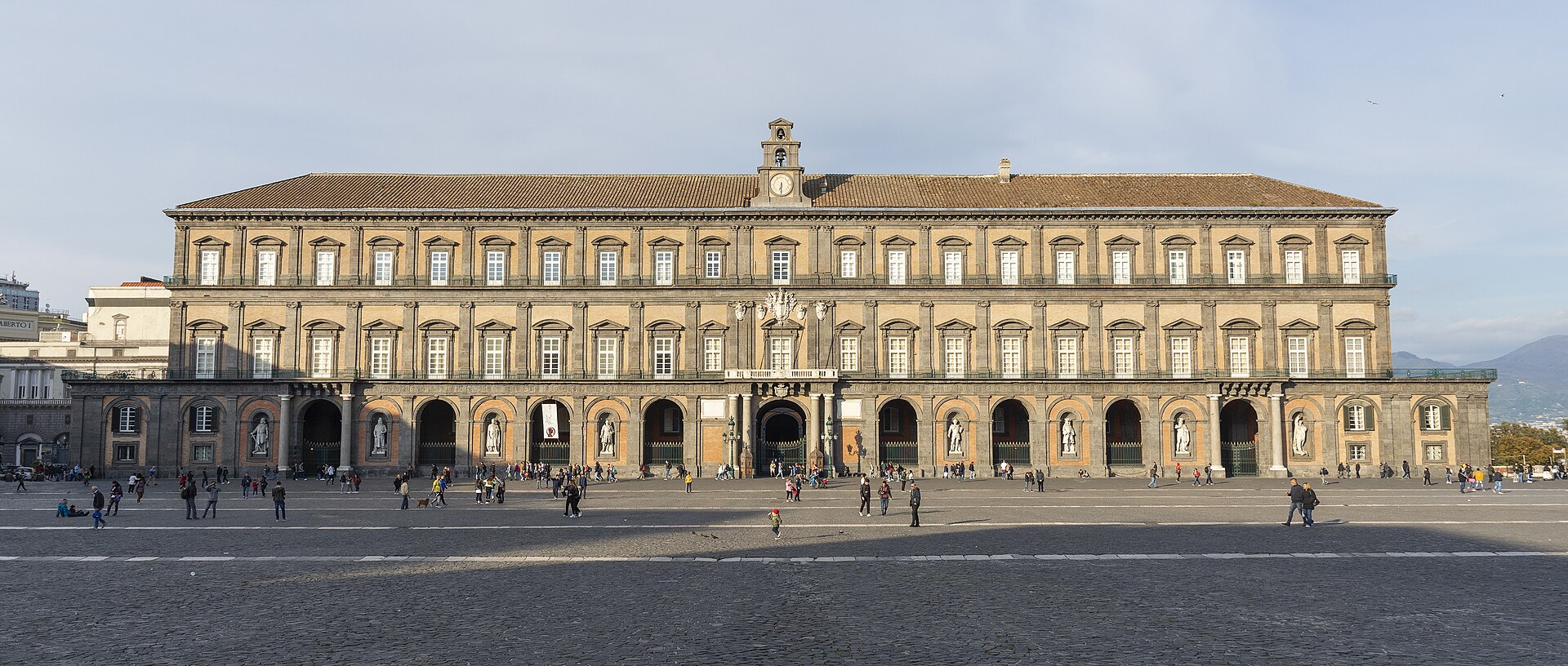
Royal Palace of Naples
Piazza del Plebiscito 1, 80132 Naples
This palace was built for a king who never showed up. In 1600, the Spanish viceroy ordered architect Domenico Fontana to construct a grand royal residence because King Philip III of Spain was rumored to be visiting Naples. Philip never came, but the palace got built anyway, and over the next 260 years four different royal dynasties lived here — Spanish, Austrian, Bourbon, and Savoy — each leaving their mark on the interior like geological layers of monarchical taste. The grand staircase, added by Francesco Antonio Picchiatti in the mid-17th century, was described by Montesquieu in 1729 as the finest in Europe. The Royal Apartments on the first floor are a dizzying progression of frescoed ceilings, gilded furniture, and Flemish tapestries. The Throne Room still has its original Bourbon furnishings, and the Court Theatre — a tiny jewel-box theater built in 1768 — is decorated with papier-mache figures so lifelike they look like an audience frozen in time. In 1860, Garibaldi marched in and handed the palace to the new Kingdom of Italy, ending centuries of royal occupation. Today it houses the National Library, which holds the Herculaneum papyri — ancient scrolls carbonized by Vesuvius in 79 AD and painstakingly unrolled over the centuries, one of the most important collections of ancient texts in existence. The facade along Piazza del Plebiscito features eight niches containing statues of the dynasties that ruled Naples, added in 1888. It's a remarkably honest piece of public art: instead of pretending Naples had one continuous royal story, the city literally lined up its conquerors in a row, as if to say, "Look how many people wanted to own us."
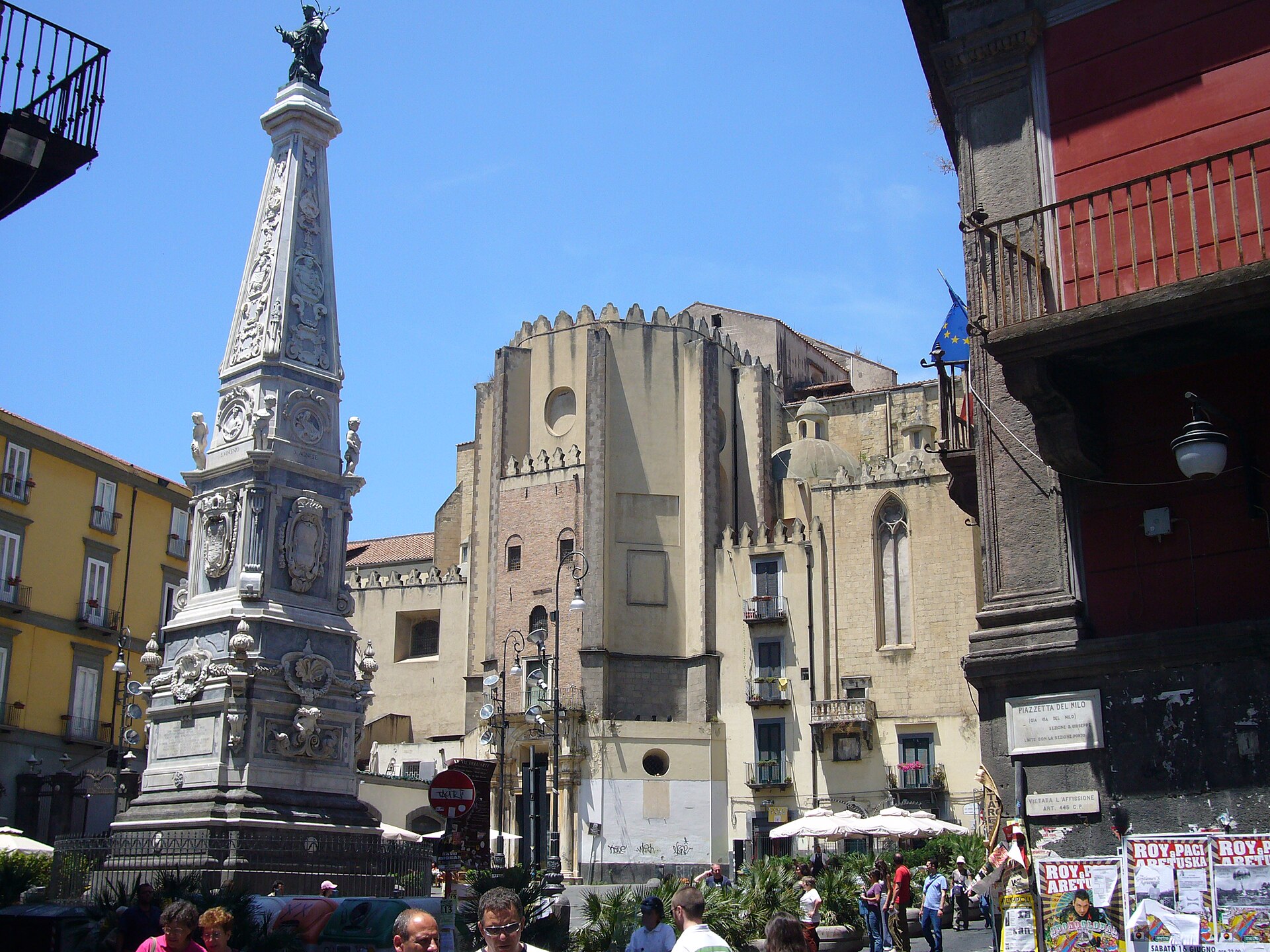
San Domenico Maggiore
Piazza San Domenico Maggiore 8A, 80134 Naples
This church sits on one of the most beautiful piazzas in Naples, anchored by a Baroque plague column erected in 1737 — because in this city even the monuments to mass death are gorgeous. San Domenico Maggiore was begun in 1283 by order of Charles II of Anjou and served as the royal church of the Angevin dynasty. Thomas Aquinas studied and taught in the adjacent Dominican monastery, which makes this one of the most important sites in the history of Western philosophy and theology. The interior is a study in Neapolitan excess: frescoed ceilings by Francesco Solimena, a carved wooden ceiling from 1621, and 45 chapels crammed with paintings and sculptures. But the most unsettling objects are upstairs in the sacristy: 45 wooden coffins containing the mummified remains of Aragonese royals and nobles, some still wearing fragments of their original clothing. The coffins are stacked on balconies ringing the room, staring down at visitors with the blank authority of people who expected to be remembered and largely weren't. Caravaggio's "Flagellation of Christ," originally painted for a chapel here around 1607, hung in this church until it was moved to the Capodimonte museum in the 1970s. A copy now hangs in its place. The loss is still felt: Caravaggio painted it during his fugitive years in Naples, on the run from a murder charge in Rome, and the painting's violence has a desperation that feels personal. The piazza outside is one of Spaccanapoli's best people-watching spots. University students, street musicians, and tourists mingle beneath the plague column while the church's facade — unusually, it's a Gothic apse, since the main entrance faces a different street — looms overhead.
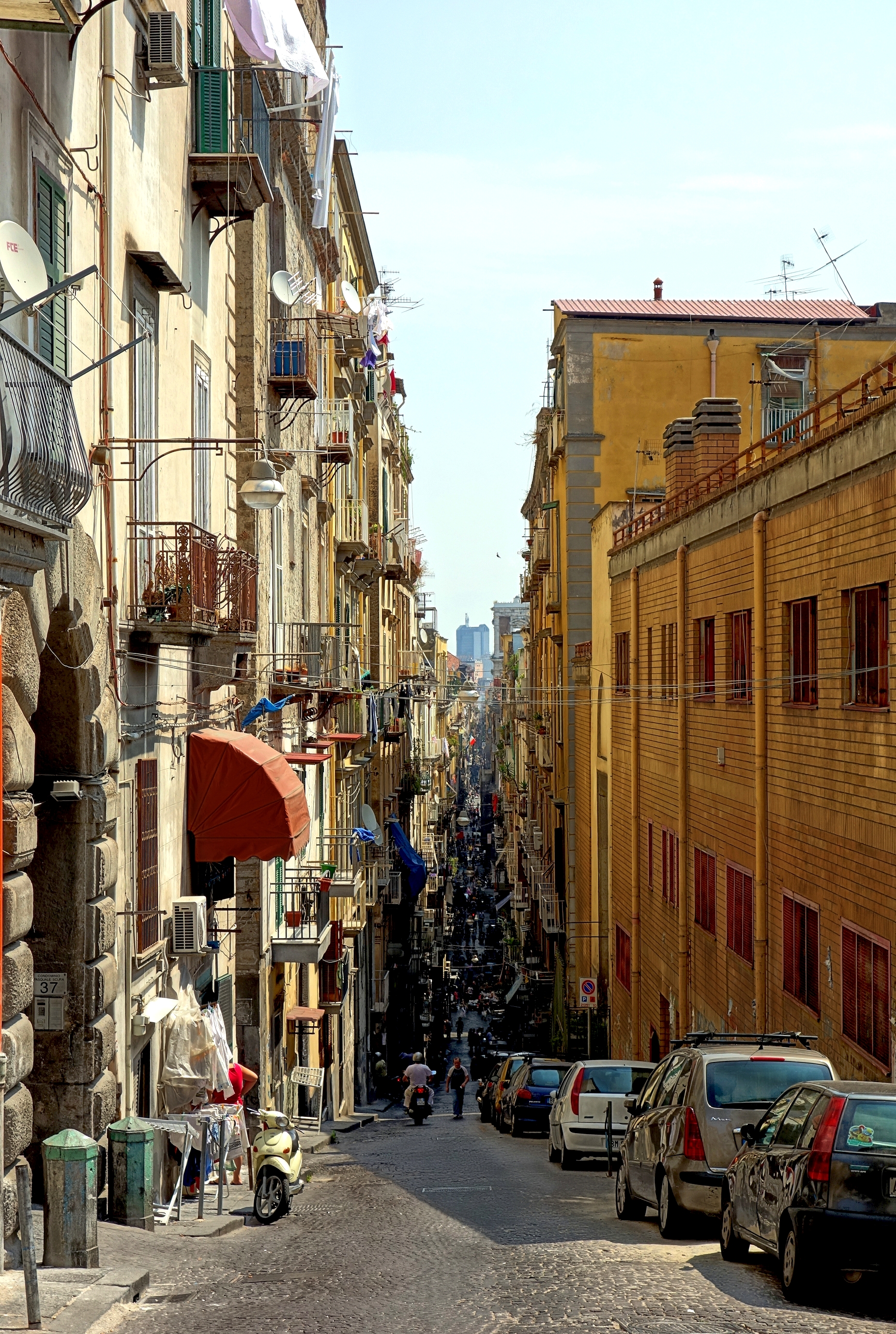
Spaccanapoli
Via Benedetto Croce / Via San Biagio dei Librai, 80134 Naples
Stand on the hilltop terrace of Castel Sant'Elmo and look down, and you'll see it immediately: a single straight line slicing the entire old city in half like a surgical cut. That's Spaccanapoli — literally "Naples-splitter" — and it has been carving through the city's belly for over 2,500 years. The Greeks laid it down in the 5th century BC as one of three east-west decumani that formed the grid of their colony Neapolis, and every civilization since has just kept walking along the same path. The street changes names as it crosses neighborhoods — Via Benedetto Croce through the university district, Via San Biagio dei Librai through the old artisan quarter — but locals treat it as one continuous artery. Walking it end to end takes about twenty minutes if you don't stop, which you won't manage because every ten meters something grabs you: a Baroque church facade, a street shrine with fresh flowers, a guy selling deep-fried pizza through a hole in the wall, a palazzo courtyard you can peek into where laundry hangs five stories above your head. This is the most chaotically alive street in Europe. Vespas thread through pedestrians at alarming speed, arguments happen at full volume from balconies, and the smell shifts every block from espresso to fried dough to incense from the next church door. Philosopher Benedetto Croce lived here — the street is named for him — and so did Giambattista Vico, the father of modern philosophy of history. Rick Steves sends every Naples visitor down Spaccanapoli, and for good reason: if you only have one hour in Naples, spend it here. This street IS Naples, compressed into a single walkable line that hasn't fundamentally changed since the Greeks drew it in the dirt.
Spanish Quarter (Quartieri Spagnoli)
Quartieri Spagnoli, 80134 Naples
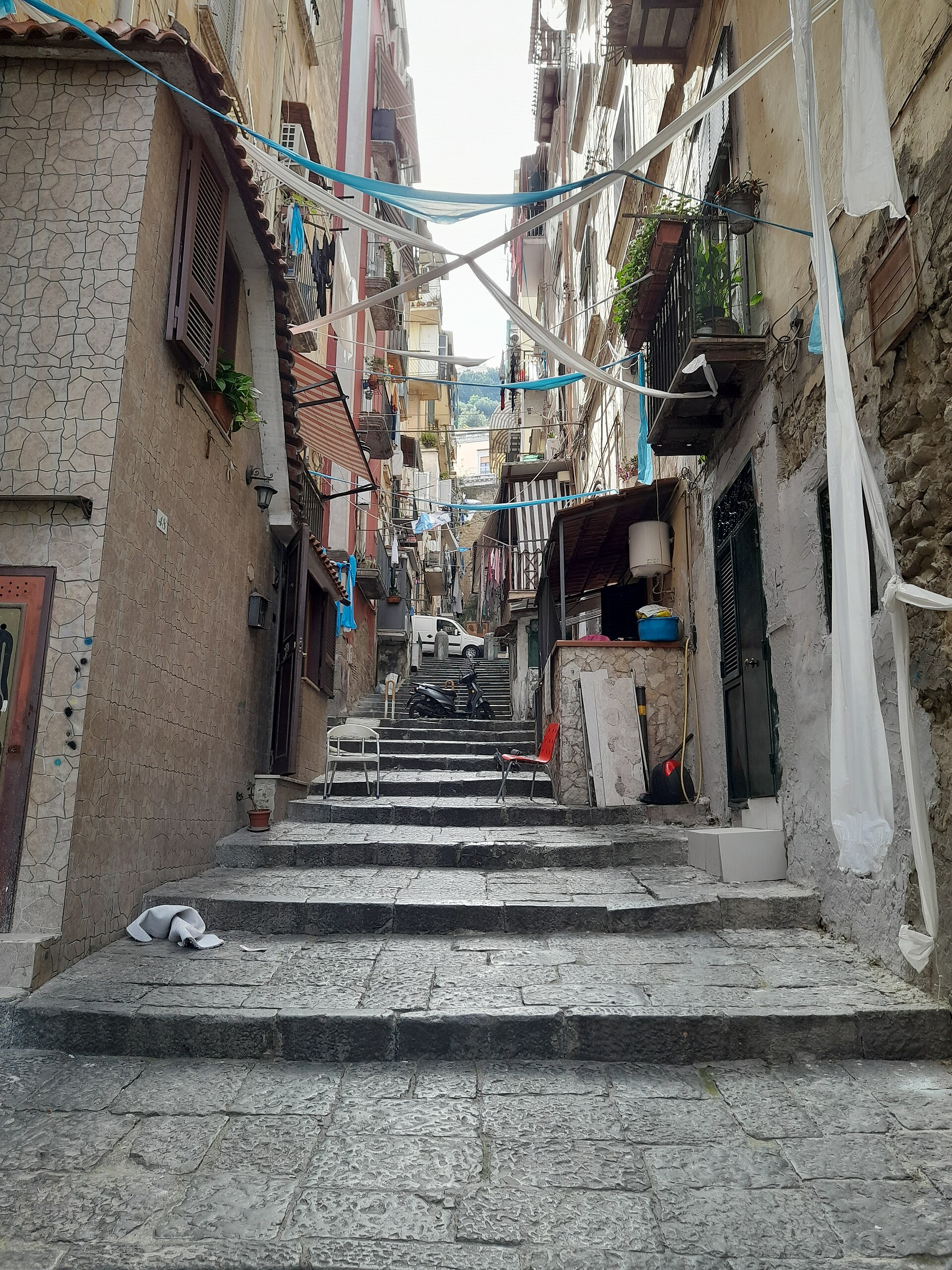
The grid of narrow streets climbing the hillside west of Via Toledo was built in the 16th century to house Spanish troops garrisoned in Naples, and it has been considered dangerous by polite society ever since. The Quartieri Spagnoli is the neighborhood Neapolitans argue about: some call it the authentic soul of the city, others call it a place to get your wallet stolen. Both camps have a point, but the truth is that this is one of the most intensely alive urban neighborhoods in Europe, and avoiding it means missing the real Naples. The streets are impossibly narrow — some barely wide enough for two people to pass — and the buildings rise six or seven stories on each side, creating canyons of stone where laundry hangs between windows, scooters park on sidewalks, and conversations happen vertically, shouted from balcony to street and back. Shrines to the Madonna and to Maradona occupy equal wall space, often side by side, because in Naples the sacred and the secular have always been roommates. A massive mural of Diego Maradona by artist Jorit Agoch dominates one building facade. Maradona's status here goes beyond sports: he arrived in 1984 when Naples was openly mocked by northern Italy, led Napoli to their first-ever Serie A title in 1987, and became the symbol of a city that refused to accept its assigned place in the Italian hierarchy. His death in 2020 prompted an outpouring of grief that looked more like the passing of a saint than an athlete. Come here for the street food — fried pizza (pizza fritta), cuoppo (a paper cone of fried seafood and vegetables), and espresso from bars where the barista remembers your name after one visit. This is not a tourist neighborhood. It's a neighborhood where tourists are tolerated, which is a very different thing.
Teatro San Carlo
Via San Carlo 98, 80132 Naples
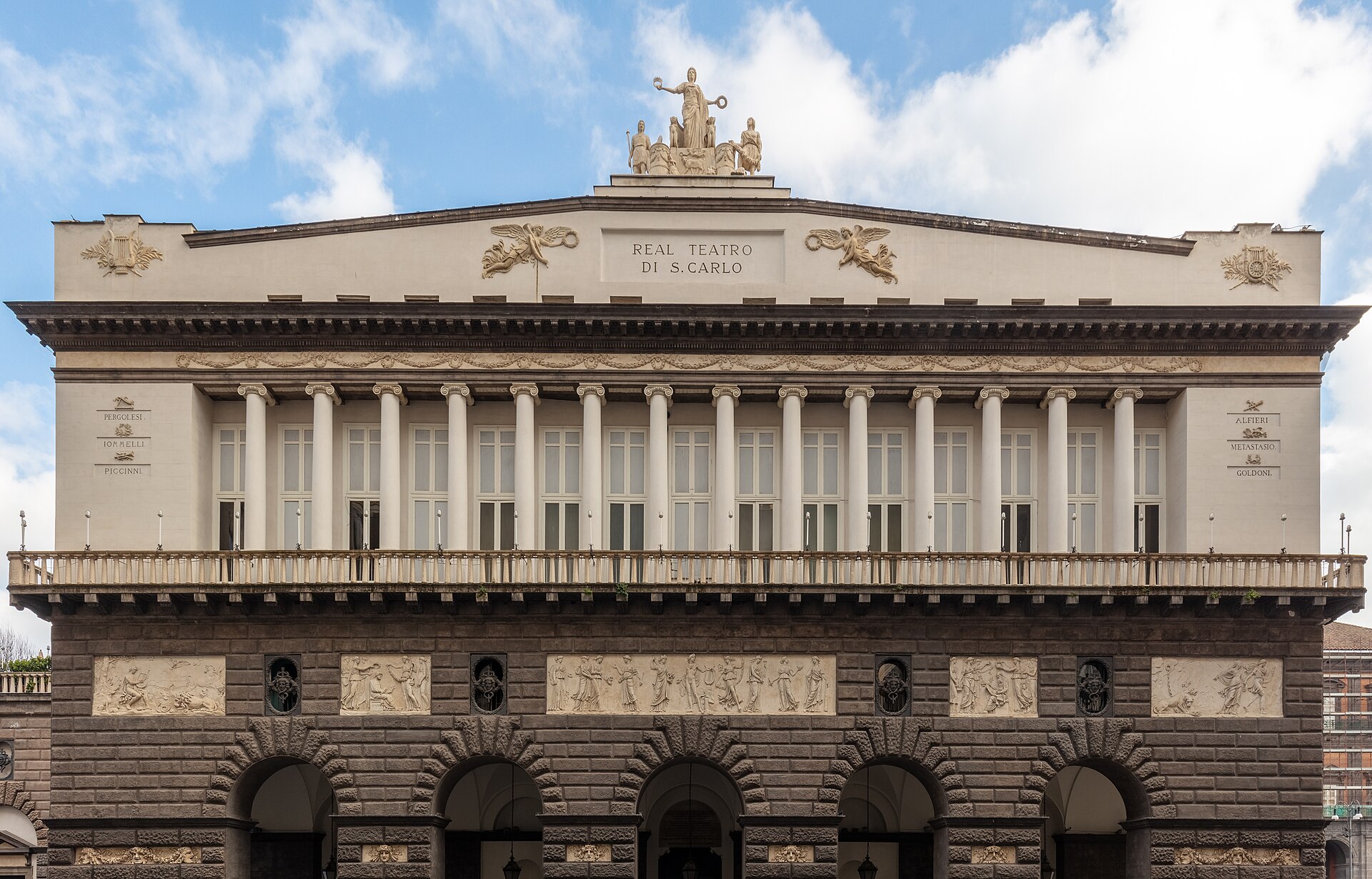
This is the oldest continuously operating opera house in the world, and it opened 41 years before Milan's La Scala and 55 years before Venice's La Fenice. When Charles III of Bourbon inaugurated it on November 4, 1737 — his name day, naturally — he wanted to prove that Naples was the cultural capital of Europe, and for a while, he was right. Composers didn't become famous until they'd premiered at San Carlo. Rossini was the house composer. Donizetti premiered multiple operas here. Verdi wrote specifically for this stage. The horseshoe-shaped auditorium seats about 1,400 and is decorated in the Bourbon royal colors of blue and gold. The acoustics are legendary — Stendhal wrote that there was nothing in Europe that could compare to it, not even anything that came close to it. The sheer scale stunned visitors: six tiers of boxes, a royal box the size of a small apartment, and a stage large enough to hold entire cavalry charges, which it sometimes did. On February 13, 1816, a fire during a dress rehearsal gutted much of the interior. The Bourbon king ordered it rebuilt immediately, and architect Antonio Niccolini managed to reconstruct it in just ten months — an extraordinary feat. The rebuilt theater was even grander, and its neoclassical facade became the model for opera houses across Europe. Today San Carlo remains Naples' grandest cultural institution. Guided tours run during the day, but the real experience is attending a performance. The red velvet, the gold leaf, the chandeliers, the fact that people have been sitting in these same seats listening to music since before the American Revolution — it adds up to something no modern concert hall can replicate.
Via San Gregorio Armeno
Via San Gregorio Armeno, 80138 Naples
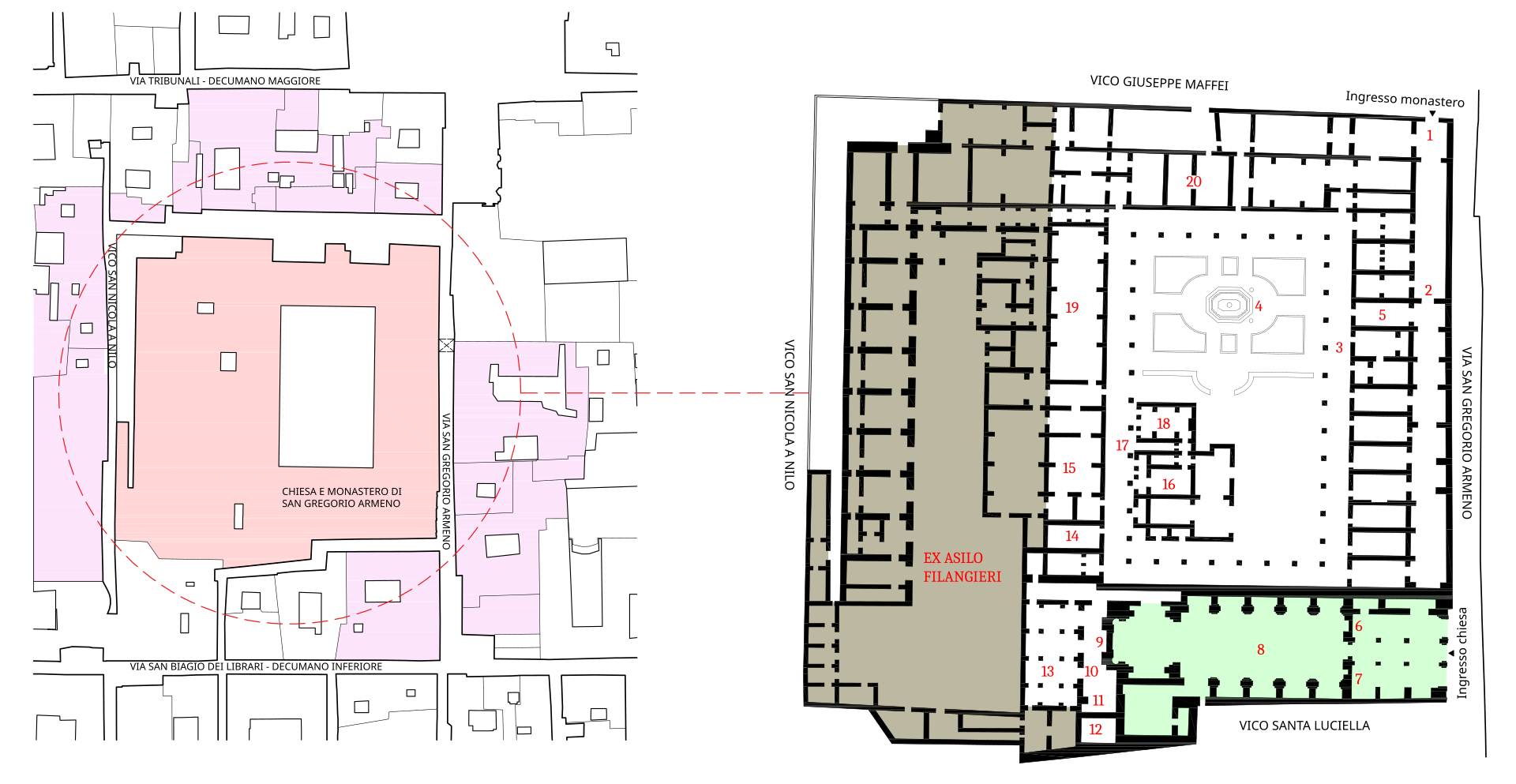
Every December, this narrow street becomes one of the most densely packed places in Italy, but the artisans who work here operate year-round, hunched over workbenches carving, painting, and assembling the elaborate nativity scenes — presepi — that Neapolitans take more seriously than almost anything else. This isn't just a Christmas tradition. It's an obsession that dates back to at least the 15th century, and San Gregorio Armeno is its epicenter. What makes Neapolitan nativity scenes extraordinary is that they're not just about the manger. A proper presepe is a miniature recreation of Naples itself: market vendors, pizza makers, fishmongers, drunks sleeping it off in doorways, laundry hanging from balconies — all surrounding the Holy Family in a scene that says, basically, God was born in a Neapolitan neighborhood. The craftsmanship is staggering, with some figures taking months to carve and dress in handmade clothing. But here's where it gets wonderfully weird: the artisans also make figurines of contemporary celebrities, politicians, and sports stars. Maradona is a perennial bestseller — he's essentially a secular saint in Naples — but you'll also find the current pope, various prime ministers, movie stars, and whoever happens to be in the news that week. Putting them in the nativity scene alongside the shepherds and angels is a tradition that confuses tourists but makes perfect sense to Neapolitans: the presepe is a portrait of the whole world, not just Bethlehem. The street itself is named for the church and convent of San Gregorio Armeno at its center, founded in the 8th century by nuns fleeing Constantinople with the relics of Saint Gregory of Armenia. The convent's cloister, with its Baroque fountain and citrus garden, is one of Naples' most peaceful hidden corners.
Via Toledo
Via Toledo, 80134 Naples
Stendhal called this the most populated and gayest street in the world, and while 19th-century French novelists had a tendency toward hyperbole, he wasn't entirely wrong. Via Toledo has been Naples' main commercial artery since the Spanish viceroy Pedro de Toledo laid it out in 1536, connecting the Royal Palace to the northern reaches of the city in a straight shot that carved through the existing medieval street plan like a surgical incision. The street runs for about 1.2 kilometers and acts as a border: to the east lies the tangled historic center, to the west the steep grid of the Quartieri Spagnoli. Walking its length, you pass palazzi from every century since the 16th, shop windows ranging from high fashion to cut-price electronics, and an unbroken stream of Neapolitan humanity that makes it feel like the entire city has decided to take a walk at the same time. Beneath your feet is what many consider the most beautiful metro station in the world. The Toledo Metro station, designed by Oscar Tusquets Blanca and opened in 2012, is a subterranean cathedral of blue and white mosaics that simulate descending through water to the ocean floor. It won the LEAF Award for Public Building of the Year and has been featured in design publications worldwide. Descending the escalator feels like diving into the Mediterranean. The street is pedestrianized on weekends and holidays, when it becomes an open-air theater of street performers, lottery ticket sellers, and families eating gelato in the evening passeggiata — that Italian ritual of strolling and being seen that reaches its maximum expression here. Via Toledo is not Naples' prettiest street, but it might be its most essential.