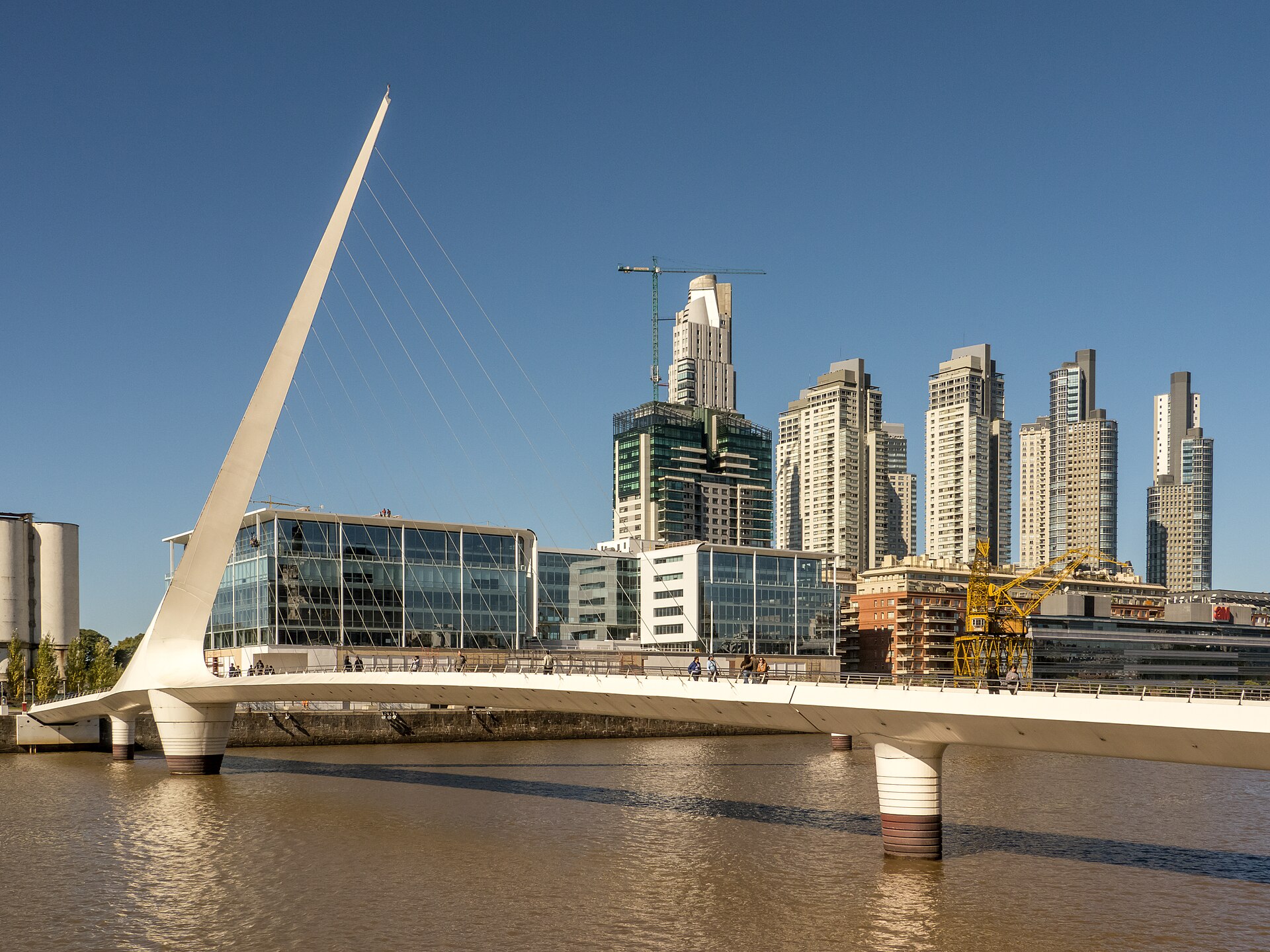
The Puente de la Mujer (Bridge of the Woman) is a rotating pedestrian bridge in Puerto Madero designed by Spanish architect Santiago Calatrava — a 170-metre white steel structure whose asymmetric mast and cable stays are said to represent a couple dancing tango. The bridge rotates 90 degrees on its central pier to allow boat traffic through the dock, and watching the mechanism operate — the entire 800-ton structure swinging silently open — is one of Puerto Madero's unexpected pleasures.
Calatrava designed the bridge as a gift to Buenos Aires (the construction was funded by Argentine businessman Alberto González, not public funds), and it was installed in 2001 at a cost of $6 million. The design is characteristically Calatrava — white, skeletal, and so obviously inspired by natural forms that the tango interpretation is only one of several plausible readings. The single pylon, leaning at an angle with cables radiating from its top like tendons, creates a silhouette that has become Puerto Madero's defining image.
The bridge connects the two sides of Dique 3 in Puerto Madero and is most photogenic at sunset, when the white steel catches the warm light and the reflections in the dock water double the visual effect. The surrounding waterfront — lined with the converted brick warehouses that anchor Puerto Madero's restaurant scene — provides the context that the bridge's sculptural elegance requires: without the industrial heritage backdrop, it would be beautiful; with it, it becomes a statement about how cities can transform their industrial past into something that feels inevitable rather than imposed.
Verified Facts
The bridge was designed by Santiago Calatrava and installed in 2001
The bridge is 170 metres long and rotates 90 degrees for boat traffic
The design is said to represent a tango-dancing couple
Construction was privately funded by businessman Alberto González
Get walking directions
3 Duque de Abruzzi, Escobar, B1635, Argentina