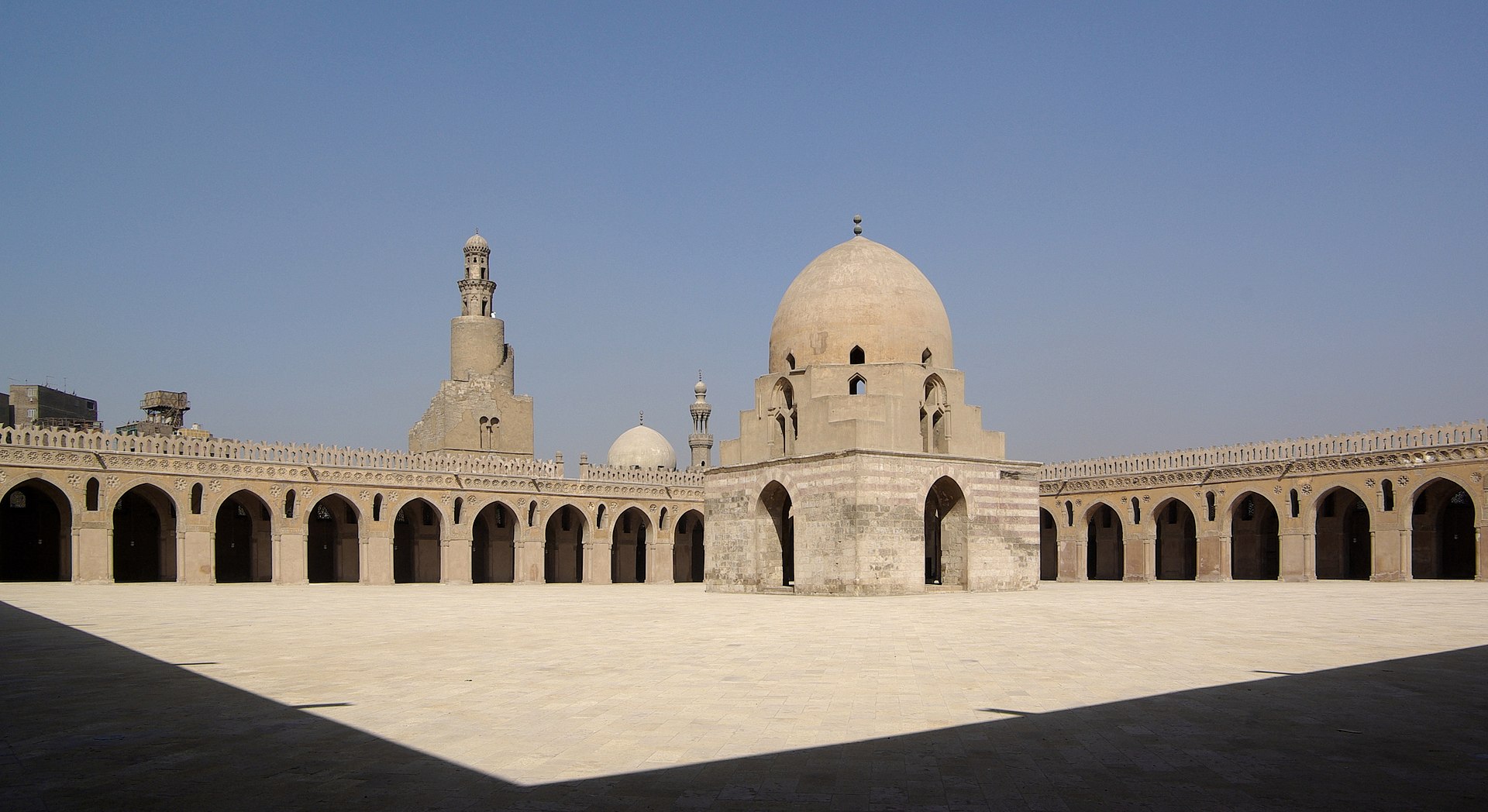
The Mosque of Ibn Tulun is the oldest mosque in Cairo that retains its original form — built between 876 and 879 AD by Ahmad ibn Tulun, the Abbasid governor who declared Egypt independent and built this mosque as the centrepiece of his new capital. The mosque is one of the largest in the world (6.5 acres), and its vast, open courtyard — surrounded by arcaded porticoes and anchored by a spiral minaret inspired by the Great Mosque of Samarra in Iraq — is the most spacious and serene architectural experience in Cairo.
The mosque's simplicity is its power. Unlike the later Mamluk and Ottoman mosques, which are decorated with marble, stucco, and tilework, Ibn Tulun relies on the proportions of its spaces, the rhythm of its pointed arches, and the interplay of light and shadow across the stucco-covered brick walls. The carved stucco frieze that runs around the upper walls of the arcades — geometric and floral patterns incised into the plaster — is the earliest surviving example of Egyptian Islamic decorative art and predates the elaborate work of later periods by centuries.
The spiral minaret — a helicoidal tower that visitors can climb for views across Islamic Cairo — is unique in Egypt and directly modelled on the minarets of Samarra, reflecting Ibn Tulun's origins in Abbasid Iraq. The Gayer-Anderson Museum, housed in two connected 17th-century houses adjacent to the mosque, displays a private collection of Islamic and Oriental art in one of the best-preserved historical houses in Cairo.
Verified Facts
The Mosque of Ibn Tulun was built between 876 and 879 AD
It is the oldest mosque in Cairo retaining its original form
The mosque covers approximately 6.5 acres
The spiral minaret is modelled on the Great Mosque of Samarra
Get walking directions
Ahmed Ibn Touloun Street, Army Housing, Cairo, 11797, Egypt