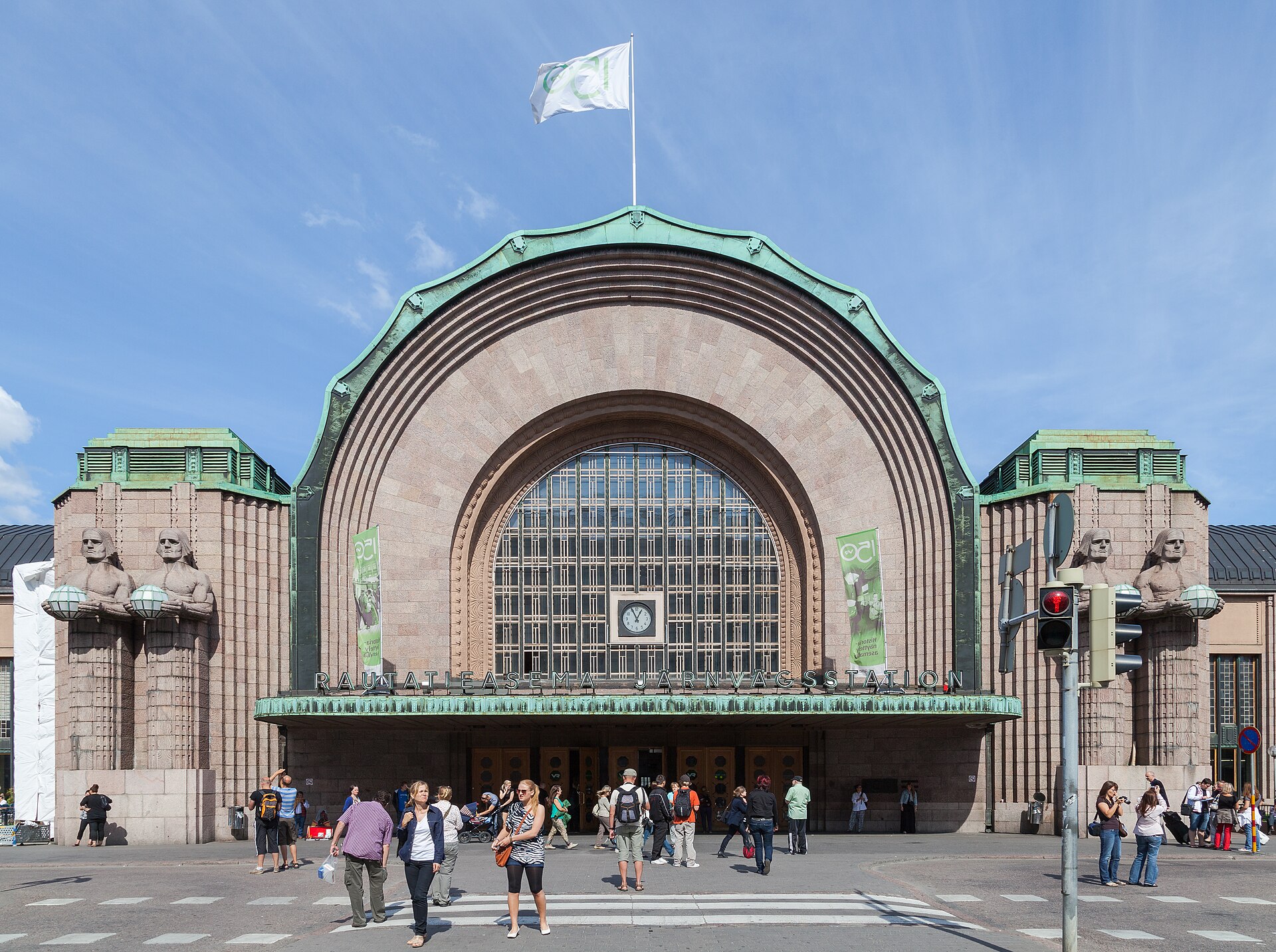
Helsinki Central Station is the most recognisable building in Finland — a granite Art Nouveau-meets-Art Deco railway station designed by Eliel Saarinen and completed in 1919, whose clock tower, arched entrance, and four stone giants holding globe-shaped lamps have become the symbol of Helsinki as surely as the cathedral. The station handles 200,000 passengers daily and is the busiest building in Finland, but its architectural quality is so high that it transcends its function — this is a building that makes arriving by train feel like arriving at a temple.
Saarinen originally designed the station in the National Romantic style (medieval references, rough stone, organic forms), but public criticism led him to redesign it in a stripped, geometric style that anticipated Art Deco by a decade. The result — clean granite surfaces, geometric detailing, and the famous lamp-bearing giants by Emil Wikström flanking the entrance — influenced station design internationally and established Saarinen's reputation (he later moved to America, where his son Eero designed the Gateway Arch and TWA Terminal).
The station's central hall, with its high vaulted ceiling and natural light from the arched windows, is one of Helsinki's finest public interiors. The building sits at the intersection of Mannerheimintie and Kaivokatu, at the exact centre of Helsinki's urban geography, and every major destination in the city is within walking distance or a short tram ride from its doors. The station's status as a national landmark is such that when it was cleaned in 2010 (decades of soot removed from the granite), Helsinkians were startled to discover their dark, familiar station was actually light grey.
Verified Facts
Helsinki Central Station was designed by Eliel Saarinen and completed in 1919
The station handles approximately 200,000 passengers daily
The four stone giants were sculpted by Emil Wikström
Eliel Saarinen later moved to America; his son Eero designed the Gateway Arch
Get walking directions
Kaivokatu 1, 00100 Helsinki